
Editor’s Note: Vanyaland film editor Nick Johnston has left the country, posting up this week in the Great White North to cover the 51st Toronto International Film Festival. As usual, and perhaps now more than ever, we wish we were up there with him! Check out our continuing 2026 coverage, get rolling with our official curtain-raiser, and revisit the complete Vanyaland coverage archives from past TIFF editions.
There are two great films inside Werner Herzog’s Bucking Fastard — one an absurd, uproarious comedy, the other a lovely, pastoral meditation on being weird —but it’s how they come together that makes Herzog’s first narrative feature since 2019’s Family Romance, LLC a masterwork. I genuinely don’t know how it’ll play to general audiences, as there were plenty of walkouts at the TIFF P&M screening from those who ignored the folks around them shouting with laughter, but all I know is that I was utterly transfixed. Herzog’s not exactly known for his warmth, though his narrative features a persona-defying quality that would surprise most viewers. That, though, is what I ultimately walked away with: a sense of “feeling seen,” or whatever that means, as a strange person existing in a beautiful yet indifferent world. It’s odd to think this is the Herzog equivalent of a warm hug, yet it takes on that quality, especially as it shifts from the broadest surreal comedy into an oblique, sensitive fairy tale, full of melancholic pathos that hit me right in the ribs.
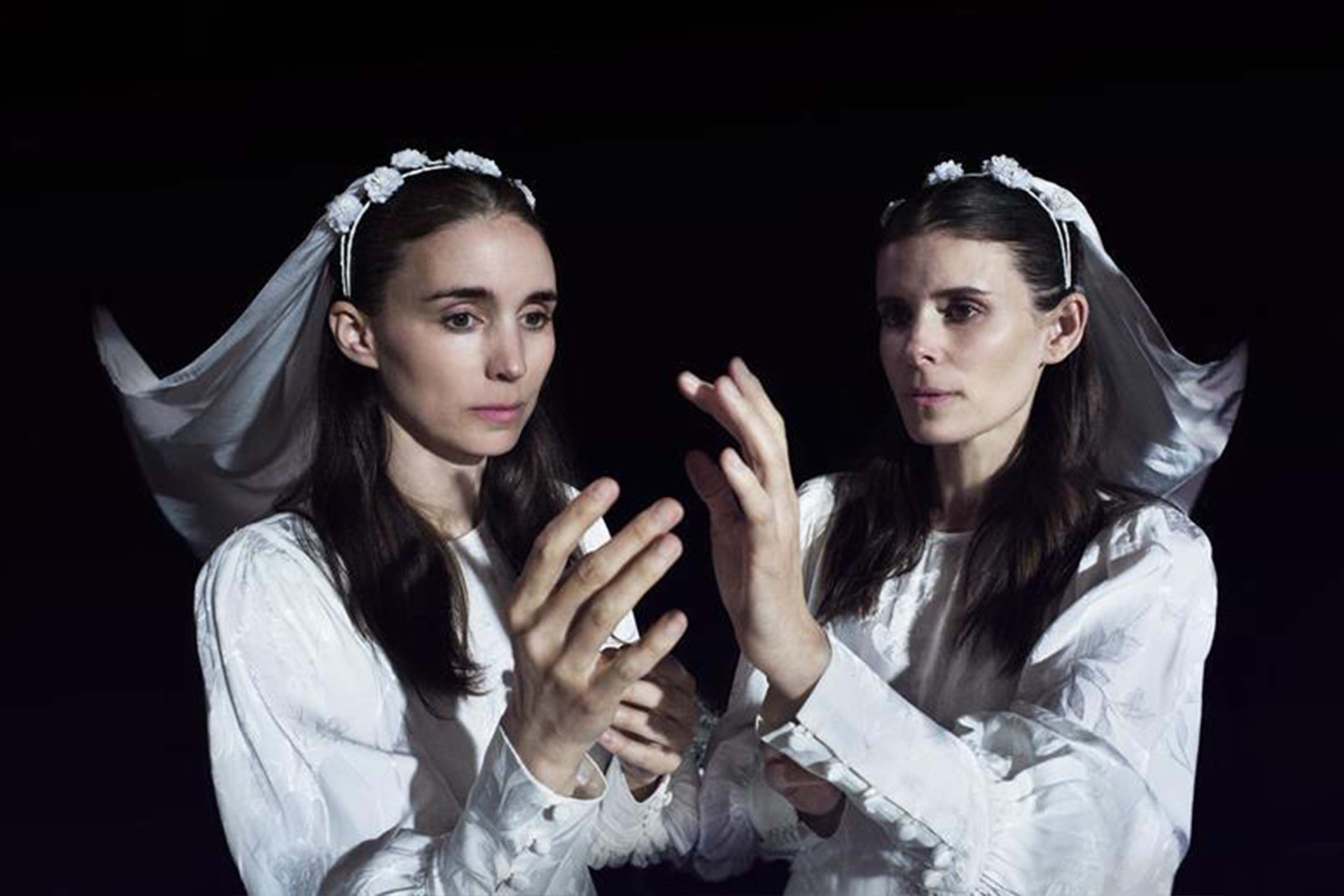
Bucking Fastard is a terrible title, yet it serves a purpose in pointing to the film’s origins. If you stick around for the credits, you’ll see that the usual fictitious persons disclaimer has been replaced with one acknowledging that the movie is based on actual events. “Bucking fastard” was uttered in a British courtroom by Frieda and Greta Chaplin, twin sisters taken to court by a man they’d both fallen in love with and then stalked. They dressed identically, worked in tandem, and spoke simultaneously, as if connected by a force beyond easy understanding. As such, Herzog’s more than willing to acknowledge them as the basis for Jean and Jane Holbrooke (Kate and Rooney Mara), even as he takes them past mere reality and into the realm of poetry. The first half of the feature adapts this story in a recognizable, if exaggerated, Ireland. Jean and Jane’s romance with Gareth (a hammy, hilarious Orlando Bloom), a lothario living next door to their family home, and the various acts of vandalism they commit when he leaves them, are recounted before an astonished judge and serve as a demonstration of their quirks and depth of feeling.
Again, it is brilliantly funny – watching the Maras set his Range Rover on fire or struggle to lift a waist-high concrete fence only for Bloom to hop over it – and it continues as they make their way into the big city. A helpful social worker (Domhnall Gleeson) tries to teach them to separate, showing how hard it can be to open a tin of sardines when four hands compete to do what two can do. It doesn’t really take, but it does plant a small seed that will become important later on. There, they find a group of suitors, mostly a gaggle of goofballs from a shipping company next to their second-floor apartment, and have various foibles and follies with them. For example: at one point, the sisters discover that someone is taking creepshots of them undressing before posting them to the internet and, despite being somewhat… flattered(?), the two become determined to catch him. They figure out exactly where the perv would take the photos from an opposing rooftop and soap it up – a tell by slip-and-fall – and their always unpredictable reactions ensure it remains dynamic and unpredictable, even when we think we know what’s going to happen. In short, it’s a fucking laugh riot, as funny as anything Herzog did in his Bad Lieutenant, and the Maras are fiercely committed to their roles – they have a strange harmony in their simultaneous recitation of dialogue, and react off of each other in wonderful, complementary ways.
The notes of sadness that occasionally bubble to the surface in the first half, such as a trip home to see their parents that sees them ignored on the doorstep until they leave in tears, become a larger focus in the second. Moving to the countryside to stay with an aunt, the twins are enchanted by a tale of a mystical land of love and beauty, one that they could theoretically dig to. Despite the pastoral setting, it still feels like the world is pushing them out – a defense mechanism to prevent the precious nature of their bond from undermining the brutality of reality. They intervene when a gang of idiots wants to kill the local fox population and manage to save one, naming it Cupid. He becomes their companion, a sad-eyed creature whose welps and yelps hold a measure of the beguiling beauty they’re searching for as they begin to dig their tunnel. Their bond begins to fray as they make progress, but eventually they find something, and perhaps it fits the description, though it may not resemble what they originally hoped for.
Herzog executes this downshift perfectly, echoing the similar turn that Jacques Audiard took a decade or so ago in The Sisters Brothers. He clearly recognizes what he has in his protagonists: lovesick creatures seemingly pulled from the world of fiction and placed into a context full of people fascinated by them but ultimately hostile to their attempts to find some measure of reciprocal love. Their quirks, even in the first half, are empathetically rendered – the humor comes from the mismatch rather than a fault found – and we see the pain of this yearning and the weight it puts on their bond. I don’t know if the Maras have ever been better on screen, perfectly in sync, pitched right at the quasi-comedic tone that Herzog wants to maintain yet capable of pulling it back into something realer than you’d expect. They fit seamlessly into cinematographer Peter Zeitlinger’s landscape, whether in the shipping yards, on the mountain plains, or walking among gorgeously lit stalactites in the wondrous world their tunnel (and Cupid) leads them toward.
Much has been made of Herzog’s choice to dedicate the film to the memory of David Lynch, which appears as an epigraph rather than an end title and will likely set many viewers up for a big disappointment. It’s not a “Lynchian” film as described by David Foster Wallace, who I imagine would have liked to add an addendum to his essay on the making of Lost Highway once he saw The Straight Story. What it portrays is the good that Lynch yearned for, with the honest and pure-at-heart (if fallible) finding their way through the world – Joseph Merrick if the world were more keen to exploit him rather than abuse him – ultimately, in some way, triumphing over the darkness like the robins of love that Laura Dern spoke of in Blue Velvet. It’s an interesting turn for Herzog, who’s made a kind of realist nihilism into a personal trademark, in that he imagines a kind of heaven that people like Lynch could inhabit, amidst all of the bizarre wonders of the world that one could find if they only were willing to look a little closer. Perhaps he is getting softer with age, but perhaps he’s telling us something urgently, running out of time to impart and recontextualize his career. For a man who got so much recognition for recounting the soullessness he saw in a chicken’s eyes, it matters quite a bit when he presents you with the worlds of feeling he found in a fox’s.