
Editor’s Note: Vanyaland film editor Nick Johnston has left the country, posting up this week in the Great White North to cover the 51st Toronto International Film Festival. As usual, and perhaps now more than ever, we wish we were up there with him! Check out our continuing 2026 coverage, get rolling with our official curtain-raiser, and revisit the complete Vanyaland coverage archives from past TIFF editions.
That crazy bastard finally did it – Jesse Eisenberg has finally made an honest-to-God good motion picture that isn’t just a lot of florid scenery hanging around a great performance. This time, there are two great performances and intentionally shoddy florid scenery. It’s a surprisingly big difference, and it goes a long way to making The Debut a legit, well, debut for Eisenberg as a genuinely skilled filmmaker and storyteller. All of his greatest attributes are here – a keen ear for punchline timing, an understanding of and willingness to immerse himself in the creation of group dynamics, a delightfully realized setting – without the kind of maudlin melancholia that reads as writerly when seen in the pages of The New Yorker or heard as the A-Story in an episode of This American Life.
Look, I get that’s a bit harsh, especially in the introduction to a review that will ultimately be pretty glowing, but it comes from a place of sympathy. Eisenberg, like us all, killed his idols and took on their forms, honing what would become his voice from the bits and parts of his influence. You can see him tear out of this cocoon over the course of his three films, with The Debut being the moment when he spreads his wings and takes flight. When You Finish Saving the World resembles what would happen if a bunch of n+1 authors were hired to reboot Family Ties, an over-articulated point about banal liberalism in search of a story and characters. A Real Pain has very strong writing and two fantastic protagonists, but Eisenberg makes a mistake in pulling us away from his characters – any time he started to narrate, he lost me.
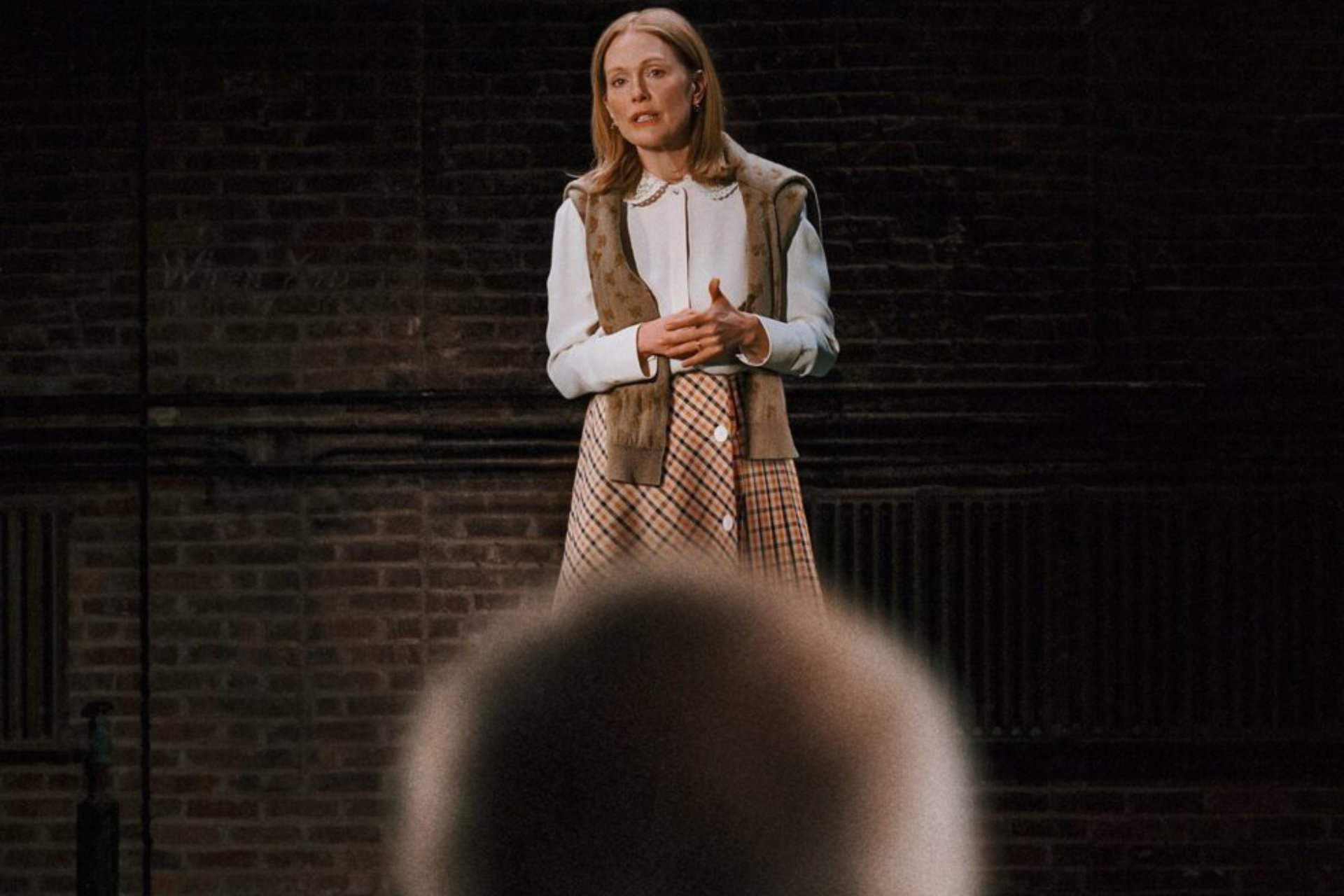
The Debut, however, has a dynamite and laser-focused script that is fully and firmly disconnected from “reality” as we know and understand it. The cast and crew at the Brook Theater – a small-town community playhouse – are theater-kid archetypes presented to us through the eyes of Mona (Julianne Moore), a homemaker with two high-school-age kids, a husband, and little else. They mostly ignore her, though she occasionally annoys them with her needs for “connection” and “intimacy.” She’s been an afterthought for her entire life, forgotten about and abandoned unless she’s done something wrong or out of schedule – meant to be seen and not heard when doing dishes or fixing dinner or so on and so forth. That’s why it’s such a surprise when she takes to the Brook stage and auditions for the Diva-ish role of the building super in Nosy Neighbors (a very silly collection of Broadway clichés masquerading as a musical, written to parody perfection by Eisenberg and his collaborators), despite her lack of acting experience. It goes about as well as expected, though she obsessively hopes against hope that she’ll get the call saying she’s in.
Luck, it seems, is on her side, and late one night, she gets the phone call she so desired. On the other end is Jerry (Paul Giamatti), the headstrong actor-turned-director, and he’s panicking. Her lone competition and Jerry’s favorite, Serena Cherry (Bernadette Peters), has split for a better opportunity, and Mona’s all he’s got. He asks her to join the production, and she accepts in a heartbeat. When she arrives at the Brook the next morning, it’s everything she ever dreamed of. Everyone is so nice, from the stage assistant (Eldar Isgandrov) asking how she takes her coffee to her co-stars, including the talented lead (Halle Bailey), to the costume designer (Havana Liu Rose) weaving colorful creations backstage. They want to know her, how she feels, and they all build a quick, easy rapport. Jerry, even, is pretty nice – it’s not a Whiplash situation. Yet. The director, of course, pushes her to get into the character and separate herself from the meekness she defaults to in her daily life (a scene in which he tries to coax her into brassily demanding his rent is among the film’s highlights). She knows he’s not mean, and he really does help her, taking her to do “research” and giving her the space to work.
To everyone’s surprise – and where The Debut distinguishes itself from many of its similarly-styled peers – she’s up for the task, and delivers a show-stopping performance in rehearsal one afternoon. The whole outfit is astonished, none more so than Jerry, and Mona soaks in the praise and attention. She’s an actor, goddamn it, and a serious one, and she will do whatever she can to find the emotional truth of the character – a washed-up super who came to New York with dreams and wound up fixing toilets. She pesters Jerry with ideas and suggestions on how they could potentially change the production to make things more “real,” and her comments only grow more infeasible. Deciding she’s had enough of her shitty husband, she goes full method and moves into a flophouse hotel in her nearest city, where the only “room service” offerings are bottles of Monkey Juice and in-shell boiled peanuts. Things only get crazier and crazier from there, and it looks like Mona’s life, much less the play, is in jeopardy. Can she pull out of this tailspin? Will she hit her cues? Will she ever light one of those goddamn cigarettes she’s got around?
Based on pedigree alone, you can assume Moore and Giamatti do fantastic work here, but the former’s performance is near-transcendent. Her commitment to the strange, surreal character Eisenberg has crafted for her is as rigorous as her work in dramatic roles, and she’s blissfully funny without resorting to the kind of hamming another actor might have launched into based on a surface read of the role. It’s important that both sides of Mona’s personality – the meek, overlooked, abused housewife that eventually gives way to whatever the hell she becomes once she finds her mojo – land with equal measure and maintain a believable continuity even as circumstances grow increasingly unrealistic and frayed. Giamatti is her exasperated straight man, whose commitment to his art and the realities of his age have filled him with envy and contempt beneath a veneer of professionalism. It’s a brilliant pairing of dueling personalities, with Moore’s intensity driving Giamatti crazier and crazier, and Eisenberg taps into that electric mixture throughout the runtime.
What’s more interesting is how bizarrely kind The Debut is, even as it pokes fun at what might seem like an easy target for a professional actor to take potshots at. It’s hard not to laugh when it comes to the foibles and follies of community theater productions, but it’s even harder to make someone cry – and despite the alt-comedic stylings he emulates here (there are some jokes I imagine the I Think You Should Leave crew would feel jealous of), there’s enough pathos to sustain our rooting interest in Mona and Jerry through their errors and bad behavior. Both ultimately find some absolution and grace by the time the curtain closes on Nosy Neighbors, and the film resolves itself in a manner less bitter than you’d expect. Truth is, even though we might laugh at how genial everyone is behind the scenes, the vibe is simply a stylized version of reality – a best-case scenario for a small-town production with a cast and crew of passionate neighbors. Mona’s perspective on the magic of that initial experience and the wonder she feels on her first day might echo a powerful memory for Eisenberg, and that heart is what makes The Debut hit harder than any of his other films. After all, why do any of it if there isn’t love there?