
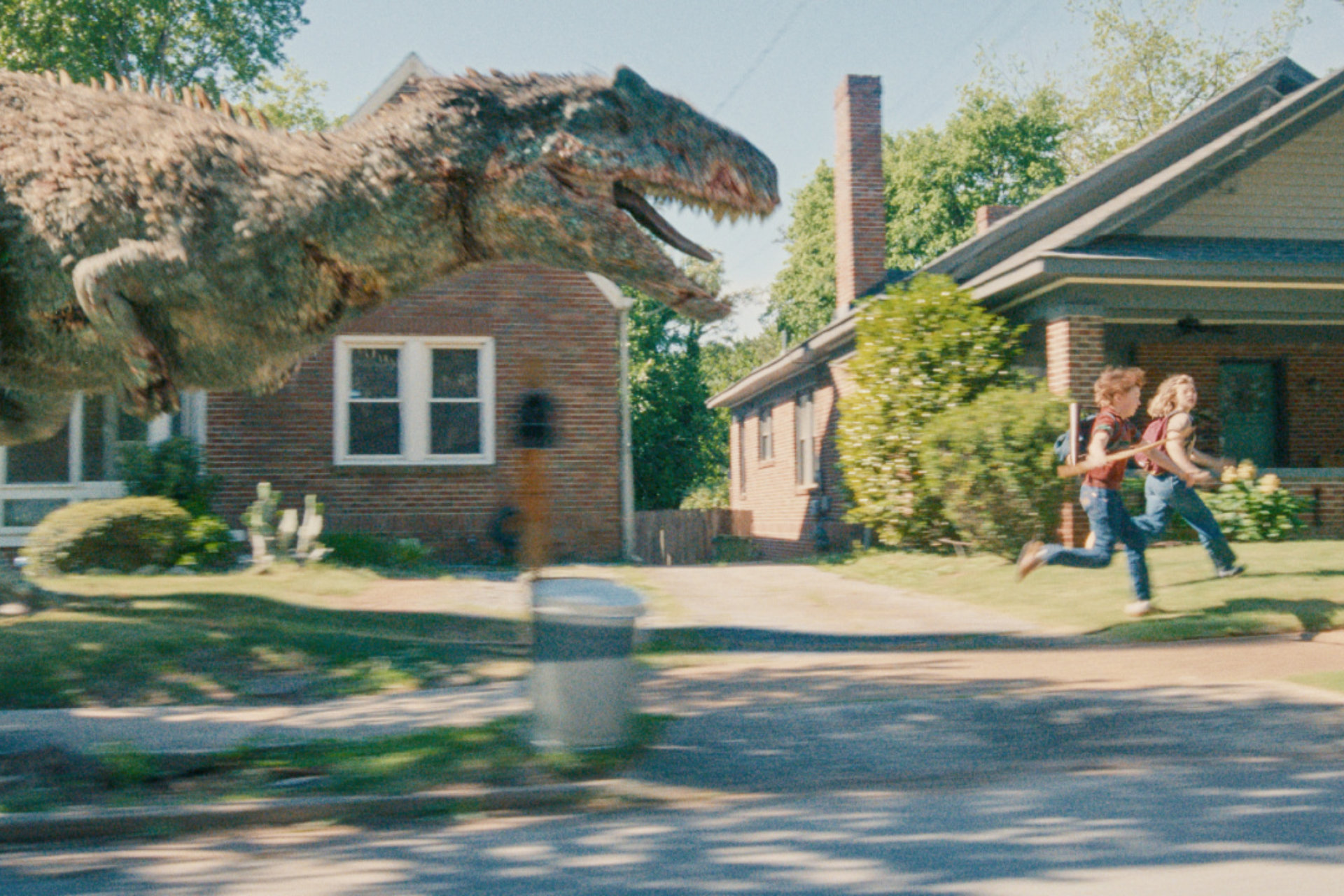
If nothing else, David Robert Mitchell’s The End of Oak Street proves that Warner Brothers will — and have, now — spend at least $80 million on a movie in which feathered dinosaurs “do it like they do on the Discovery Channel.” Yes, Mitchell spent nearly a decade in Director Jail following the drama surrounding criminally underrated Under the Silver Lake to make a “Dark Amblin” picture in which big-ass lizards fuck. There’s something deeply endearing about that, in a weird way — say what you will about the dude, it took shit bottoming out for him to even consider making a sequel to It Follows, the feature that propelled him to a surprising (if short-lived) superstardom, and one could theoretically consider this a nadir. It’s not bad, per se, as Mitchell’s too strong a filmmaker to produce something wholly without merit, but its tonal inconsistency is a real issue. It desires to push the boundaries of the PG-13 in its edginess and be the kind of family tale one would have taken the kids to back in 1982.
That fateful year — presumably chosen because it was one of the best sci-fi summers at the multiplex*— is from where the Platt family, along with their friends and neighbors, depart in their time-shifting journey. The opening half-hour is a nice reminder of the Linklater-like work Mitchell excels at, mostly unseen since 2011’s The Myth of the American Sleepover. He illustrates the family dynamic at a cookout, taking small diversions along the way to establish the core four’s characterization. Denise (Anne Hathaway) is our protagonist, for the most part, a loving mom who has channeled her discontent with her marriage into a novel she’s writing in secret. It’s not that she doesn’t love her husband Greg (Ewan McGregor) — it’s that he’s never there, delivering pizzas to supplement his day job income. In reality, he’s seen the book and doesn’t want to inflame matters further by telling her that he got fired and the pizzas are now their only source of income. They’ve got great kids — Audrey (Maisy Stella), their science-obsessed daughter, is likely Cornell-bound, and their son Brian (Christian Convery) loves the family dog, Starbuck, about as much as he loves raising good-natured hell around the neighborhood. Still, Denise is unsatisfied, and you better bet that an unexplained science-fictional phenomenon will make her realize the error of her ways. Otherwise, what is this? Kramer vs. Kramer?
It happens during a thunderstorm, only this time the bright flashes of light aren’t aimed for a clock tower – they’re the bands of a neighborhood-sized time-warping wormhole, which sends the entire subdivision back to the late Jurassic. Mainly, the Platts are just frustrated that the power’s out, and worried about Starbuck, who ran off in the night. As Mom and Dad look for the dog, it slowly becomes clear that they aren’t in suburban Michigan anymore. Mitchell’s filmmaking in this sequence is particularly strong, perhaps the moment in which he ceases doing Spielberg pastiche and begins iterating on the master’s style. It’s funny, thrilling, and gives the characters their first taste of the terrible sublime — the sense that they are small parts in a pageant that’s larger and vastly weirder than they imagined a day or two ago. Dinosaurs, often glimpsed only in part, now rule their little world. They’re impressively rendered, and different than a Jurassic Park viewer would expect, feathers and all, and there’s a lot more variety in the creature mix than just the usual assortment of familiar nugget shapes, with prehistoric turtles, alligators and giant snakes making interesting appearances.
What Mitchell struggles with are his dueling impulses to make the film broadly accessible and to explore this concept to its limit in a semi-plausible way. The atomized suburbanites have no sense of community — the idea of banding together for survival in the face of impossible odds isn’t even a consideration — and much of the neighborhood is relegated to the role of “raptor food.” As such, there’s a strange and pervasive nihilism at odds with the film’s gooey family-centric core, one that can be seen simply in the way Mitchell treats the neighborhood pets. Starbuck is a central animus for much of the film’s action: Most of the Platts’ travels around their time-lost neighborhood concern finding the dog (who does, ultimately, make his way out of the mess). Meanwhile, we see three cats – one which is a “bait” animal meant to draw Audrey’s attention to danger during that initial sequence, another which is forced to flee into the night after its home gets smashed up, and another’s corpse being eaten by three pint-sized dinos. This isn’t a “vegan alert” or anything (as much as I hate the double-standard), but merely just that strange fuck-you-get-mine survival impulse, which is just assumed and not a point of critique.
As the film barrels toward its Rick and Morty conclusion — a rush job meant to keep the film under the hundred-minute mark — it becomes clear that the set-up’s novelty is its tragic flaw. It’s a concept so cool and fun, with endearing characters, smart production design (the Terminator-style shaved walls and piping inside some of the other houses look really swell), and good direction, that whatever ending the audience anticipates is likely stronger than what Mitchell and company came up with, and one that’s probably more fulfilling as well. A shock value twist also doesn’t help matters, especially with how rushed its impact ultimately is. Regardless, there’s a kernel of something here, and aside from an overuse of split-diopter composition, Mitchell’s filmmaking remains as enthralling as ever. So, yeah. Oak Street’s a mixed bag, but it’s worth it just so you can tell your friends about the dino-coitus and have them not believe a single word you say. It sounds like a bit, but it is very, very real. Much like the movie itself.
* For more, check out Chris Nashawaty’s The Future Was Now, which goes into the making of ET, Conan the Barbarian, Tron, The Thing, Wrath of Khan, Poltergeist, The Road Warrior and the GOAT Blade Runner, all of which were released in theaters within a single six-week span.