
Editor’s Note: Vanyaland film editor Nick Johnston is back in Canada this week covering the 50th Toronto International Film Festival. And as usual, we wish we were up there with him! Check out our continuing 2025 coverage, get rolling with our official curtain-raiser, and revisit the complete Vanyaland coverage archives from past TIFF editions.
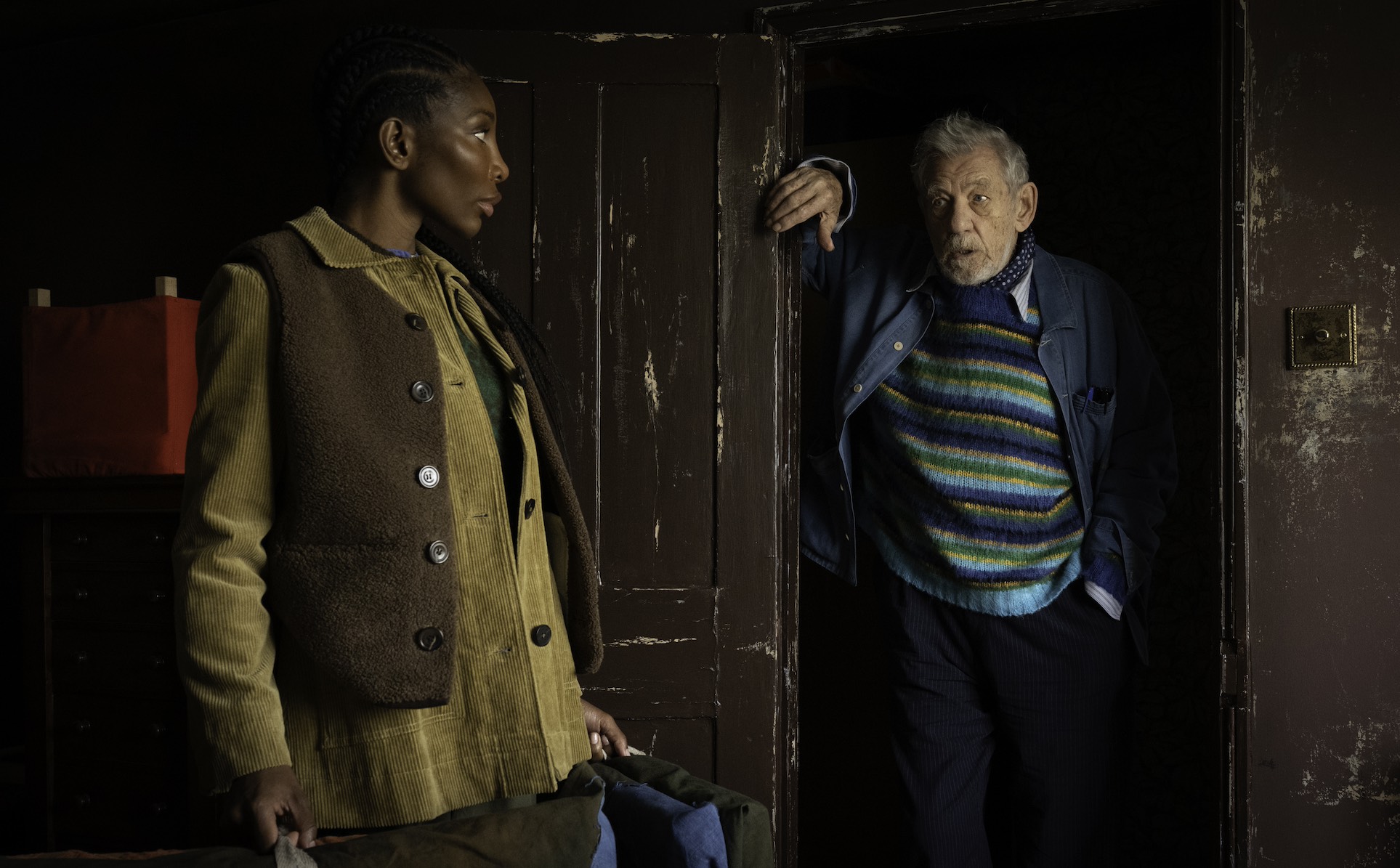
As far as I know, there aren’t too many directors capable of pulling off a hat trick of good movies in a single calendar year, but, once again, Steven Soderbergh has defied all expectations and done so. His latest feature, The Christophers, could not be more different than either Presence (a ghost story told with brilliant cinematic flair) or Black Bag (a delightfully written and star-studded spy thriller-comedy): It’s a chamber comedy, anchored by two great performances from Ian McKellan and Michaela Coel, about an aged former enfant terrible of the art world, his new assistant, and a series of eight unfinished paintings known as, you guessed it, the Christophers. There are plenty of simple pleasures here – Soderbergh’s steady hand behind the camera and in the edit suite, the effortless brilliance of pairing a dynamo like McKellan with a stone-faced straight man like Coel, Ed Solomon’s delightfully witty screenplay that dovetails into a picture-perfect ending – but what I like most about The Christophers is that it’s a film, ultimately, about the function of criticism and its uses, good and bad.
Julian Skar (McKellan) made a living at that after he shook up the art world with radical, insightful queer paintings at a time in which, he says, it was actually dangerous to admit that one was bisexual. He didn’t have a column in the Times or Guardian, nor was he an academic: Skar was the Simon Cowell on a show called Art Fight, where he tore into legions of would-be artists with fiery bon mots, crushing their ambitions before they ever had a chance to grow into something greater. This destroyed his life and reputation, and though he’s still plenty wealthy, living in two giant row houses in the middle of London, he spends his days recording Cameos for 100 quid – 150 if he air-signs it. He’d already wrecked his family life, alienating his two children (James Corden and Jessica Gunning), who, admittedly, were not the best kids to begin with, and had a massive rupture with the love of his life, the man whose name the Christophers get theirs from. Hence, the set of unfinished paintings, the third and final set in a series, waits in the detritus of Skar’s junk-filled home for someone to come along and finish them. Or destroy them, if Skar had his way.
This is where Lori (Coel) enters the picture. We meet her while she’s sketching the street scene in front of the food stall where she works, and she remains an enigmatic presence throughout much of the film. We learn bits and pieces about her – she went to art school with Julian’s daughter, she’s stopped showing her work – and follow her as she goes about her task. Skar’s dumb kids want her to infiltrate his little world and finish the Christophers so that, when he passes on, they can sell them for lots of money. The previous pieces’ prices have only gone up in the decades since they were first shown, and new, unexhibited work would fetch quite a sum at auction. It’s forensically easier than it sounds. She’ll be using his brushes on his canvases in his studio, and the finished pieces will easily pass the tests authenticators will use to prove they’re his work. She’s a bit uncertain for reasons that become clearer as the film goes on, but when they offer her a third of the net profits, she signs on. She quickly comes to regret it, as Julian has aged nicely into a charismatic curmudgeon, sustained almost entirely by spite and the fact that his Cameo inbox stays full. He’s a terrible boss, a boor, and an asshole who spent his golden years tearing housewives and children apart on British TV. And yet, Lori sees something – a glorious fire — that was once in him and works to bring it out again.
See, Lori might be a great painter, but she’s a gifted critic. After her boss discovers a heavily critical piece about him on her portfolio website (and, well, the plot), she, to Julian’s extreme surprise, launches into an accurate evaluation of the existing Christophers, placing them in a timeline: the first were when he fell in love with his muse and their romance matured, the second series was all about their dissolution. She gleans this from the heaviness of brush strokes, his usage of colors (including ones, like ochre, that he talked shit about), the subject’s orientation towards the painter, and so on. This is essential to their partnership – and blossoming friendship — for three reasons: It allows her to puncture the bullshit defenses he’ll throw up with tactile detail, demonstrates that she has an uncommon insight into his work, far outside of the popular caricature of his painting yet without the honeyed perspective of a sycophant, and shows that she knows that only he can really finish the works, in the conceptual sense. She may be able to fake her way through the authentication process, but they’d be inauthentic in spirit and context. Contrast this with the way that Julian tosses out barbs after a ten-second glance in the direction of a painting, the inattentive twaddle that gets a reaction from the crowd and does little more than flatter the speaker.
Well, if you’re going to make that kind of critic empathetic, you could hardly pick a better actor than McKellan, who is given essentially carte blanche by Soderbergh and Solomon to be witty, messy, pithy, bitchy, snobby, salty, teary, and, ultimately, sweet, throughout the course of the 98-minute runtime. It’s a commanding, top-flight performance which Coel complements brilliantly (in a mostly thankless role!), and Soderbergh refuses to get in their way. Does it feel stagey? I can see some folks complaining about that, given that it is mainly set in a single location. Still, I think Soderbergh does enough cinematically in how he draws our attention to the details in each scene through cuts and framing to assuage that notion.
Yet what’s beautiful is how it feels like a four-person feature (two on-screen, two off) with care given by each player to support the other. It’s a lion-in-winter feature that reminds me quite a bit of Peter O’Toole’s last years, perhaps if his Ratatouille character had crossed into the live-action realm, and it’s beautifully penned, performed, and presented. The Christophers is a lovely tribute to the process of creative evolution via how, rightly or wrongly, an audience engages with an artist’s work and how the artist responds. It is not, however, a call for us to be nice (and, hopefully, shut up) – rather, it’s a plea, from one of our great filmmakers, to be true.