
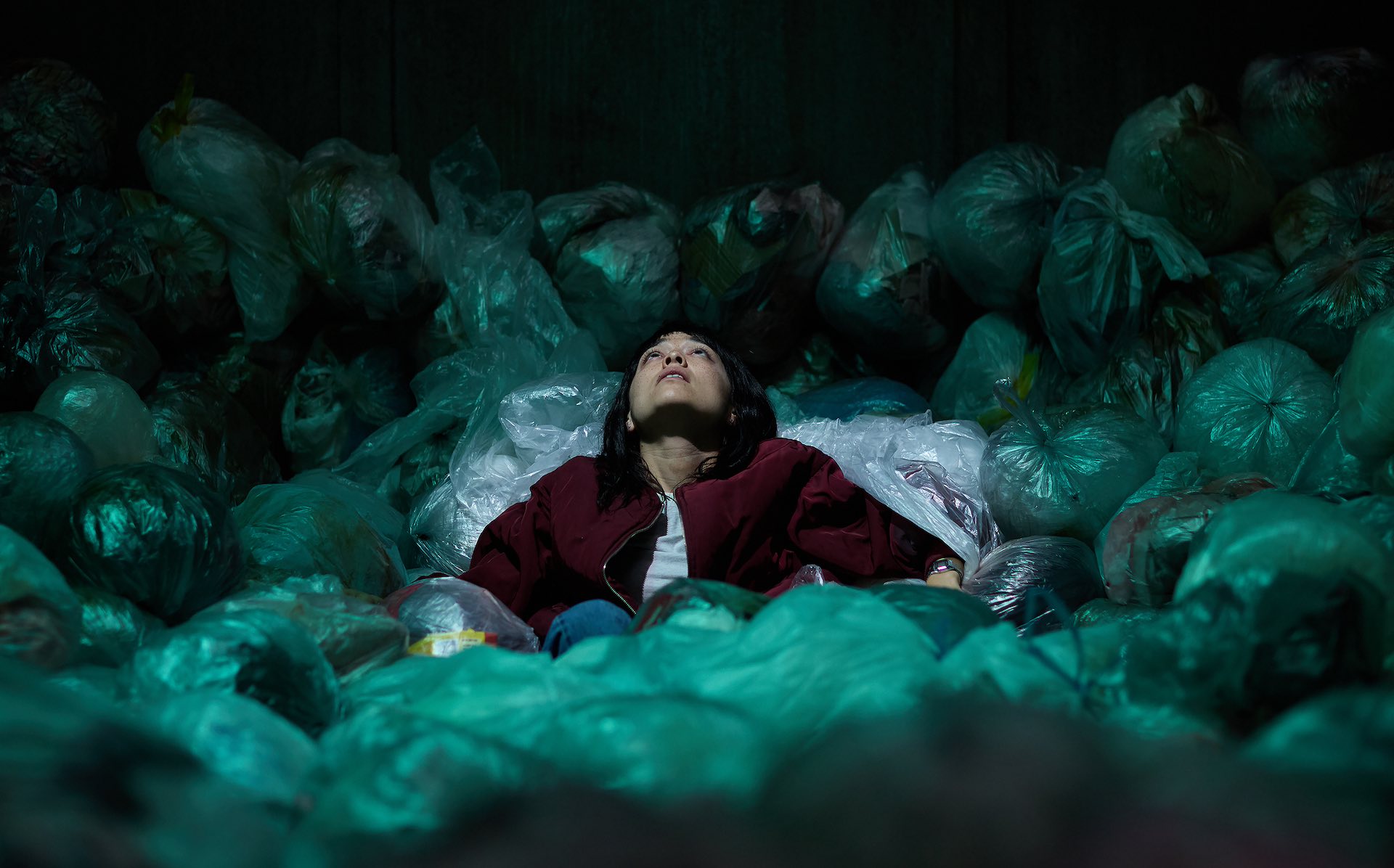
Editor’s Note: Vanyaland Film Editor Nick Johnston back on the ground in Utah covering the 2026 Sundance Film Festival for the grand finale out in Park City. He’s already very busy. Check out our preview of the 2026 festival; keep it locked to our full coverage of Sundance reviews from this year’s festival as they go live, and check out our full archives of past editions.
Three’s a trend, so we’re going to go ahead and call it: There is a new horror sub-genre on the market, folks. You could say it started with Darren Aronofsky’s The Whale, a grotesque portrait of Calvinist nihilism masquerading as Oscar bait; was properly inaugurated by Coralie Fargeaut’s The Substance; is currently taking over TVs with the Ryan Murphy-produced The Beauty; and is represented in this year’s Sundance Midnight line-up by Natalie Erika James’ Saccharine. Its theme isn’t particularly unique conceptually — indeed, there have been many films about the desire to be beautiful and the horror of being ugly — but one major development has served as a demarcation point.
This is the widespread availability of GLP-1 drugs, which made weight loss that much more achievable for everyone carrying around too much weight. Hence why I’m dubbing the genre “Ozemploitation,” as the brand is often more associated with “beauty” than health, often to its detriment (GLP-1s are proving to be incredibly useful in a number of fields other than weight loss, though all claims should be heavily scrutinized before passed on). The skinny new you you’ve always wanted is just a pill away, etc. Saccharine might be the most fully realized, at least as far as this new genre goes, in that it is pretty much Stephen King’s Thinner if brought on by a haunted weight-loss drug instead of a curse.
Like some people, Hana (Midori Francis) begins her weight-loss nightmare with a gym crush, pining after a trainer offering a 12-week “challenge” to get in shape. She’s deeply, deeply insecure about her looks, resenting her weight because it reminds her of her father, who had his own struggles with disordered eating, and her rail-thin mother. Her friends in medical school try to encourage her, but she’s just stuck in a rut, no matter how often she swears off sweets. That is, until she has a chance encounter at a gay bar with an old classmate, one who she remembers being a lot heavier in high school. She lost a massive amount of weight in a few weeks, which automatically (and rightfully) raises some red flags. Yet she brushes off Hana’s concerns, pulling out a little pill from her purse — just take one of these each day, and the pounds will melt off, no matter what you eat — and offering a few to her. Because this is a horror movie, you know exactly what she’s going to do, and sure enough, she breaks her weight-loss plateau.
Much like its real-world non-supernatural equivalent, the problems stem from its price. This is where James gets quite clever — instead of making Hana scrounge for pennies, she has her use her background in science and access to specialized equipment to figure out exactly what’s inside the little capsule, hoping to replicate it with less-expensive ingredients. It’s a good news/bad news situation. The good news is that the material is definitely cheap, if a bit uncommon, and the bad news is that she’s been taking pills with human ash inside of them. Still, you can’t beat results, so she steals a bit of a cadaver from anatomy class — a morbidly obese woman dubbed “Big Bertha” by a classmate — and cremates it, “rolling her own” haunted weight-loss meds. It’s all pretty awesome, at least at first. She’s impressing her trainer with her progress, delighting her mom, fitting into smaller sizes, and so on. But Bertha and her share a unique link, and through it Bertha’s able to haunt her (more than normal, that is, as it seems that possession is just a side-effect like hair loss and horrible farts). She’s a poltergeist who will crush you with her invisible girth if you don’t binge-eat for her, and it’ll take some serious sacrifices on Hana’s part to get this ghost off of her back.
One can easily see the influences of Aronofsky and Fargeaut on James’ film: a conversation between Hana and her morbidly obese father is presented as if one of Sadie Sink’s conversations with Brendan Fraser were oriented around her perspective, and the opening credits cross-cut between slow-motion binge-eating (played both in normal motion and reverse) and deep close-ups on Hana’s crush and her toned body. Yet James is more content with slotting her work into the traditional horror framework than with the headier ambitions of those two, and the result is an accessible and entertaining, if occasionally slight, feature. Saccharine works best when it’s defying our expectations – for instance, the scene in which Hana heads to the lab to analyze the pill, or a lengthy sequence in which a now-skinny Hana tries to convince her best friend (Danielle MacDonald) in the program that she’s being haunted by one of the Boomers from Left 4 Dead, and reveals that she believes that the ghost is most present when her blood sugar gets too low. That’s a clever variation on these rote sequences, ones which are both novel and funny in their applications, and it helps the film maintain its tension –we literally have no clue what’s going to happen.
Alas, that’s somewhat the problem: James opens up so many possibilities for where the film could go that the ending feels like a bit of a disappointment, where the re-usage of a particular (and expensive) image trumps coherence. It also muddies the meaning in plenty of unexpected ways, as the film’s ostensibly about “body positivity,” yet “fatness” is a literal specter hovering over Hana and commanding her to consume. At least Thinner contrasted its protagonist’s grotesque obesity with its equally terrifying opposite at the other end of the scale, and though the film occasionally stresses its intended meaning, it feels as if it wants to have its brutal fun while staying on message without realizing they contradict each other. The suggestion of “cheating” also clouds the feature, something Fargeaut didn’t have to worry about given the fully fabulist nature of her work. I’m loath to bring up personal experience sometimes, especially when it comes to weight, but as a person who went through this process without the help of a GLP-1 or pill filled with human ash, I genuinely do not for one second hold it against anyone who decides that, with the consultation of a medical professional, they should use a medication to help them lose weight.
Hana would probably be a perfect candidate, honestly, though a heaping helping of therapy would do much more to help than any pill could. Then, at least on these shores, you’d simply be haunted by your premiums increasing, your insurer arbitrarily dropping coverage for GLP-1s, or your co-pay for therapy jumping up in price. Jesus. I just scared myself.