
Here’s a swell aspect of survival horror: if a story is gross and bizarre enough, it doesn’t matter how sentimental it gets. The audience will stick with it no matter what—it’s hard as hell to gag over cornball shit when you’re actually dry-heaving over watching, say, the skin melt off of a dude’s hands. A good example of this is Fire in the Sky, a based-on-a-true(ish)-events melodrama about a dysfunctional family and friend group in the mountains of West Virginia that transforms into something genuinely unique when its narrative is interrupted near the end by one of the most disgustingly visceral and nightmarish alien abduction sequences ever committed to celluloid.* Brian Duffield’s Whalefall has a similar ethos, but it’s less patient. That is to say: If you’re claustrophobic or have a lizard-brain fear of being eaten by a much larger animal, you won’t have to wait an hour or so to find yourself reaching for the empty popcorn bucket, praying that the dude in the seat next to you won’t hurl at the sight of your ralphing, and spark a Triangle of Sadness-like chain-reaction that will undoubtedly ruin the ushers’ afternoon and bring shame upon your family for generations. You might cry, too, but not from embarrassment. Rather, those tears will be well-earned, from how this macabre, soulful meditation on grief translates its central metaphor into compelling survival horror.
Based on Daniel Kraus’s novel (he shares a co-screenwriter credit with Duffield here), Whalefall is, in fact, that movie where Austin Abrams gets eaten by a fucking whale and has to fight his way out without overt divine intervention or Larry the Cucumber telling jokes. But those who have read Kraus’ book know two important details. First, a ton of research went into how this scenario might happen and how one could, theoretically, live through it. Second, it’s much more poetic than you’d expect — I’ve described it to friends as written like one of Malick’s narrations in The Tree of Life, with gorgeous prose counterbalancing the horror inside a whale’s guts. A number of changes have been made, the most overt being that Abrams’ character, Jay, has been aged up to roughly match the actor’s, but the nuts and bolts of the story remain the same, and they’re nearly as effective as they were on the page. If you have a pedantic father or father figure in your life, point them to the book if they’d like citations, but only after you’ve given them a long, long hug.
Jay’s dad (Josh Brolin) wasn’t exactly the hugging type. A captain of a small fishing boat, whale fanatic, and diving expert, he lived a tough life and died a tough, solitary death, choosing to drown himself while he still had the choice rather than wait for his mesothelioma to rob him of his breath the old-fashioned way. His old man was tough, and he wanted a tough son. He got Jay, who went off to Iowa for school in the middle of his father’s illness, and never looked back. The last time they saw each other, they came close to blows aboard his dad’s boat, and Jay chose to swim to shore instead of staying next to the drunk, coughing shell of the man that once cradled him in his arms and cooed him to sleep. A year later, back in town, he decides to take one last dive to recover something of his father’s skeleton from the ocean floor. Dad was considerate enough to do it close-ish to shore, and Jay sets out in the choppy early morning surf, recalling his dad’s advice as he dons his scuba gear. Well, except for the one part about “always bring gloves.” It’s too late for that – the shore patrol is nearly upon him. Oops.
At first, the dive goes as planned, but when he stumbles upon what he thinks are the mossy remains, a large squid darts out of the inky black distance. Only one thing can make that invertebrate swim like that — a sperm whale. He tries to get away, but the giant animal is just too fast and he’s between it and dinner, caught in the crossfire. Whales don’t eat people, he thinks, as he’s pushed along at unknown knots, right on the whale’s nose. Whales don’t eat people, he thinks, as the gargantuan mouth opens and the squid fights in vain against the momentum and the force of the jaws. Whales don’t eat people, he thinks, and he’s right. They do eat squid, though, and the whale won’t notice much if one appendage is a little longer than the other. The squid grabs his leg, and down they go into the gullet. Illuminated by jellyfish and bioluminescent krill, he gets his bearings just long enough to realize a few things. First, the air inside the chamber – essentially the whale’s throat — is toxic. Second, he’s steadily running out of oxygen. Third, the squid is still alive. Fourth, even if the squid’s gone, he has almost no chance of getting out alive. What’s a dude to do in a stomach full of indigestible squid beaks and acid? Try, at least. And possibly connect with his father’s spirit in the process? Or is that just the hypoxia?
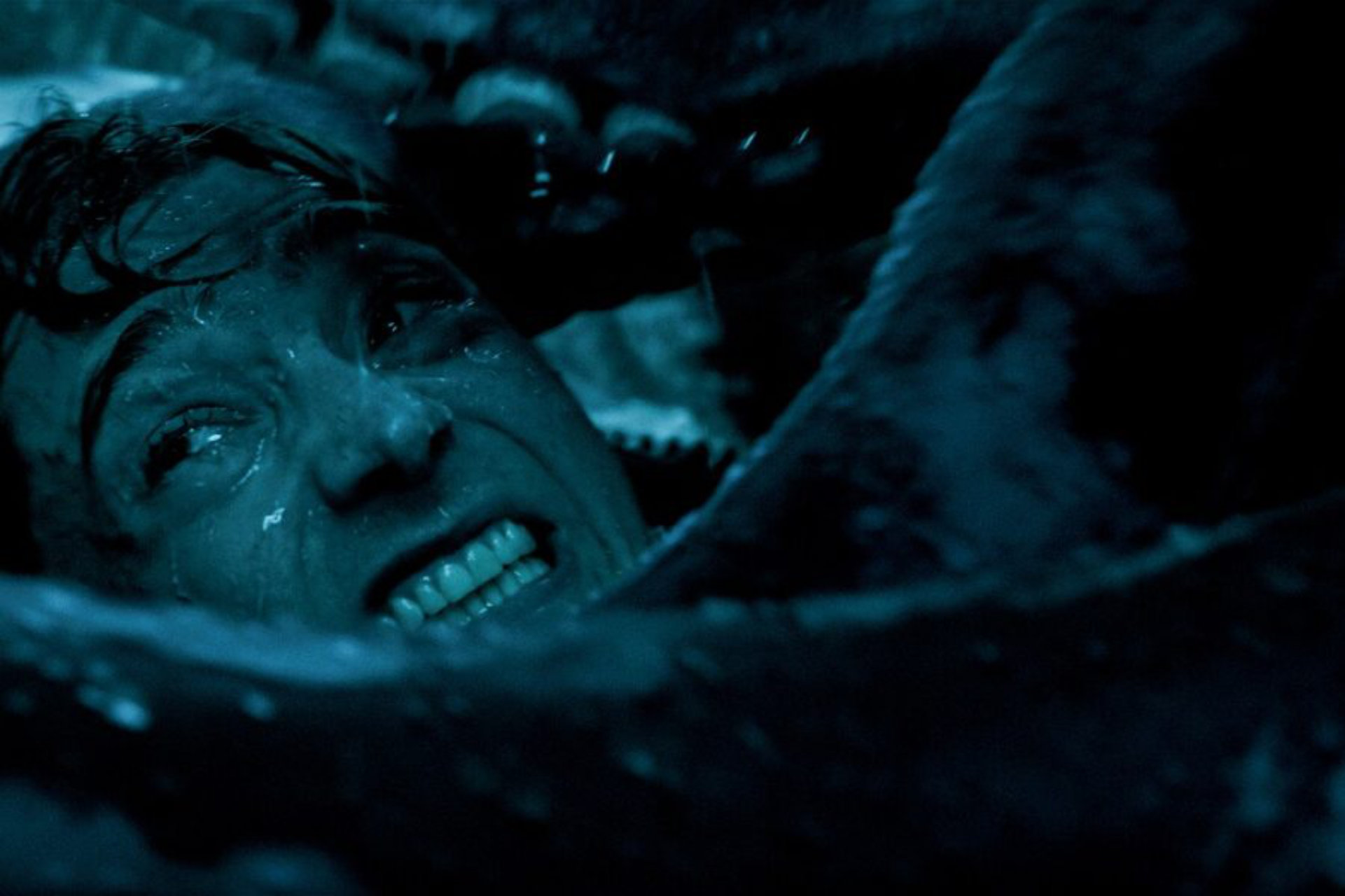
That scene described above, in which Abrams and the squid are swallowed up, elicited a stunned gasp from someone in my audience, who immediately followed it up with a sheepish “Great scene.” Folks weren’t laughing at him — rather, I think we all agreed with the sentiment. That’s when shit kicks into full gear, and the movie rarely pauses once we enter the chamber’s turquoise-blue walls. The interiors are impressively realized, marvelous feats of near-seamless practical and digital effects work, and, importantly, they’re utterly disgusting. The shots have a tactile quality, as if, if you reached up towards the screen, your hand would leave a fast-fading imprint on the slick, fleshy walls, and come away covered in wet mucus (try eating your popcorn after that). The horrors are almost unrelenting, and Abrams suffers a-plenty. I’ll let you find out exactly what happens to him when you check out the movie, but all I can say is: if you do any scuba diving, don’t forget your gloves.
Yet the experience isn’t fully real-time, nor is it completely set inside the whale itself, even if we never stray far from Jay’s perspective. A gorgeous sequence shows the whale under attack by a pod of orcas, rendered in stark, echolocation-substituting black-and-white; the stunning natural-selection violence rhythmically edited to Jay’s on-shore memories, accompanied by Brolin’s disembodied growl. Any extended trips to shore are less successful, though that’s not really anyone’s fault. Abrams and Brolin are exceptionally well-cast, especially the former, whose wide-eyed terror pulls us into the emotional reality of his ordeal, and Duffield directs these scenes well. They aren’t as strong simply because they stray too far from the panic-inducing present, though they hit their marks.
That said, the film does a decent job of engaging with the book’s gooey heart. This is certifiably a “Cryin’ with the fellas” movie, trumpets blaring to bring down the thick walls of masculine socialization to reach a Jericho inaccessible in daylight without acute trauma. I’d recommend both, though, based on their specific strengths. Kraus’s novel immerses you deep in Jay’s perspective and would work wonderfully as training for a speed-reader, since even the slowest sentence-scanner would tear through that narrative at light speed. Duffield’s film is a theatrical spectacle on the same level as something like Gravity, and I imagine it would play similarly at home – still good, but it may take on watery doubt, its immersive hull punctured by one’s split attention. This benefits from the scale of the screen and the distraction-free environs of the theater, as much as riding a roller coaster beats a YouTube video of the same ride. Just remember, though, to not sit in the splash zone.
* If you’ve never seen it before, don’t just watch the clip in question on YouTube — it’s still straight-up terrifying on its own, but it’s so much more impactful in context.