
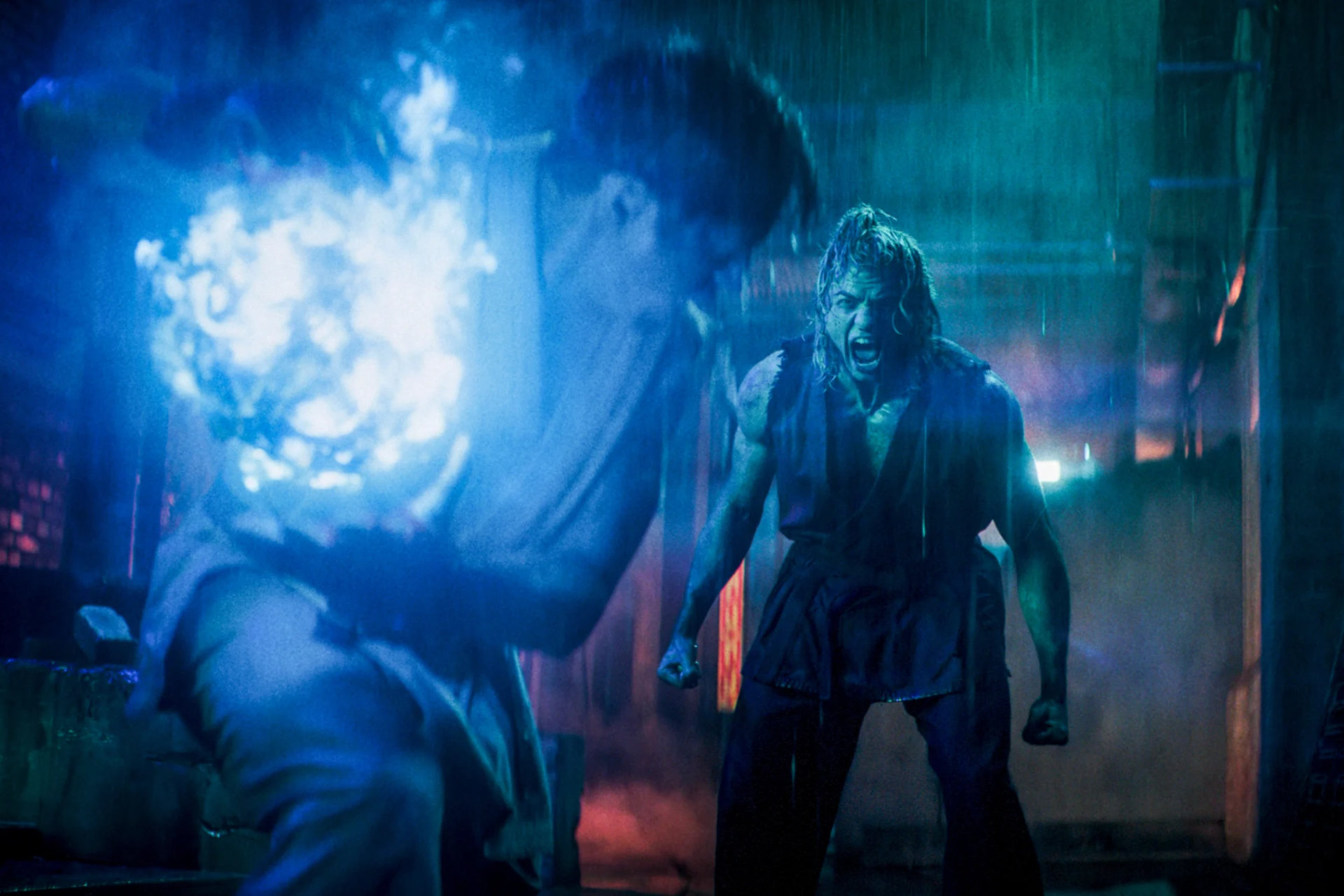
Why is it so hard for those making fighting-game adaptations to realize their audience wants… fights? The Mortal Kombat films have slowly moved toward this over the last three decades, but for whatever reason, it seems impossible to bring Street Fighter to the screen without stuffing the runtime with bullshit. The Van Damme film was basically an episode of G.I. Joe elevated by Raul Julia’s high-camp performance; 2009’s The Legend of Chun-Li was… whatever the hell that was. Now Kitao Sakurai’s big-budget effort aims to compete with the latest crop of video game movies by staying unabashedly true to the ‘90s arcade-cabinet aesthetics of Street Fighter II. Audiences didn’t riot when Shadow the Hedgehog showed up in Sonic 3 — in fact, they seemed to like it — and presumably they can go along with blond flattops and giant green monsters. Pity there’s not really that much action.
There’s a whole lot of bants, though: chatterbox joking mostly replaces the fisticuffs as we follow Ryu (Andrew Koji) and Ken (Noah Centino) as they make their way to and through the ‘93 World Warrior tournament. It’s been organized by M. Bison (David Dastmalchian), the dictator of some random country with tower blocks peeled from the pages of 2000 AD, who has his own roster of fighters ready to roll. There’s the Wolverine-clawed, Phantom-masked Vega (Orville Peck), the champion boxer Balrog (50 Cent), the vodka-swilling beast of a man Zangief (Olivier Richters), and the shockingly jolly green giant Blanka (Jason Momoa). Opposing them are USAF commander Guile (Cody Rhodes), the stretchy guru Dhalsim (Vidyut Jammwal), and INTERPOL agent Chun-Li (Callina Liang). But Ryu’s being stalked by the big boss Akuma (Joe Anoa’i), who wants to lead him to the dark side, and whose influence led to the death of Ken and Ryu’s sensei. He’s waiting for the champ, and Bison wants to suck whoever wins dry. Their power, that is. The film makes that joke several times, just in case you don’t get it the first time.
The big, broad ‘90s aesthetic is both a pleasure and a problem. It looks great, at least for the first 20-odd minutes, as Sakurai apes the fuzzy sheen of CRT TVs and the garishness of early UFC tournaments, where the colorful roster characters have always been at their most appealing. The banter hasn’t totally taken over the dialogue just yet. There are a few inspired bits — an ESPN profile of Ryu and Ken narrated by Chris Berman, Ken’s various attempts to make money off of his fame (including beating up a car, much like in II, and him serving as an MTV VJ for a spell). Then the film is practically handed over to Andrew Schultz and Eric Andre to fill dead air between not-fights and fan service, and the fun of the setting evaporates in an unappealing DTV sheen. Sakurai just can’t let the action breathe or develop in any given scene without undermining its momentum, and he relies on hack work comedy — itself a staple of the ‘90s nerd-media adaptation — to try and stress to the viewer that everybody here is having a good time and nothing really matters all that much. It’s just boring after a certain point, with the primary influence seeming to be the intro cinematic to Cyberpunk 2077 rather than, say, the Capcom games themselves.
Say what you will about the modern Mortal Kombat movies, but at least they understood that vintage high camp comes from stomped seriousness rather than wink-wink-nudge-nudge wit. It’s enough that the cast looks like the characters in this case, because anything they say or do (in the case of Rhodes and Fiddy) has a decent chance of being funny thanks to their goofy-ass outfits. What’s truly astonishing is how much Street Fighter resembles Travis Knight’s Masters of the Universe, and I don’t just mean that the production cut fat checks to the 4 Non Blondes estate for the rights to “What’s Going On.” They’re both weirdly ashamed to exist, pitched squarely at adults who have fond memories of Saturday morning cartoons or feeding quarters into the machine at the bowling alley rather than their children, who might very well be entertained by a more straight-laced portrayal.
It’s even more bizarre in this case, given that the games are still massively popular, and it’s hard to imagine any of those people enjoying this enough to justify the sequel-bait anticlimax it ends on. Likewise, it’s equally hard to picture anyone in the audience enjoying this more than they would, say, the goofiness of a slurred Van Damme speech or Julia’s scenery-chewing glee at playing an unabashedly evil heavy. One can practically hear the resignation in Dastmalchian’s voice as he’s asked to deliver a variation on the “For me, it was Tuesday” line, which lands with a resounding shrug on fatigued ears, even in a teeth-rattling Dolby Digital auditorium. I doubt he’ll get a chance to try again, since no one will be willing to shell out tokens to get past the continue screen. It’s best to move on and, I don’t know, play skee ball or something. Anything but another round of this.