
Editor’s Note: This review originally ran as part of our on-site coverage of the 2026 Sundance Film Festival out in Park City, Utah, and today we’re re-publishing it with the film’s wider release. Check out our preview of the 2026 festival; revisit Vanyaland Film Editor Nick Johnston’s full coverage of Sundance reviews from this year’s festival, and check out our full archives of past editions.
Boy howdy, what an utter joy it is to have Gregg Araki back making movies again. It’s been 12 years since White Bird in a Blizzard premiered at Sundance, and though he’s had a very productive career in TV (where he was the showrunner for Starz’s Now Apocalypse and director of the best episodes of series like 13 Reasons Why and Dahmer), his voice has been sorely missed amid all of the changing mores of the last decade. One could practically write a variation on “We Didn’t Start the Fire” stocked with the major events and minor dramas since then, and Araki’s time off the big screen has seen the growth and flourishing of an entirely new generation – one with a vastly different approach to sexuality than he grew up with.
It may come as a shock that his latest sex-comedy farce, I Want Your Sex, isn’t a boomer-like bashing of how Gen Z doesn’t fuck like their Gen X or millennial counterparts, but rather an interesting cross-generational dialogue about what works and what doesn’t between their perceptions of sex and kink. It’s also diabolically funny, with standout work from oddball rizz-machine Cooper Hoffman and a hilariously vampy Olivia Wilde, with Araki’s typically dynamic aesthetics befitting its cartoonish nature. Turns out that bit of sugar does help the medicine go down.
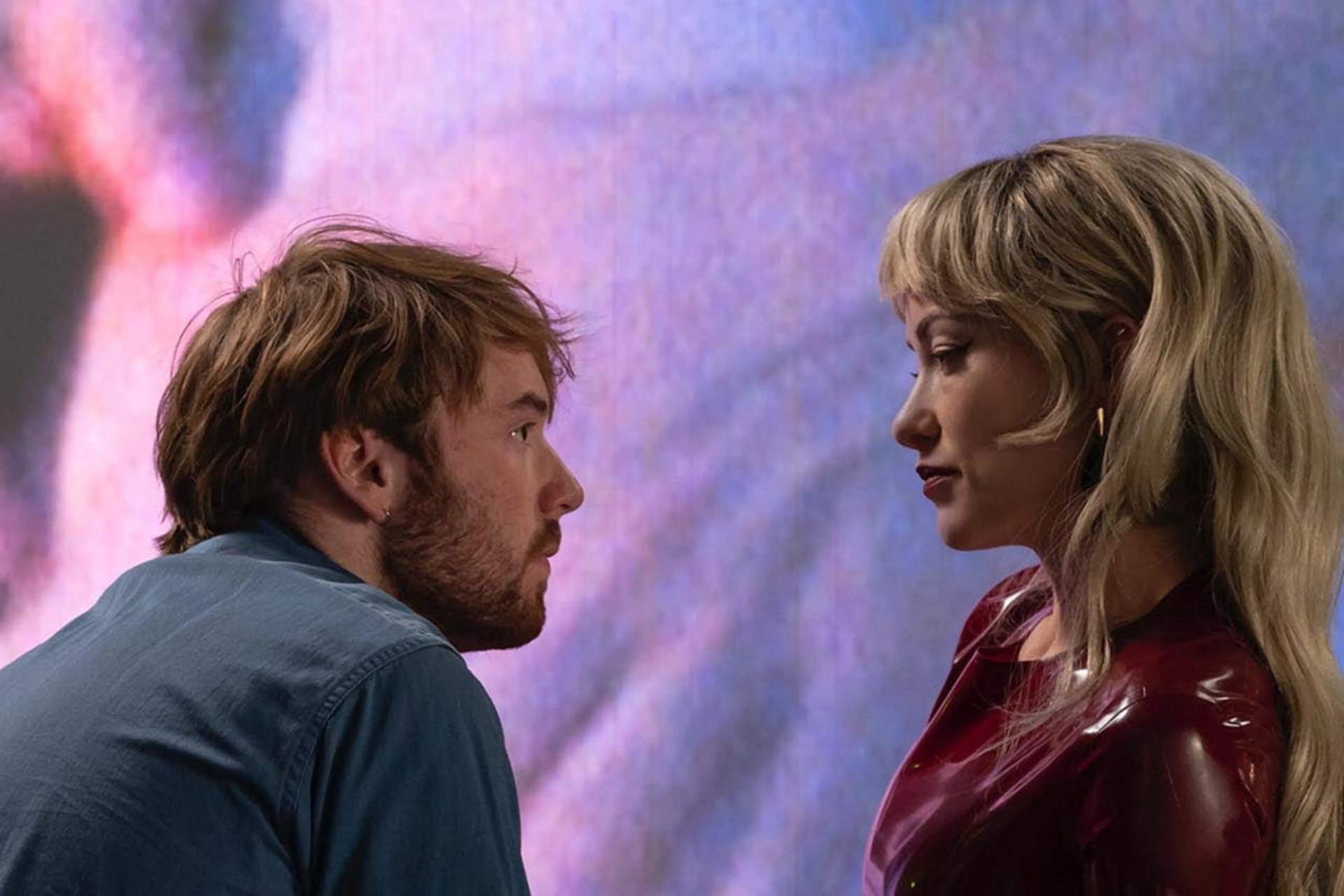
Much like Wilder’s Sunset Boulevard, Araki opens I Want Your Sex with a body floating in a swimming pool, though it’s not a washed-up writer lying motionless in the still waters – it’s Erika Tracy (Wilde), a provocative sex-positive visual artist who, much like William Holden and Gloria Swanson’s characters in that classic, is approaching her sell-by date. She’s discovered by her assistant, Eliot (Hoffman), clad in pink lacey lingerie and sporting a bloody nose. He leaps to her rescue, unsuccessfully gives her mouth-to-mouth, and dials 9-1-1. Smash-cut to Eliot in a police interrogation room as he’s being interviewed by two cops (Margaret Cho and Johnny Knoxville), who have keyed in on him as a potential suspect. The circumstances were pretty strange, after all: he’s got no memory of her ever entering the pool or what he was up to in the hours before her drowning, and as he’ll come to reveal, plenty of motives for wanting Erika dead. Most of the film unfolds in flashback, set in the days after he graduated from college and stumbled upon an opportunity to become an assistant to one of his art-world icons.
In many ways, before he met her, Eliot was the Gen-Z manifestation of an eons-old archetype – the sexually frustrated young man, infused with a touch more passivity and caution in intimate matters. His best friend and roommate (Chase Lui Summers) needed him to pull his weight with the rent, and his girlfriend (Charli XCX, a name I will be writing a lot this week) barely tolerated his presence, much less enjoyed having sex with him, as he was an impediment to her studies. So entered Erika, who needed a bevy of young people to help with her upcoming exhibition. These responsibilities ranged from chewing endless amounts of Bubble Double for a giant 3D portrait of her private (well, public bits) to helping her move furniture, along with all the other tasks disposable faux-interns do for the rich and famous.
After a little light flirtation, she singled him out one afternoon, invited him into her office, and Kaboom: What looked at first like a boss scolding a young employee for his wandering eyes turned into a dom-sub relationship built on Eliot’s humiliation and her gratification. And golly gee, did he love it until things started to get weird. Not just normal kinkster weird – Erika’s game ran the gamut from “uncomfortable” to “excessively fucked-up,” all the way to the point that he’s now in a police station, unloading all of this information onto a pair of puzzled policemen.
If Daniel Clowes doesn’t draw a portrait of Hoffman, sweating nervously in one of the many sketchy situations his character winds up in, I’ll be massively disappointed – he feels like one of his characters ripped off the page and put on the big screen (at least back in the pre-New Yorker days when he was still drawing Eightball). He has a naïve sweetness that makes his words feel like they’re rendered in speech bubbles, and his handsomeness – not Hollywood standard by any means, but enough to give hope to the legions of good-looking regular guys out there in the world that they, too, can play piggy with a person as conventionally attractive as Wilde – goes a long way to making his character feel natural and believable in this scenario. Eliot embodies most of the good qualities of his generation without ever feeling like a caricature, and we can understand why he’d want to immerse himself in a relationship like this. It’s liberation through submission and so on, a part of himself he’d never have explored without Erika’s influence, encouragement, and knowledge.
The only problem is Erika herself, who is brilliantly embodied by Wilde and outfitted by Araki’s costume designers. She’s one of Araki’s classical archetypes – a hedonistic nihilist with sociopathic tendencies, who is nevertheless charismatic, engaging, and worth being weirdly empathetic towards, even as she crosses boundaries that aren’t just faux pas but actual crimes in the state of California. She’s hilariously droll, with her catty asides about colleagues and friends delivered with an acrid punch, and her flame-out in the back half, sparked by fears of her irrelevancy as an artist and the potential failure of her latest show, is desperately funny, even as she starts to totally destroy Eliot’s life. In short, she’s an Araki protagonist approaching the back half of their forties, having survived from the first Bush through Biden in a position insulated enough from shifting values around sex to not fully understand that what she’s doing is exploitative and wrong on an emotional level. She got away with it for so long (and understands the value of a good Ryan Holiday-style publicity stunt) that it’s just second-nature to use and abuse, provided there’s at least some initial consent.
What Araki’s done here is craft a genuine satirical farce – not just a comedy – in which his observations about cross-generational approaches towards sex are both pointed and self-critical, a playground in which one can find something to pry at and, in the process, laugh about it. The morality on display in I Want Your Sex can be described as a synthesis, in which the greater modern cognizance of sexual dynamics and their effects can coexist with the kind of perpetual adventurism of his day on the frontiers of the queer counterculture, as each ultimately provides a solution to the corresponding problem, provided the other person isn’t a sociopath. Isolated, shy, and alone? Put the phone down, go out, meet someone, and try something new. Interested in cultivating a healthy dom/sub relationship? Maybe don’t pull from your employee stock, communicate better, and try not to ruin anybody’s life for the sake of your art and ego. Taken to their logical extremes, the consequences of these opposing points of view both suck (though, through Erika, Araki saves his frustration for his peers and their boneheaded inability to grow), and, through this merger of generational values, one can enjoy a healthier relationship with desire, sex, and their partner(s).
In the wake of the sex comedy being punted off-screen, I Want Your Sex is a reminder of what function the genre could serve before the omnipresence of internet porn rendered them seemingly-irrelevant. You’ll laugh at what Araki’s cooked up, but I think you’ll also want to think and talk about it, too.