
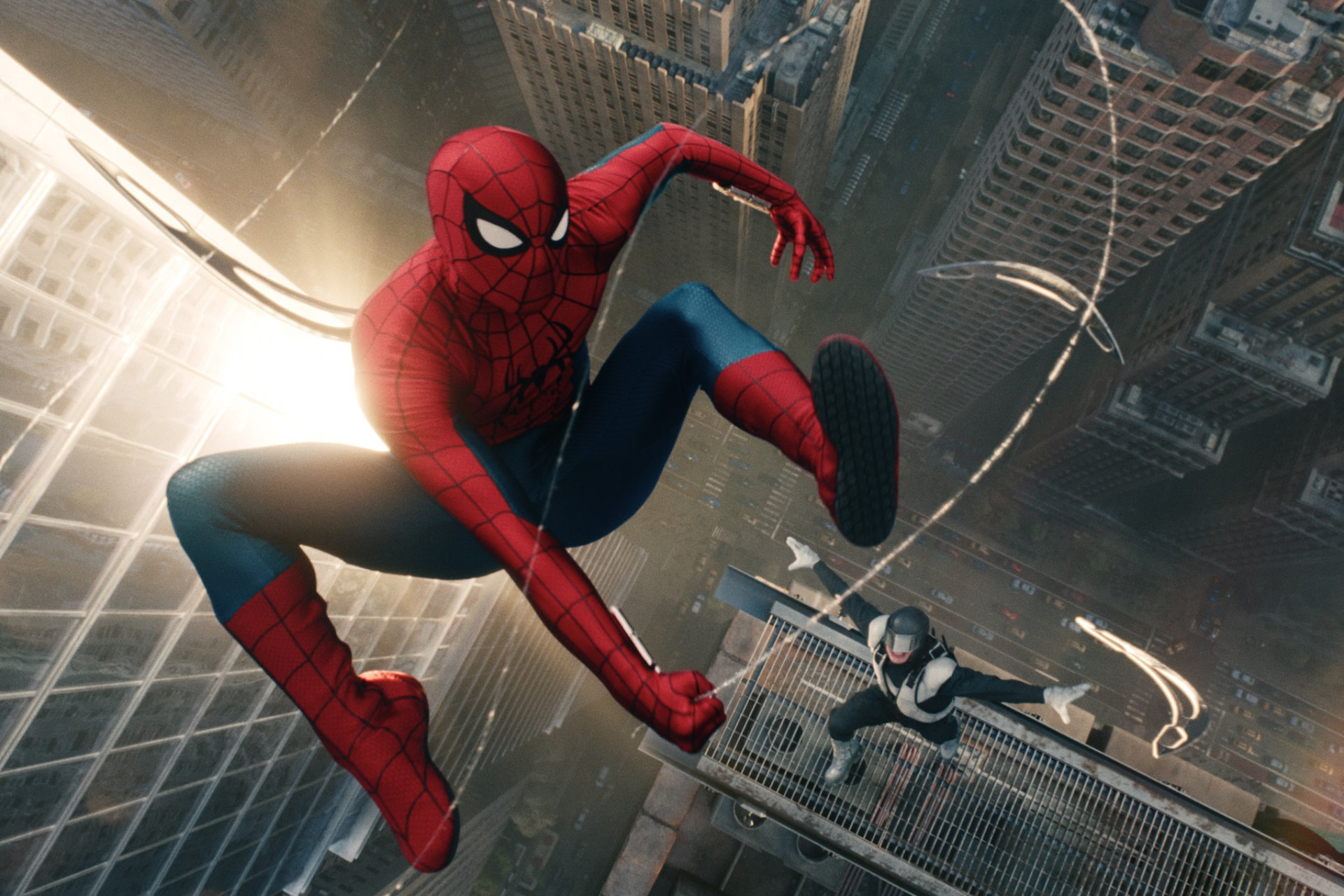
If the last decade’s proven anything, it’s that people fucking love them some Spider-Man. They like it when there’s one Spider-Man, they love it when there’s three Spider-Men, and they go gaga when there’s a straight million of them running about in the best studio animation franchise of the decade. This comes despite all of the nerd complaints about the live-action series: Spider-Man’s more of a Spider-Kid, he has too much help from “mentors,” his dialogue’s cringe, and so on and so forth. Those complaints are mostly right on the money, but they’re easy to forget when you’re watching Tom Holland swing and zing, tossing barbs like he slings web fluid.
This is the last remnant of the MCU’s greatest asset – the near-supernatural ability to cast their roles perfectly – and its lead and core ensemble remain compelling as ever in Deston Daniel Cretton’s Spider-Man: Brand New Day. It’s a typical outing for the wall-crawler in the modern era, being an often-fun Spidey movie brought down by truly dogwater integration into the wider world of Marvel upcoming releases. It’s both better and worse than Jon Watts’ No Way Home in parallel – MCU Spider-Man has never looked or resonated as well, and yet it’s burdened with kicking off a new “Phase” that looks, somehow, more atrocious than how they pulled in the Multiverse.
I genuinely don’t know how much I can write about Brand New Day’s story*, because everything past the first 15 minutes feels like a gigantic spoiler, so I’ll do my best to summarize those early moments. It is a very, very bad time to be Peter Parker (Tom Holland), befitting the new status quo established at the end of No Way Home. In order to save the universe, he had to sacrifice his identity – no one remembers that he’s Spider-Man anymore, but then again, no one remembers who the hell Peter Parker is anyway. He’s almost totally alone, devoting himself to crimefighting, watching as his friends live out their dreams at MIT, desperately missing MJ (Zendaya) and Ned (the drip God known as Jacob Batalan, CEO of Sex).
Years pass. He’s almost singlehandedly responsible for cleaning up the NYC streets and is beloved by New Yorkers of all stripes, and yet that gaping hole in his heart remains. His buds have graduated from college and are back in the city, and he wants nothing more than to reach out and be close to them once again. Unfortunately, he’ll get that chance when a new mystery villain appears on the scene, who threatens his fully innocent former friends. Times are tough, and the “Parker luck” continues to torment him, no matter how sweet Holland is.
Even with the dramatic success of No Way Home — earning a billion dollars during the Omicron wave — it feels like Cretton is trying to correct the course. The Watts films progressively retreated into green-screened soundstages for their environments, culminating in the unfortunately necessary soullessness of the third film’s empty cityscapes, and I don’t think I’ve ever been as happy to see a Vancouver street substitute for Queens. Even with desaturated color-grading, the setting still feels more vibrant and alive, and New York once again feels like as much of a part of the ensemble as Zendaya or Holland. Crowded parties, streets filled with imperiled extras, bodegas, trash-strewn alleyways, and bit players with pitch-perfect reaction shots — all you need is Spidey stopping a finance exec from stealing a Knicks trash can, and I’d call it a sterling facsimile.
Likewise, the cast feels more alive, as Cretton’s much more experienced with complicated emotional landscapes. He makes you feel Peter’s loneliness in a very acute way, occasionally to the movie’s detriment in just how thoroughly of a bummer it is. Yet this emphasizes the ensemble’s chemistry, which is what really differentiates the Holland films from other superhero works, and makes us pine for its presence.
Honed by his time on Shang-Chi, the action is thoroughly competent if ever-so-slightly derivative. This speaks to that course-correction quality: Sony and Marvel have seen how successful the Insomniac video games have been, and so the fights occasionally feel like they should have Spidey-Sense dodge indicators hovering over baddies’ heads and a health bar in the bottom right corner. It’s more obvious in the all-CGI sequences, like the one in which Spidey faces off against a rampaging Hulk, but even then, Brand New Day remains a stroke or two under the MCU’s modern-day par because of its energy. A wuxia-inspired showdown between the hero and the Hand, a Ninja clan from Daredevil turned good guys turned back to bad guys, is probably the highlight, with the wall-crawler slotting seamlessly into the usual wall-gliding ballet of sword and skill.
But instead of establishing a wholly new visual identity as one might think a sequence like that would imply, Cretton leans on his predecessors for style pointers even outside of the action. There are lots of allusions and quotations — the first-person web-slinging and a fall-from-a-rooftop lifted from the Webb films, the “how do I shot web?” comedy and shot after shot taken from the Raimi playbook — and it feels like Cretton wants to use the fresh start given to him by Brand New Day to consolidate the implications of No Way Home outside of the story itself.
Alas, the director is still serving at the whims of Kevin Feige, and with that comes the obligation to pump up future MCU installments. Some of those present from the wider universe are well-used: Jon Bernthal’s Punisher hasn’t been this interesting or charismatic since his first streaming outing, and his character forms a swell bond with Holland’s, which culminates in one of the film’s strongest scenes. Mark Ruffalo is usually a delight in these pictures, and he slots nicely into the “damned mentor” role, like Alfred Molina in the Raimi movies or Rhys Ifans in the Webb ones. But the cameos get rougher from there — one is a bizarre faux-comic intrusion which gives the film its first outright belly-flop, and the other is so spoiler-heavy that I can’t even really refer to it without getting in trouble.
What I will say is that it may be the most baffling** attempt to establish a known name that I’ve seen outside of a Zack Snyder feature, though without the amusing gall of Snyder’s disregard for anything other than his own conceptualization of “badassery.” It ensures that there’s no heroic triumph at the end of Spidey’s struggle with this unknown villain, and portrays that new character in such an unappealing light that it’s hard to imagine being delighted at seeing them in a future installment.
Barring that, I think the haters get it half-right. The problem with these Spider-Man movies isn’t that Peter Parker’s a kid and has to spend each one of these movies growing up — Holland and the other core cast make this work so well as popcorn melodrama that it’s understandable that audiences would eat it up and ask for seconds and thirds and fourths. What makes this series worse than its predecessors is that, outside of Homecoming, they’re backdoor pilots with a dogshit batting average. Far From Home tried and failed to set up Secret Invasion (though you could still ignore it, for the most part), No Way Home brought the “Multiverse Saga” kicking and screaming into existence, and now Brand New Day does the same for a new era of Marvel projects.
There’s a simple reason for this: The Spider-Man movies are the only reliable box-office bets for modern Marvel, and there’s no other venue to gin up broad excitement anymore, especially for the kind of payoff they’re hoping to get. It’s a shame, honestly, because this is one burden Peter Parker shouldn’t have to shoulder, “Parker luck” be damned.
* It doesn’t involve Peter putting his life together after dissolving his marriage to save his aunt’s life, and more closely resembles Brian Bendis’ Ultimate Spider-Man in practice. This is good, because Marvel editorial has still never quite figured out what the fuck to do with mainline Spider-Man comics after the Bronze Age. At least Paul doesn’t show up.
** Yes, bold text — italics alone just aren’t strong enough.