
Editor’s Note: Vanyaland film editor Nick Johnston has left the country, posting up this week in the Great White North to cover the 51st Toronto International Film Festival. As usual, and perhaps now more than ever, we wish we were up there with him! Check out our continuing 2026 coverage, get rolling with our official curtain-raiser, and revisit the complete Vanyaland coverage archives from past TIFF editions.
While watching Ink, one question came to mind and never really left: Why has it taken this long for Danny Boyle to make a film for Netflix? It’s not like he’s a total stranger to streaming — one could theoretically watch his ill-advised and ill-fated Sex Pistols show through a number of services, though not the one that it premiered on — but Boyle’s loud, hyperactive style feels complementary to how one watches Netflix. A loud IDLES cue or a whip-bang montage will rouse you from household stupors, folding laundry or watching pots boil or doomscrolling, and make you focus on enough of the film to consider it “watched.” And it goes down easy enough, interpreting the rags-to-riches story of the UK Sun tabloid as an Animal House slobs-and-snobs battle, full of laughs and energy, instead of a political jeremiad about the sins of Rupert Murdoch. The problem is that Boyle gets lost in the sauce, empathizing too much with his characters as abstract ideals rather than very real people: The fully fictional version of this movie would likely be just as slight, but it wouldn’t feel cowardly.
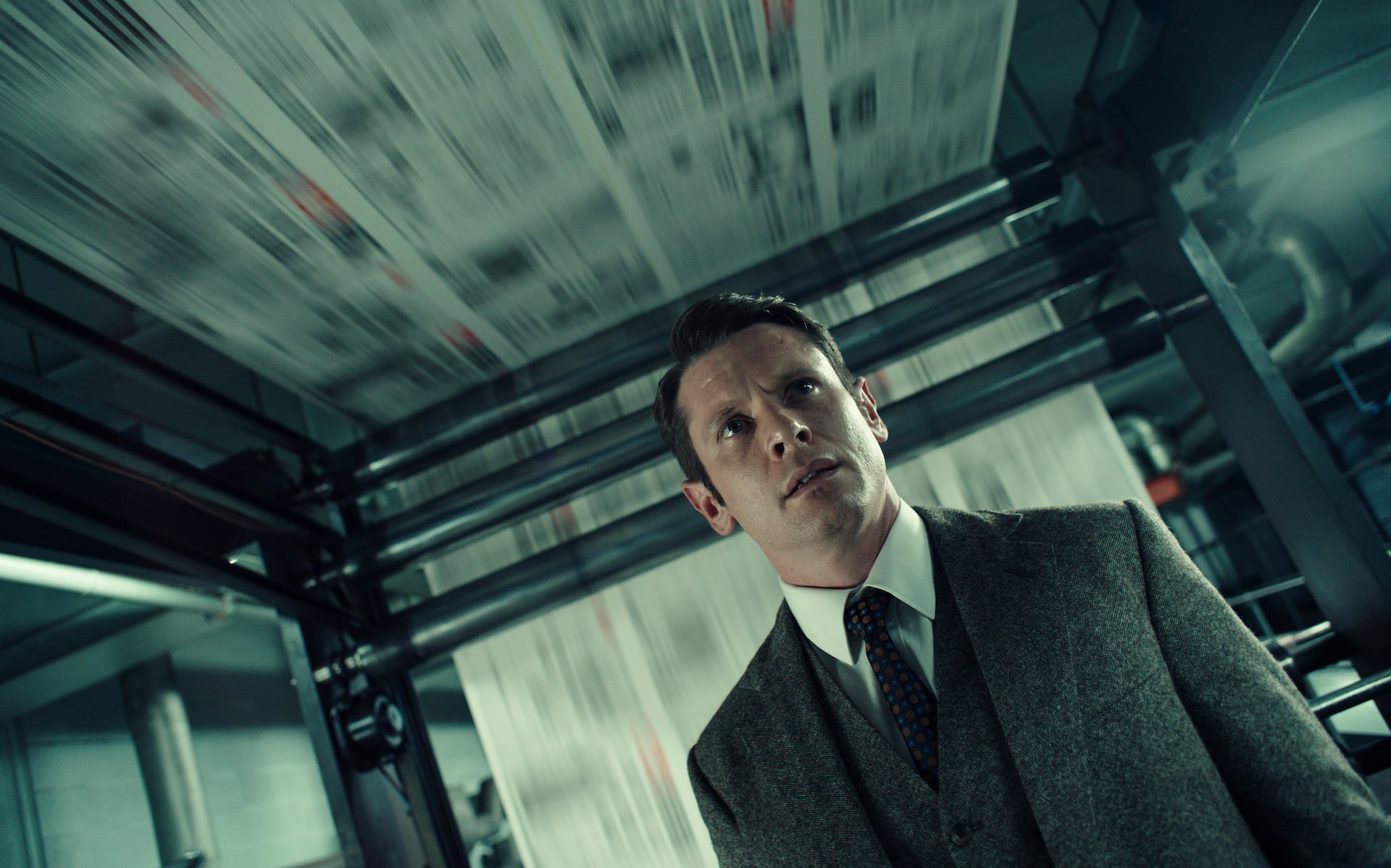
Unlike, say, The Social Network, Ink wants you to understand that the Sun newsroom was well-sloshed, well-shagged, and soon-to-be widely-read when editor Larry Lamb (Jack O’Connell) came on in ’69. Once an editor for the Mirror, Lamb’s got a chip on his shoulder, excluded from the old money media boys’ club, laughed at by his former boss, and, in Boyle’s words, an “underdog.” The new boss ain’t the same as the old boss, though. If Lamb’s got a chip, Rupert Murdoch (Guy Pearce) has a boulder. He’s got even more to prove, being an Aussie in a Brit’s world, looking to one-up his now-departed old man in the family trade: Media. Already the king of the Foster’sland, he was also held back by old money, and the Sun was his first chance to own a six-day-a-week rag within Albion (he already had The News of the World by that point). The two men hash out their ideas at dinner and discover their ideologies fit like puzzle pieces. Murdoch doesn’t really care what Lamb does, as long as the editor moves enough copies to dethrone the Mirror from its long-held rank atop the sales charts. In fact, the Aussie kind of likes taking the old sods down a peg or two in the process, even if it means some content in the pages might go against his personal moral standards.
So begins Lamb’s tenure at the Sun, widely laughed at and mocked by those at the other rags, with a staff made up from what dregs he could poach from other newsrooms using Murdoch’s checkbook. It’s these scenes that give Ink much of its value as mere entertainment, with it being pleasurable enough watching O’Connell recruit a variety of alcoholics, fops, obsessives, perverts, and other types not meant for high tea. You know, writers, editors, layout designers, and so on and so forth – the kind of folk who make the whole business of news worth it in the first place, because the pay ain’t great. Playwright James Graham, adapting his own work from the stage to the screen, does a good job expanding the two-man cast that performed for West End audiences into a large ensemble, and the dialogue has a rapid-fire quality that’s expertly performed in rhythm with Boyle’s manic energy.
Of the staff, the most important is Jules Davies (Claire Foy), a fictional composite character who serves as Women’s Page editor and Lamb’s mistress, as her suggestion that the paper mirrors television in how it appeals to the masses gives Lamb a modus operandi. Giveaways, sport, sex, crime, and all the other things that sell, paired with advertising that makes the Sun can’t-miss loo reading material. They’re heavy on the puns and take a populist bent, even siding with striking Father Christmases and feeding quotes to kids for a good Christmas front page. But, alas, all good things come with a fair amount of moral compromise, and Lamb finds himself heading in a dark direction. That’s when Boyle also finds himself up shit creek without a paddle, as he’s made the first section of the film so entertaining and madcap that he can’t pull off the transition to seriousness. Nor can he really condemn his characters for their bad behavior, at least until Lamb gets an idea for what to do with Page 6. This, of course, comes after he’s botched reporting on the kidnapping of a close Murdoch family friend, who ultimately meets a tragic end. Yet the nudity was the real point of no return, the sign of Lamb being fully in control while Murdoch – a man who can quote Byron before dismissing it as “pretentious claptrap” – suffered indignity after indignity on the way to the top.
Again, it feels like Boyle got too close to his characters to hold them in any sort of contempt, regarding them more as tragic figures who may have put us on the path to ruin but had a great time doing so. They were the original media rebels, a UK lineage that Boyle no doubt sees himself as part of, breaking the class ceiling and broadening what was acceptable for prole and elite alike. It’s why his pasted-on montage of moments from modern history interspersed with redacted Sun front pages, blurred Fox News clips, and other emblems of the NewsCorp empire feels so dishonest – we’re not made to hate the Union men walking off the job when they refuse to participate in one of Lamb’s schemes, as Boyle’s too busy breaking out the crescent camera rig to do cool shots of O’Connell preparing the type for the front page himself. They’re part of the old guard, slowing things down, ripe and ready to be fired by a man with the will to innovate and break the strictures holding him back from realizing his ambitions. I’m sure he knows this frustration well, though he likely wouldn’t admit it. Really, he just wants us to think it all looks cool, and wants to impress us with whatever’s in the toolbox.
That everything-and-the-kitchen-sink ethos informs Boyle’s use of AI here, and puts a giant asterisk next to any discussion of whether this film actually looks any good (and, as it’s Alwin Kucher lensing, it often does!). It’s just such a boneheaded move, as none of the shots are necessary or interesting or incapable of being realized without using the very technologies whose mindset – “move fast and break things” – he aims to critique. I left before his Q&A started, after the credits rolled, so I missed him giving the finger to someone in the crowd at the Princess of Wales Theater who protested his prevaricating response to a question about AI, but I imagine he expected this entire issue to just buzz by him. In fact, I think he made a film so thematically bland in Ink that he should probably be happy there’s any sort of controversy at all surrounding its release. Otherwise, I imagine it’d have gotten the few plaudits from the festival circuit and vanished from view well before it disappeared into the Netflix catalog, occasionally recommended to those few who would likely just watch another season of Is It Cake? Instead of slogging it out in the name of prestige cinema. But, hey, at least Boyle tokenmaxxed while humanizing Rupert Murdoch!