
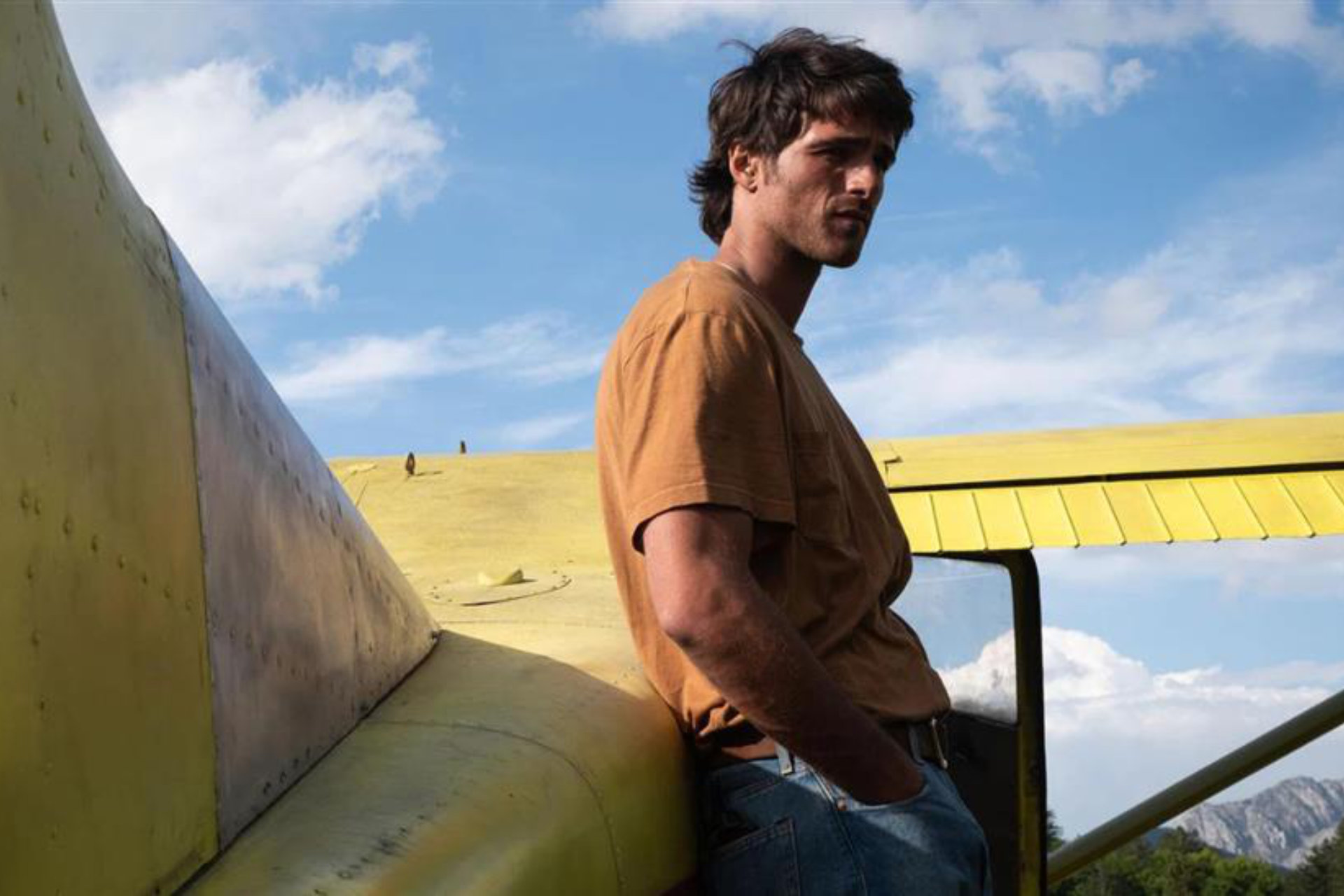
Say what you will about Sir Ridley Scott, but the man is a master at crafting evocative, immersive screen dystopias. He’s so good at it, in fact, that some of the audience will misread the text and go about trying to make them manifest. Pray that no one will do that with The Dog Stars, his adaptation of Peter Heller’s post-apocalyptic novel, because, odds are, you likely won’t be one of the lucky ones shacking up in a Colorado airport like our protagonists here, enjoying the comforts of rustic living and the occasional slaughter of roving gangs. You’ll probably be one of the billions dead from the superflu that wiped out modern civilization or dinner for a bunch of cannibals hopped up on the golden age of aviation.* Yet I don’t think you have to worry about anyone getting particularly inspired by this (one would have to watch it first), and Scott is ill-suited for its realization — “dystopia,” after all, implies society, and Scott comes up with little new with its absence. Saddled with a poor script by Mark L. Smith that is, for what’s worth, well-performed by a strong cast, it’s a terrible adaptation of Heller’s novel and a chore to sit through, filmed with a listlessness that I thought Scott had shaken off after Exodus.
The adaptation largely follows the book’s structure, with a few net-negative additions at pivotal points. Scott opens with a mostly wordless prologue following Tig (Jacob Elordi), once a mechanic and a family man before the flu hit, going on a supply run from his home base in Erie to Denver. He lives out there with his dog Jasper and the ex-Marine Bagley (Josh Brolin) in an abandoned airport and makes sojourns through the Rockies in a patched-together Cessna. Despite Bagley being a bit of a psychopath due to all of that trauma, it’s not a horrible life. They have power, clean water, and, for whatever reason, loads of label-out Coca-Cola products taken from the gas stations he pilfers for fuel in Denver. He even shares the Gospel of Sprite with a Mennonite farmer (Benedict Wong) and his brood. But he can’t let go of a central hope to enjoy this relative idyll — that somewhere, out there, there might be a facsimile of civilization, where the violence and bleakness of day-to-day life might once again be obscured by community.
As it so happens, it seems there are signs of something in Grand Junction. Hig’s cockpit radio crackles to tantalizing life and, though the message is garbled, it’s enough to give him hope, though not enough to test the limits of the Cessna’s safe-return distance, especially when he’s got Jasper as a tether to Erie. But when that tether is severed — in an alteration from the source so frustratingly boring that it’s a wonder they didn’t just skip the plot point to begin with — he decides he’ll make his way out there. If he makes it and likes it, great. If he doesn’t, well, there was this nice mountain he and his dearly departed wife loved, and he’ll leave his mark by crashing the plane into one of its faces. Thank god for mechanical failures, then. A few hours into his journey, he blows a fuel line and crash-lands into a valley inhabited by former nurse Cima (Margaret Qualley) and her veteran father, Pops (Guy Pearce). After the usual standoff and suspicion, the three form a working partnership to get him back in the air, and Cima, herself a widow, starts to fall for Hig. But this isn’t exactly fertile ground for a blossoming romance, and they’ll have to fight all of Colorado’s misfits and weirdos to find a path forward.
Despite swell work from the cast (in particular, Brolin, whose sardonic coping mechanisms are practically the lone spot of authenticity), Smith’s script is rough. He transforms Heller’s slow meditation on grief into the kind of survivalist fairy tale that makes weekend warrior campers who have never known life without indoor plumbing think that they’d have an absolute blast scavenging for food in desiccated downtown Denver. Unlike Brian Aldiss, I don’t think the “cozy catastrophe” is entirely meritless as a subgenre — indeed, I actually quite like Day of the Triffids — but there has to be something more to it. Of all the bastards birthed by Cormac McCarthy’s The Road, Heller’s was unique because of its deep wellspring of sadness, presented to us from a close psychic vantage, and how it transmuted dolor’s metaphorical emptiness into a literal landscape. There’s too much “fun” here for the feeling to be properly enveloping, and Scott finds himself trapped in an impasse between the novel’s tone and Smith’s attempt to broaden the story for multiplex audiences.
Sir Ridley has always thrived on maximalist settings and tones — he did, after all, craft the perfect sci-fi mood piece in Blade Runner — and the absence and stillness inherent in the wild is a bad fit for his style. His most recent run of successful features (The Last Duel, House of Gucci, Napoleon, and, to an extent, Gladiator II) were aggressively over-the-top, and worked wonderfully for that reason. Here, he can only muster similar enthusiasm at two points — a nighttime raid on the Erie airport, where Brolin massacres what looks like an invading force of Die Antwoord video extras in night vision, and the encounter with the aforementioned Pan-Am cannibals, which is so out of place in the established world of the film (and an unwelcome addition to Heller’s plot) that it feels like it was added in reshoots to “spice things up.” Erik Messerschmit’s lifeless digital photography (a drastic downgrade from his similarly-spartan work with David Fincher) doesn’t enhance this world’s decayed beauty, nor does Harry Gregson-Williams’ sleepy score.
But what made Scott’s work this decade so memorable was its sharpened edge, used to shred and refashion his image as a blockbuster filmmaker. The Dog Stars, as it were, feels like a last attempt to play it straight for posterity, coddling instead of confrontational. To be fair, though, it’s astounding that Scott, at 88, is still directing films with eight-or-nine-figure budgets, and I don’t think I’ll ever quite be able to stop rooting for the guy, should he decide to keep on keeping on and direct pictures as a nonagenarian. But whatever gentle point about the virtues of togetherness in tough times he hopes to impart is too anodyne to have an impact. Here’s to the next one.
* Yes, this is in the movie.