
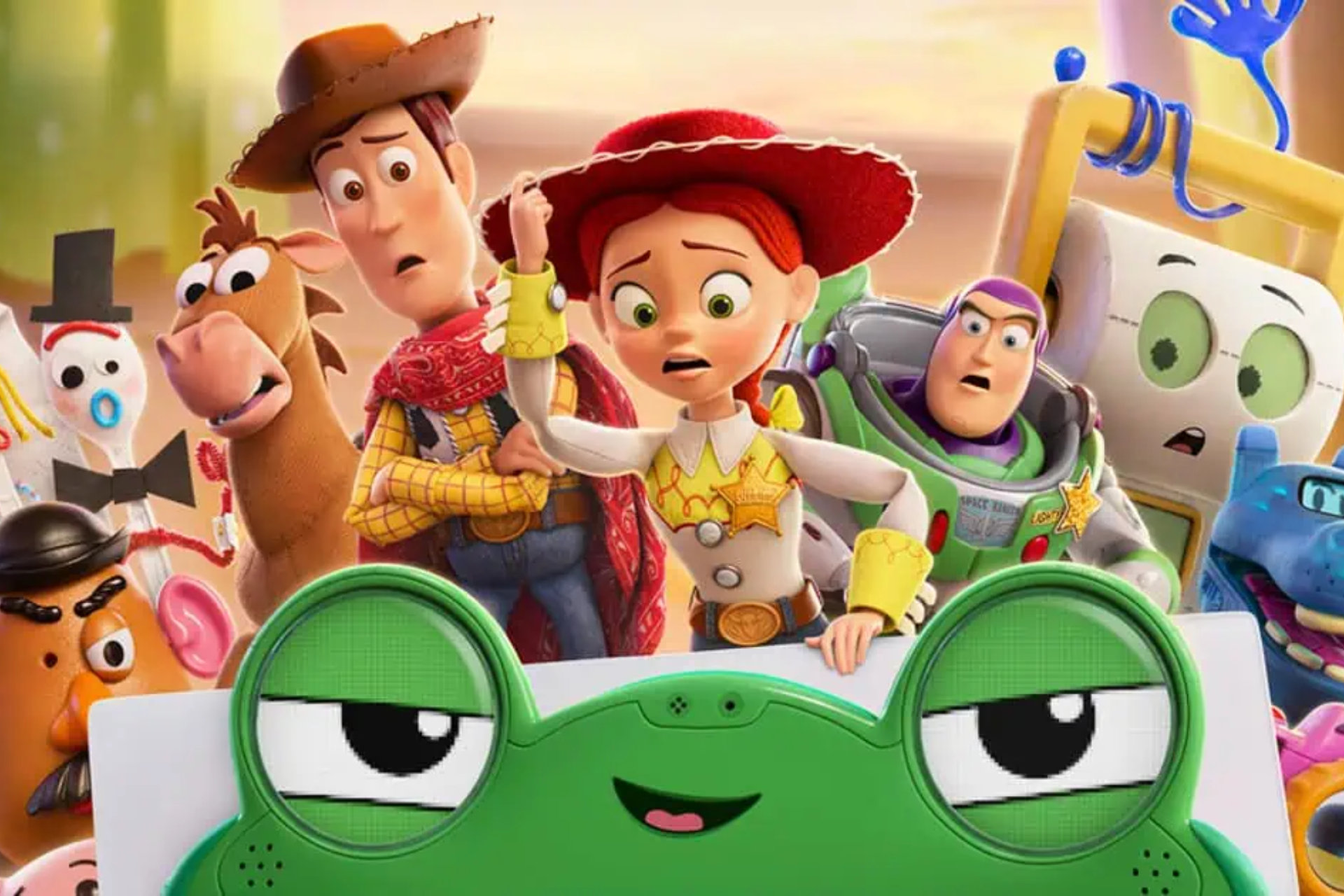
In retrospect, Forky might have been a mistake. Sure, Tony Hale’s utensil-turned-plaything might have been the best part of Toy Story 4, a funny existentialist bit (with a dash of Ligotti-esque nihilism about the curse of consciousness tossed in there as well) in a movie frequently bereft of amusement, but it opened the floodgates for Pixar to pursue this train of thought in further sequels. Andrew Stanton’s Toy Story 5 sees the studio declare a tablet — and a child GPS monitor and a digital camera and a potty-training device — a “toy.” This could be an interesting premise in the hands of someone willing to get into the nitty-gritty of the way screen-based play and one’s attachment to these devices differ from the physical and creative acts that this franchise has traditionally celebrated, but Stanton and company aren’t quite interested in all that. What they wind up with is a half-hearted message about how “tech is good when used right,” and that cyberbullying sucks, which, sure, both messages are valid enough. However, they aren’t good enough as the basis for another Toy Story feature,* and I think Stanton and company know that.
Of all the sequels, Toy Story 5 feels the most like an attempt to reboot the series, in that it rehashes the central conflict of the first installment for a new generation. The toys, represented by Sheriff Jessie (Joan Cusack), have to face down the apocalyptic threat known as a Lilypad or “Lily” (Greta Lee), happy to hypnotize the toys’ owner, Bonnie, and micromanage her life in an attempt to maximize her chances at happiness. She knows she’s a “toy,” but she acts like a God. See, Bonnie’s one of the few kids who still play with toys, and, because she has trouble making friends, her parents decide that the answer is to plunge their daughter straight into the world of digital alienation. Jessie thinks this is a bad idea, because a) it is, and b) she has a personal hatred of machines. She’s witnessed what happens when new-fangled technology comes around and ruins a perfectly good situation — her first owner got too old and started talking on phones and listening to records, and before you know it, she was headed straight to the junk shop — and so she schemes to foil Lily’s plans. Woody (Tom Hanks) and Buzz (Tim Allen) are mostly there to do clean-up work when things get screwy.
This is another issue — the ensemble is simply too big. Pixar did a good job of retaining the core group of toys, but Toy Story 4 added so much dead weight that now we barely get any lines from mainstays like Rex or Hamm. Worse, they need more, and given the last time one of these characters was given a permanent end, they wound up being incredibly popular overseas**. They mostly come in during act two, when, after trying to tag along to a sleepover with some of the “friends” Lily has cooked up for Bonnie, Jessie, and her horse Bullseye, winds up back at her first owner’s house. It’s now inhabited by a young girl much like the one Jessie knew decades ago — imaginative, fun, smart, silly, playful. In short, she’s a perfect friend for Bonnie. Problem is, she’s got no good way to get back to her house, so she’ll have to get along with the help of Smarty Pants (Conan O’Brien), a potty-training device, and a few other denizens from The Drawer of Misfit E-Waste. That is, if Lily hasn’t manipulated her way into getting the rest of the toys packed up and tossed into the garage. Oh, and there’s an army of newfangled Buzzes on the loose, after a shipping container full of them was lost at sea. Maybe they’ll play a part, huh? Perhaps they’ll be a fusion of the best of the old and the new, deployed at the right moment? Hmm.
The problem is that Jessie’s right — the technology is a harbinger of bitter, sad days to come — and the world that Lily wants to make for Bonnie is brutally depressing. Based on the way that Stanton lingers over the hypnotized faces of Bonnie’s neighbors aglow in the blue light from their devices, you’d think there’d be a stronger suggestion that this is, you know, corrosive to a community and to one’s soul. Equivocating imaginative play — a single and multiplayer activity — with screen-based passive consumption (the games shown here aren’t Minecraft, they’re stuff Zynga wishes they’d made) is a poor argument, but it’s the one that, ultimately, Stanton settles on. Tech is a good tool, and that’s what matters most. The problem is that toys aren’t tools. They’re toys, made with the expressed purpose of purposelessness. They provide little pre-installed edification or enrichment, and that’s kind of the point. That’s why O’Brien’s ilk are shoved in desk drawers, and Blaze’s horses remain proudly displayed — there’s no purpose for them to outlive. This is to say nothing of Stanton’s pivot to the tried-and-true cyberbullying subplot, which is about as safe a statement one can make and one that feels like a distraction from the fact that it isn’t how the tech is used that makes it toxic. It’s what it replaces.
Based on In the Blink of an Eye, his Cloud Atlas-via-TEDx flop that was unceremoniously dumped on Hulu a few months ago, Stanton’s one of the filmmakers in the Pixar stable who probably shouldn’t have been trusted with making this argument. But, at the same time, one shouldn’t be surprised Pixar would choose him, given his status as one of the few old heads still at the company, who directed one of the last true-blue classics they made before things went to hell. His direction is solid enough, even if the results are mostly uninspiring. You can tell exactly whichaspects interest him — the army of Bluetooth Buzzes, the imagined flights of costume-drama fantasy, a setpiece involving a bunch of silly horse toys — and those that don’t, which are mostly hoary attempts to tug on the heartstrings, answering questions that nobody gave a damn about in the first place. Everything we really needed to know about Jessie was told to us in heartbreaking fashion back in Toy Story 2, but no stone can be left unturned.
With the possible exception of the fourth, the Toy Story movies are anxious films, all about coming to terms with change, and it’s easy to forget that the first film can be read as a meta-parable about animation at the dawn of the computer age. It is, like its protagonists, a hybrid of old and new — traditional animation expertise paired with cutting-edge technology, saying that, though the method and style might change, the ethos won’t. Of course, that masked a wholesale shift towards CG and the elimination of countless jobs, but Pixar at least felt ambivalent enough about the situation to have their stand-in be deluded into thinking he’s somehow unique, only to be literally brought to Earth. This time, they’re the old guard, fighting to hold ground against a wave of boundless, personalized yet impersonal entertainment — of course, they’re getting into traditional animation with Gatto, to some extent. The artisanal means more in an age of slop, the flaws a mark of authenticity. Yet is it any wonder that they’d take the side of tech, being sprung from the cleaved head of Steve Jobs like a digital Athena? They’re the half-brother of the iPhone and, no matter how much they wish they could say otherwise, they are their brother’s keeper.
* Every day we stray further from the light of Toy Story 3, the kind of ending most creators dream their multi-installment series would receive.
** That would be Lotso Huggin’ Bear, bizarrely.