
Friends don’t let friends let their names be put as a possessive in front of a title, especially when that title is shared with one of the Universal Monsters classics. Someone should have mentioned to Lee Cronin — one of the shining lights of the Irish horror scene, who transitioned from making solid “elevated” horror (The Hole in the Ground) to hardcore splatterpunk (the fabulous Evil Dead Rise) with aplomb — that it wasn’t an honorific. This choice seems to be a combination of two similar impulses, being both a way to distinguish it from whatever mainline Mummy feature Universal’s cooking up without Blumhouse, and a contingency plan for easy scapegoating should it go tits up like Leigh Whannell’s Wolf Man.
The good news for Blumhouse and Atomic Monster is that they accomplished the first and don’t need to do the second, at least in terms of quality (they might when the box office receipts come out). Lee Cronin’s The Mummy is miles better than most garbage horror remakes thanks to how Cronin reinvents the familiar facets of this legend and because of how thunderously, brutally ugly the film gets in its back end, though Cronin tempers his nightmares with a fair amount of comedy. The problem is that there’s simply not enough of him in it — a bizarre problem to have when his name’s before the title.
This is self-evident almost as soon as one sees the runtime: 133 minutes. That’s nearly double the length of Karl Freund’s Karloff-led classic from ’32; nine minutes longer than Stephen Sommers’ hit from ’99; and 23 minutes longer than Alex Kurtzman’s aborted attempt to kick-start the Dark Universe with Tom Cruise nine years ago. Much of this bloat comes in the first hour, a largely scare-free introduction to our protagonists and their circumstances. Instead of globetrotting archeologists or resurrected Mavericks, they’re an average American family, living in Cairo, where the dad, Charlie (Jack Reynor), works for a cable news journalist. Mom Larissa (Laia Costa) is a nurse, which will become relevant later, and their two kids, Katie and Sebastian, are pleasant, as most children in movies are. But, unknown to the rest of her family, Katie’s being groomed by a friend’s mother (Hayat Camille) for a devilish purpose. One afternoon, right when Charlie finds out he’s gotten a big promotion, Katie disappears. Flash-forward eight years: the family’s now living in New Mexico, and her memory haunts the house. It’s even clear to the newest member of the clan, Maud, their second daughter, who never knew her sister: Something important has been lost.
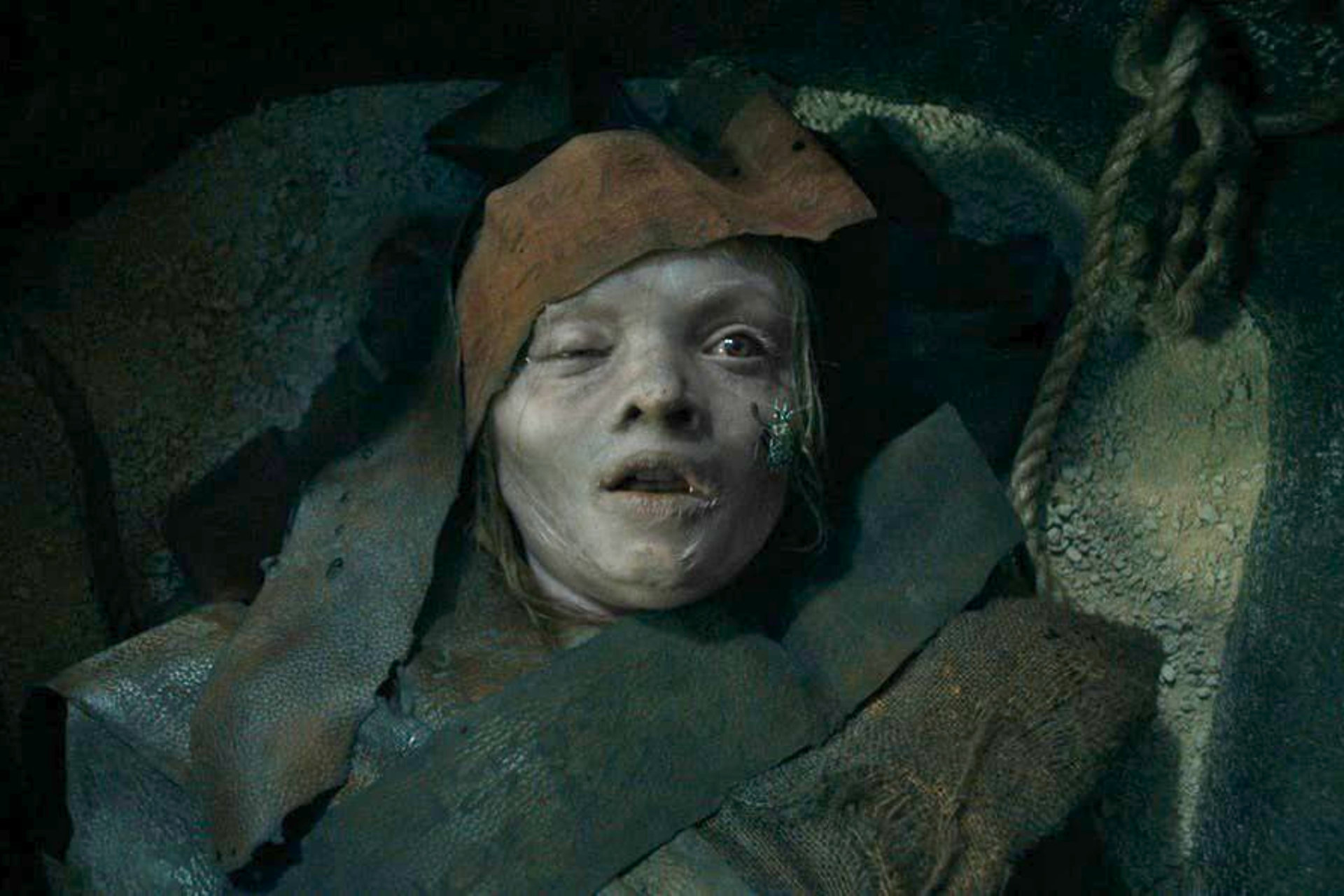
Well, after a plane crashes dozens of miles away from Cairo, near an “oasis” strewn with nectarine trees, that something is found inside a sarcophagus, wrapped in strips of inscription-covered leather, white as a sheet, covered in sores — but alive. Astonishingly, Katie (Natalie Grace) survived her ordeal, though she bears the scars of unimaginable torture. Her skin is paper-thin and easy to break; her nails are long, sharp, and jagged; and she’s prone to explosive outbursts, triggered by God knows what. For whatever reason (and I’m willing to bet that it’s metaphysical manipulation), an Egyptian doctor recommends that Charlie and Larissa take her home almost as soon as they get off the flight from Albuquerque. This is a bad idea, but at least it’s rooted in character detail – Larissa thinks she can handle her kid’s rehab, after all, and Charlie doesn’t want to intrude, knowing how she secretly blames him for the kidnapping – and they take her back, ready to reintroduce her to the family.
Meanwhile, Dalia Zaki (May Calamway), a Cairo detective whom Charlie doesn’t trust (eight years ago, her partner suggested that the dads are usually the perps without realizing that the American understood Arabic), realizes how weird all of this is, and begins to investigate what exactly happened to the young girl out in the Oasis. She and Charlie put aside their differences to work together in a Transatlantic partnership, and as the investigation progresses, conditions in the family home steadily deteriorate. Yet a force beyond their imaginations is at play inside Katie’s husk, and it’s biding its time, waiting to cause… problems on purpose.
Again, none of this is particularly novel – it’s a rather rote possession tale written in Cuneiform instead of Latin, though the transition is stronger than Whannell’s attempts to turn Wolf Man into Brundlefly – but a very clever twist on the mummy’s “wraps,” presented in a truly stomach-churning way, acts as an alarm clock for sleepy audience members. This is when Cronin starts to shift into overdrive, plunging into the depths of this family unit’s fractured psyches for pungent details. Maud’s fascination with losing her baby teeth? The brother’s guilt over his last interaction with his sister, in which he threw her favorite doll off a roof to see if a homemade parachute worked? Grandma’s beloved crucifix and constant prayers? All of these details – and more are taken and warped into macabre, gross setpieces that are, honestly, pretty funny (and intentionally so) when they’re not actively causing one to gag. One of the kills is punctuated by a cruel detail so out-of-pocket that it’s impossible not to laugh at, and this is exactly what Cronin did more economically in Evil Dead Rise to great effect.
Yet it really is that first hour, with its creeping pace and uninvolving mystery, that acts as dead weight, even though it isn’t without its charms – Reynor and Costa are believable empathetic leads, the kids are great, and there are a few genuinely cool moments (such as the plane crash, unfolding in the background as a young Egyptian teen tries to fix his bike chain). Sustaining one’s interest until those rewarding kinetic sequences unfold shouldn’t be as laborious as it is here, which is why it feels so strange, as if Cronin were doing something that suggested it were Blumhouse’s The Mummy instead of his own. His interest sags, much like ours, when there’s not an assortment of bodily fluids pouring onto the floor or torn bits of tattooed skin rippling through the air.
I think, were this actually Lee Cronin’s The Mummy (Now With Less Interference From Producers), you’d have a taught, bleak-as-fuck 90 minutes of unimaginably gory, goofy horror. Instead, those terrors are kept under suffocating wraps, and it’ll likely be entombed in the Blumhouse vault once we get a Scorpion King with modern CGI come 2028. At that point, you’ll only be able to smell what The Rock’s The Mummy is cooking, rather than the embalming fluid and rotted flesh that Cronin wishes he could give you in Smell-O-Vision.