
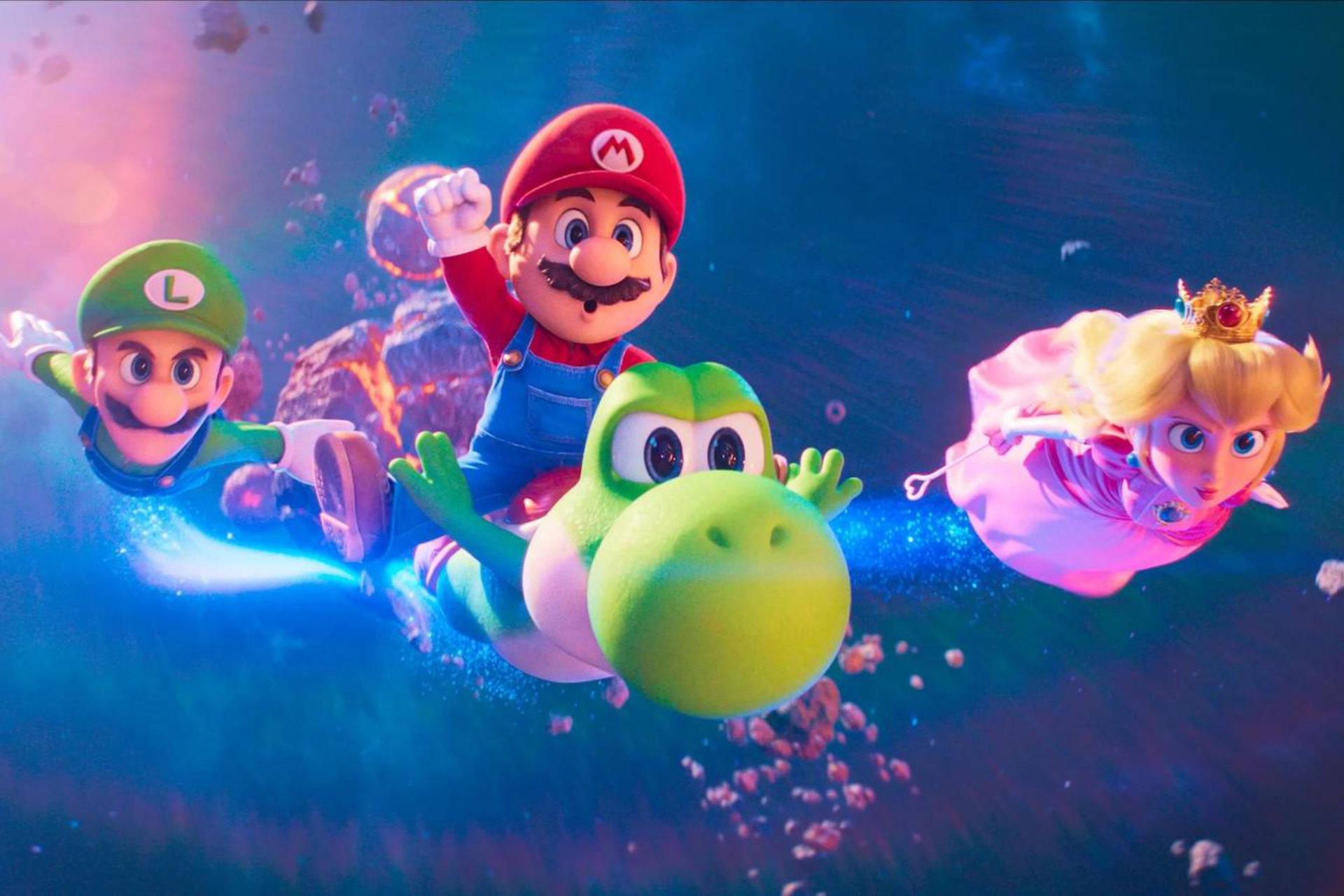
I’ll keep this (relatively) brief: Aaron Horvath and Michael Jelenic’s The Super Mario Galaxy Movie is slightly better than the last one for two reasons. First, it keeps the “origin story” horseshit cordoned off to an unsatisfying yet mercifully brief subplot involving Princess Peach (Anya Taylor-Joy) trying to figure out where she came from; second, it gives us a tantalizing glimpse as to what a good modern Nintendo cartoon might look like in a 30-second showcase of a Star Fox anime that isn’t just cel-shaded bullshit plugging a Wii U game. Yeah, they roped Fox McCloud (Glen Powell) into this “galactic adventure,” and blew the surprise once they realized Project Hail Mary was holding steady at the box office. You can’t really fix what’s broken with this franchise’s ethos – that anybody would prefer to see a narrative-heavy Mario Galaxy movie instead of playing one of the two delightful games it’s based on should have been a total non-starter – but it’s not really like the kids will mind, after all. What enjoyment remains comes in the form of a secondhand contact high from the young ones’ excitement at seeing Yoshi (Donald Glover) on the big screen.
Given how heavily Nintendo protects its IP, it’s no wonder that the company chose Minion maestros Illumination Entertainment to help nerds forget about Bob Hoskins and Dennis Hopper, and all involved were rewarded handsomely three years ago for their efforts. What they lack – adaptational creativity – is exactly what the former playing-card company wants: inoffensive family fare with enough color and slapstick humor that points people towards the Switch 2 (better get it before tariffs make it even more expensive, and don’t count on a Black Friday sale to ever bring those prices down). They’re able to preserve the look and style of the Mario games in their 3D era without risking the pitfalls that might come with bringing in a company or filmmaker with a less-than-generic style who could throw a spanner in the works. Why risk cultural capital trying to pull a “chicken jockey” moment when the reward is already guaranteed? The blandness is the selling point, and that mundanity now extends to keeping Bowser (Jack Black) away from the ivories – no “Peach” love songs here.
Outside of a few decent gags – one involving a cameo during the final fight that I won’t spoil, and Yoshi’s little origin story on the mean streets – it’ll be hard to remember what exactly happened almost as soon as one leaves the theater. This time, Bowser Jr. (a voice-modulated Benny Safdie) is our big bad, coming to take out his daddy issues on the plumbers who turned his giant of a parent into a pip-squeak, having made himself a Death Star in order to destroy the Mushroom Kingdom. His plot, and the Nintendo IP gang’s solution to it, is Star Wars with the serial numbers filed off, with a few set-pieces lifted from Marvel (such as the finale of Avengers: Age of Ultron). Mario (Chris Pratt) and Bowser have to “work together,” as they, Luigi (Charlie Day), and Yoshi are stranded on a random planet following Jr.’s attempt to spring his dad from his miniature castle. Meanwhile, Peach and Toad (Keegan-Michael Key) are out in the greater galaxy trying to spring Rosalina (Brie Larson), another princess who looks suspiciously like Mario’s would-be missus, from Jr.’s captivity. That’s it! That’s your story.
Look, I really don’t mean to be an asshole about any of this. Panning something like The Super Mario Galaxy Movie is an effort in futility – not just because I lack any illusion of pretentious power in steering Hollywood’s direction, but because I don’t necessarily see a way to make a better movie with the ingredients and constraints. These films are what Illumination Mario movies would look like, for better or worse, in any possible universe. They’re designed solely to passively complement other experiences with the same characters and settings, ones inherently more memorable by their interactive nature. What they lack is what gives them their appeal – no fretting about the number of lives Mario’s got left, or the timing on that one jump in 5-3 that’s preventing any further progress; just frictionless immersion in the Miyamoto-crafted aesthetics translated as faithfully as possible to the big screen. It has its “just desserts” appeal, being the kind of movie gamers have clamored for ever since that became a codified identity worth catering to at the multiplex.
One can see the Mario movies as a shock-and-awe display of fealty, in which the crowd’s wants and needs are satisfied without the complications that might arise from a surplus of creative freedom. It’s a terminal point in the Nintendo hedge maze where there might, instead, be a path to another as-of-yet unexplored section of their garden. But the problem with that is, should they make it too interesting, one might discover that the walls aren’t stone, they’re shrubs, and they might, God forbid, realize they can just force their way out to a new landscape. This, I guess, is what makes the comic-to-film pipeline different – plenty of folks who went to Batman Begins will buy copies of The Odyssey this summer in advance of Nolan’s new film, or go out and watch James Gunn’s Super before they go check out Man of Tomorrow in a few years; and their contributions to the genre have given fans things they didn’t know they wanted when they stepped in.
With few exceptions, films based on games are stuck in the novelty phase, catering to the sections of the crowd seeking acknowledgment and ensuring that their properties are safe, all at the expense of creating something memorable enough to compete with what lies on a game cartridge. What I hope they realize is that these worlds can be separate, and should be. Otherwise, we’ll be stuck getting The Super Mario Odyssey Movie in 2029, and The Super Mario Strikers Movie in 2032, and so on, and audiences might just take torches to the hedges before we get a Super Mario Kart Movie.