
Try as I might, I can’t bring myself to really hate Maggie Gyllenhaal’s The Bride!, which you probably wouldn’t have been able to guess should you have sat next to me during the screening. I was polite, of course, save for one audible “goddamn it” when, in a moment of passionate verve, Christian Bale’s Monster reveals that he’s gotten “Penelope,” the name he’s given to Jessie Buckley’s amnesiac bride, tattooed across his chest*. Yet The Bride! is a movie I rejected like a failed kidney transplant, with no immunosuppressant to tamp down the fact that we just weren’t a genetic match. Yet sometimes one’s genes just don’t line up, and that’s neither of our faults. The organ might work as intended for a different recipient, and indeed, there’s plenty I admire about Gyllenhaal’s patchwork creation. It’s a broad, ambitious attempt to condense a lifetime of moviegoing and making into a 126-minute feature, what one should do if they got acclaim from their first feature and $80 million to make a second if they don’t have to worry too much about whether or not they’ll direct again. She goes for broke (nearly breaking me in the process), and I can’t help but be awed by its sheer gall and its weird depth.
As one might expect, Gyllenhaal pulls a great deal from Whale’s Bride of Frankenstein, which becomes clear from the opening moments. That’s when Mary Shelley (Buckley again) appears to us as an apparition trapped in Erebus’ darkness, giving us a G-Man monologue about how she’s going to make the sequel she was never able to pen in life, prevented by her untimely death and the less-permissive mores of the age in which she wrote. It’s a less-than-graceful nod to Whale’s structure and his casting, where Elsa Lanchester played both Shelley in the framing device, where she was in the process of imagining a continuance of her tale with Percy and Byron, and the Bride in said fiction. There’s no room for subtlety here – no need to add a “?” to credit Buckley’s work in dual roles – and so she decides to write her work in the soon-to-be-rotting flesh of Ida, a gangster’s moll in ‘30s Chicago, who just so happens to look exactly like her. She comes to her at a pivotal moment in the young woman’s life, as she’s attending dinner with a group of mobsters and their dates, unaware that it’s the last meal she’ll ever have in her first lifetime. She goes, well, nuts. To the horror of the unknowing dining room, Ida and Shelley battle for some kind of control, her Windy City whine interrupted by harsh English-accented outbursts consisting of alliterative synonyms and the occasional declarative phrase, all profane.
This would be properly horrifying were you in the room with her – not even just in the world of the film, but on a stage – but the separation provided by the screen and the disjointed, never-knowing-when-to-cut way Gyllenhaal films her freakout flattens the moment and, worse, makes it irritating. Sadly, this bit survives the bump-off, as, after Ida’s shoved down a staircase by two goons on orders from their boss (he thinks she’s ratting on them, and she is), Buckley’s histrionic Harley Quinn act continues until the final frame. Death, however, is not the end for Ida, as a certain stitched-together Swiss has some plans for her. That’s right, Frankenstein’s Monster, referred to here and in the film as “Frank” (Bale),** has decided that it’s finally time for him to enjoy the pleasures of warm-hearted cold flesh, and needs someone to make him a wife. Lucky, then, that he’s in Chicago at the time of Ida’s passing, and luckier that he has access to a sympathetic scientist (Annette Bening), with training much like his creator’s, willing to play therapist at first, and then God when she realizes just how pathetic this dude really is. Gone is the creature’s pathos as a soul unfairly plucked from the ether and placed in a hideous yet immortal body, striving for some sort of enduring love and empathy regardless of how fucked-up it would be to subject someone else to the same fate. Instead, Frank’s just kind of a loser, whose life has been illuminated solely by peasants’ torches prior to being run out of town, and the flicker of filmic fantasies whose Busby Berkeley numbers he can only imagine himself in.
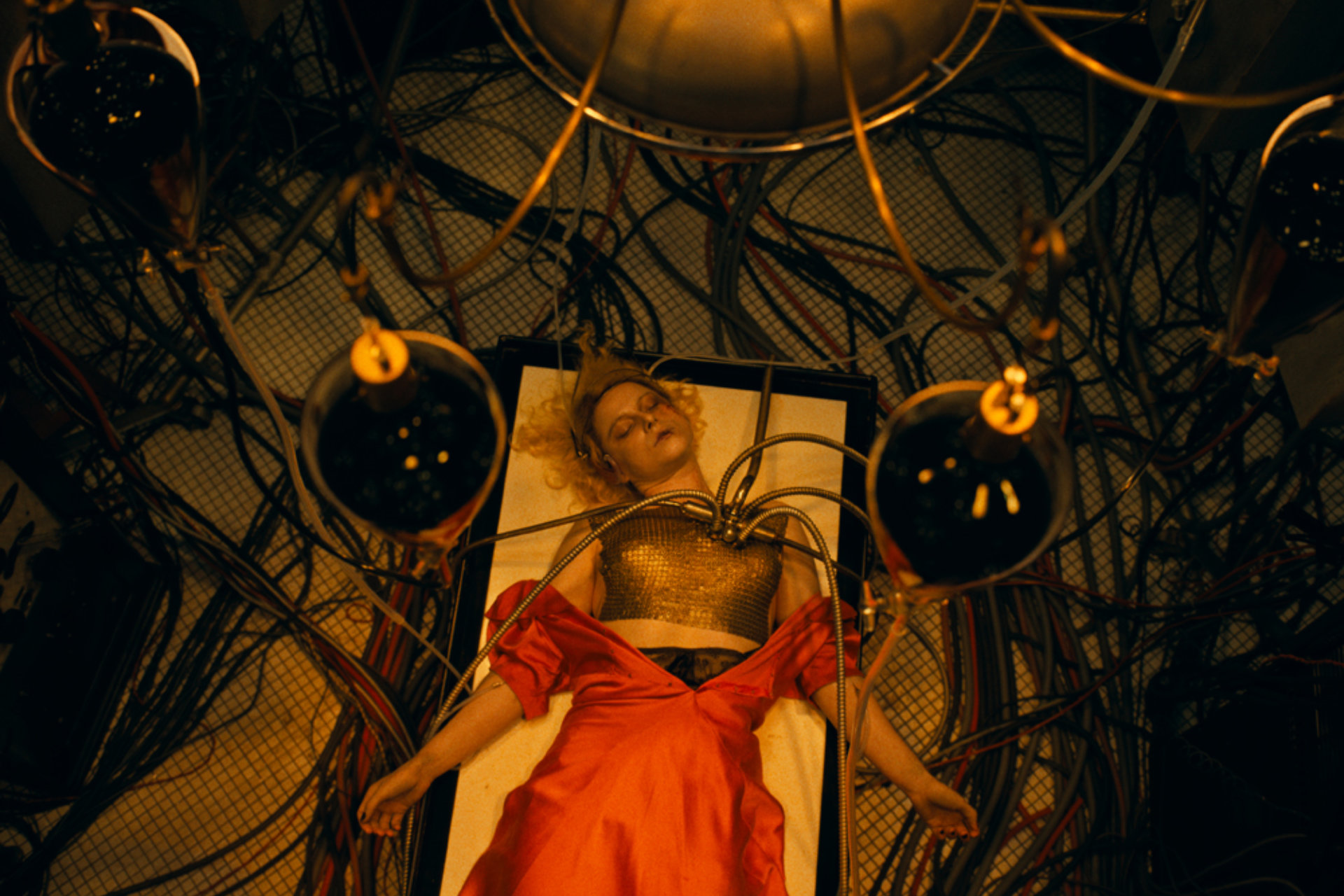
I’ve tried hard to come up with a good way to describe what Bale’s doing here, and I hate to play the Film Twitter simile game, but there’s no good way of getting this out otherwise. His Monster is roughly what you’d get if Herman Munster got shipped to Hackney and was forced to star as Lennie in a Year 10 production of Of Mice and Men. It’s a bizarre performance, made mostly successful by Bale’s charisma and how well he works as a counterbalance to Buckley’s less-successful mania. When the Good Doctor helps him flip the switch, and she comes back from the dead, white-haired and sporting a fresh tattoo lip-and-cheek splotch tattoo from some tar she spat up upon revival***, it’s clear to most that this might have been a bad idea and that if they could pull that lever back down and dump her back in the graveyard, they would. Yet Frank’s never met someone like him before, nor has he met anyone as unashamed to be who they are, even if they don’t really know exactly who that is. Before they know it, they’re at a rave with all the other societal outcasts, and before he knows it, he’s killed two men who harassed her on and off the dance floor. Monsters like them: baby, they were unborn to run.
So begins their cross-country trek to evade the law, represented here by a pair of detectives played by Penelope Cruz (best resembling Piper from Fallout 4 more than a riff on classic noir) and Peter Skarsgard. The former is chafing against institutional sexism in the department, the latter is haunted by the fact that the Bride happens to look like one of his informants that he fell head-over-heels for in the line of duty. Regardless, they work well together, which is what happens when you put two talented actors in solid archetypal roles and set them up with some faux-Hawks dialogue.**** Meanwhile, Frank’s caught on to the fact that his partner doesn’t really know who she is, and invents a fantastic backstory for the two of them: she’s Penelope, his gal, and dammit, they’re gonna do what they have to do to survive. For the most part, that means travelling around the country to go see Frank’s favorite movie star (Jake Gyllenhaal) do some soft-shoe on the silver screen and occasionally getting up to some hijinks. The only real question is whether this fiction Frank concocted can outlast the cops and the mob – and her sense that something isn’t right with what he’s telling her, as much as she’d like to believe it.
You better believe that The Bride! used every penny of that budget, too. It’s as off-the-chain as one would hope from a movie punted out of awards season and into early March, much like Bong Joon Ho’s Mickey 17 was last year, another balls-to-the-wall misfire which, despite being the better movie, I find myself liking less than I did this. Everything feels wrong here – the dutch angle goofiness evokes Battlefield Earth more often than it should; the grafting of modern culture on the ‘30s is less successful than if she went fully anachronistic; the references to other movies often fall flat (among others, there are allusions to Cabaret, Bonnie and Clyde, Joker, Swing Time, and, of course, Young Frankenstein); and the entire film is hyperactive, swerving from one lane to the next so hard that one might get car sick. The writing is hoary when it’s not being aggressively horny, such as the nascent social movement represented in the Bride’s copycats, each of whom likely would be outclassed by the women of Gatsby set in nihilism, and the romance is so flat and matte that one wonders where the Hot Topic price tag is on this screen-printed shirt. Again, I must remind you: this movie was and remains Not For Me, and if one wanted a good modern Bride of Frankenstein riff, Poor Things remains available for you to watch.
Yet, I’m still bizarrely compelled by it. One thing I don’t doubt is how genuine Gyllenhaal is, as this bears all the marks of a hyper-earnest exploration of some deep aspect of her dual careers in the same industry. Her brother, playing a Fred Astaire-type, is an intimidating presence, which is why her affection for Frank, despite all his red flags, remains rooted in palpable empathy. Moreover, Buckley is ultimately playing three characters: the person (Ida), the author (Shelley), and the persona (the Bride). The first role is subsumed by the second and the third, and the persona is guided around and fed bits and pieces of information by a man who is essentially giving her stage notes. As a blank slate, the Bride is ultimately what other people want her to be until she’s able to gain the agency to have an identity of her own – the revelation of how useless Frank’s lies were is a decent grace note – mirroring the process of self-discovery and clarification a performer makes in transitioning to a creator. That is a fascinating interpretation of Whale’s classic, and far exceeds the creative capacity of some of its modern competitors. I’d rather suffer through this than sleep through Del Toro’s, that’s for sure. Whatever this is, it’s not a floundering or off-the-cuff panic to prove one’s mettle, or a cheap imitation of better films, or, worst of all, an exercise in brand preservation at the expense of classic literature. It’s the real deal.
So, regardless of the catastrophizing some may have about grosses or CinemaScores, I do think The Bride! will find a receptive audience. There are, after all, enough people who like Benny and Joon and Tim Burton out there for this to become a staple of the High School Goth repertoire, and those who remain so well into their professional lives; and I think they’re an underserved audience, even though their contributions to a film’s cultural cachet are more long-tail than immediate. If one wanted to imagine a more vicious timeline, it would get midnight movie revivals, and ushers would have to stop people from throwing oysters or unlit cigarettes at the screen. The worst scenario, perhaps, would be that no one would care at all, and the movie would fade into ignominy. Yet I don’t think that’s possible – this was a film made for an audience of one, give or take a few hundred people involved in its creation as well (if nothing else, this movie looked like a blast to make). Moreover, I think that one person is quite happy with how this turned out, especially with how much of herself she put into it. The Bride! may not be a “good” movie, but it’s an interesting, personal one, and I’d rather have that any day of the week than the soulless dreck served up by committee we get at the cinema from week to week. Just don’t ask me to watch it again.
* You either die a Batman, or you live long enough to become Jared Leto’s Joker.
** Take your pedantic corrections to Gyllenhaal, nerds.
*** This is either the best or worst anti-smoking ad of all time.
**** I will never cease to be endeared by how much Gyllenhaal likes her real-life husband.