
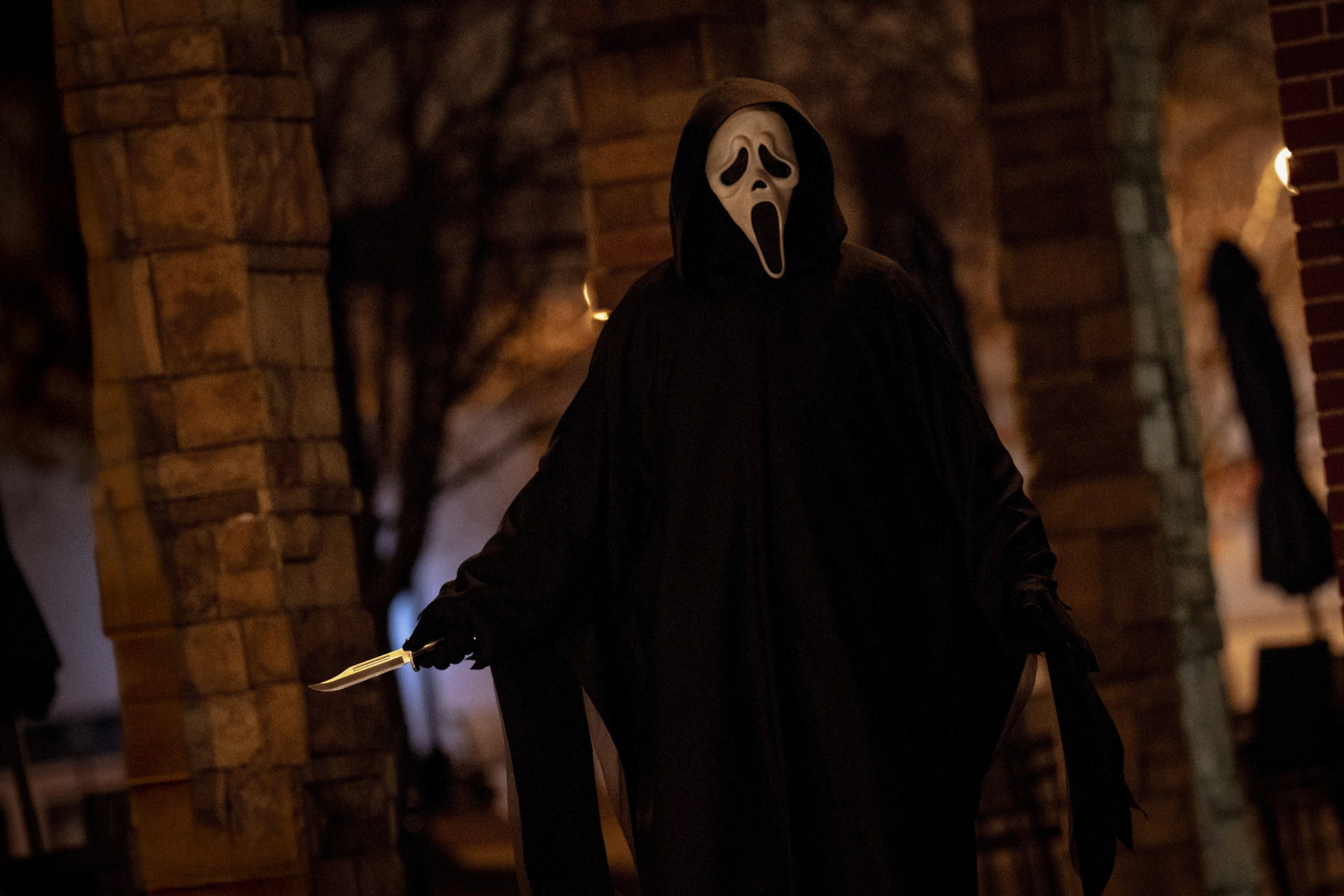
What’s a studio to do when they lose their franchise heads to scheduling conflicts, alienate and fire their leads and the replacement director they hired, and still have to release another sequel in time for the thirtieth anniversary? If you’re Paramount, you hire Kevin Williamson to write and direct Scream 7; roll the Brinks armored car up to Neve Campbell’s house since you lowballed her last time; and ditch the roman numerals so that people know that this is real roots Scream. It should go without saying that this is a jarring shift from what the filmmaking duo Radio Silence likely had planned for their Scream VII, with Melissa Barrera and Jenna Ortega’s characters getting a “Holdo maneuver” line of dismissal to ensure that their dumb subplot about Barrera being Skeet Ulrich’s kid won’t have any credit here. If it feels like Rise of Skywalker, you’re not wrong: It bears the hallmarks of a franchise film cobbled together to hit a date, with Williamson straining all of his muscles to come up with something passable in lieu of any guiding light. What’s remarkable about it is how little it resembles a Scream film despite bearing all of its aesthetic hallmarks and characters – it is functionally pointless and anemic, refusing to even engage with the sort of genre-examination the franchise was famous for under Wes Craven’s direction.
Williamson begins his film with the now-traditional echo of Drew Barrymore getting cut up, where two Stab junkies book a night at the Macher house, now turned into an Airbnb for people who wish the Lizzie Borden house had a digital lock on it, and meet their ends at the hands of our new Ghostface. The killer then burns down the house, which makes for an attractive image for the marketing department, and we move on to another part of California to drop in on the Prescotts. Sidney (Campbell) is now a café owner, raising her three children with her husband, Mark (Joel McHale), the town police chief. They live a peaceful life there, though the Modesto murders are brought up more frequently than she might like, and she regularly butts heads with Tatum (Isabel May), her daughter. Mom’s a gentle disciplinarian – she doesn’t like it when Tatum’s boyfriend (Sam Rechner) sneaks in her window to visit her, but isn’t a jerk about it – and withholds a lot about her past from the teen, who resents her for it. Yet ultimately, Sidney’s an unqualified success story about what one can do when repeatedly exposed to the worst the world has to offer.
Of course, someone has to come along and ruin everything. So, when the new Ghostface starts targeting Isabel’s school and taunts Sidney with video calls saying that he’s Stu Macher (Matthew Lillard), who somehow survived getting his head caved in with a TV and is now out for revenge, it’s a race to figure out exactly who this new killer is and what exactly he wants. Along for the ride is reporter Gail Weathers (Courtney Cox) and her two assistants, brother/sister pair Chad (Mason Gooding) and Mindy (Jasmin Savoy Brown), the two vestigial elements retained from the modern installments, who are always on the hunt for a bloody story to play Poirot with. Kids die, horror movie references are made, and the conclusion isn’t quite satisfying. It’s honestly impressive that Anna Camp, as one of Sidney’s neighbors, delivers a wonderfully goofy performance in spite of it all, or that Powell’s able to ground the film in something resembling substance, despite Sidney’s weird weightlessness as a full-on protagonist this time around. I wish there were more to praise, but, alas, it’s Scream 7.
Save for one or two kills (including a decently brutal one involving a beer tap handle’s prominent spike), Williamson’s direction is flat and artless. The scares aren’t particularly surprising, the tension remains mostly flat in would-be suspenseful scenes, and his gags mostly fall flat. He owes a great deal to something like David Gordon-Green’s Halloween, which aced the tone he’s aiming for (and, of course, he directly shouts it out during one of the interminable bits of overwritten, all-too-clever analysis done by Gooding and Brown), and, at least based on the slapstick quality of the Ghostface pursuits, Scary Movie. The cast is underserved by both what they’re given on the page and by his direction, with Campbell, Cox, and McHale only keeping things afloat with their charisma and prior experience. That leaves the young actors floundering in search of a measure of consistency in parts that are a quick collection of adjectives rather than recognizable archetypes for their exploration.
There’s also no animating ethos here — nothing driving the movie beyond the need to exist on a Paramount balance sheet to distract from the debt load. Say what you will about the Radio Silence guys, but at least they tried to continue along the line that Craven and Williamson originally laid down thirty years ago, even if broadening the franchise’s critical perspective toencompass trends in all of blockbuster cinema stretched it a little past its breaking point. Williamson remains firmlystuck in the ‘90s, when the concept of a meta-ironic horror-thriller was novel enough that he could sell his first attempt at writing a film like Scream, get Helen Mirren to star in it, and take a seat in the director’s chair simply because few films like it existed and everyone wanted a slice of the bloody pie.* The truth is that everyone going to a Scream movie now knows what a “final girl” is, and the headpats for recognizing genre conventions don’t feel as satisfying as they used to. There has to be something else, and Williamson knows that it’s not enough to be clever in these situations – he did, after all, write Scream 2, which has been stripped for parts and rebuilt.
Again, it was all so much smarter when Craven was a steady hand. There are little jabs at true crime fanatics and those willing to exploit what would be the most traumatic event in one’s life for the sake of entertainment or content, but they’re slight, not nearly as acrid as in prior installments. Oh, and there’s AI, too, as if we really needed that horseshit in a Scream movie. If one were to point to an overarching statement, it’d be about what exactly survivors owe the public, were they to court some attention to help those in similar situations, and who exactly owns their story once it goes mainstream. I suppose that, in the big reveal, Williamson intends to fight some of his fans who wanted something different than a happy, settled-down Sidney who is well into the process of moving on, but it comes across as if he’s tilting at windmills, imagining a threat that doesn’t really exist.
The truth is, there’s too much money tied up in the business of Sidney Prescott to let her story go – this is why she’s relevant in the film’s world, still the subject of Dateline specials and Netflix documentaries all of these years later, and still a prime asset in our cultural portfolio. In a perverse, fucked-up way, Scream 7 is unaware that it’s a tragedy. The antagonists ultimately get what they want, even if they don’t get to see it through, as if Kevin Spacey’s character in Se7en ended his plan with envy and all that stuff with Gwyneth Paltrow was just a flourish, followed by Brad Pitt triumphantly blasting him away while Morgan Freeman nods approvingly.** Alas, there’ll be more copycats to come in subsequent years, each with a more tenuous connection to the murders that started it all off, until we stop giving a good goddamn about the five Ws and Ghostface just becomes a gangly Jason murdering teenagers for the fun of it. Then, finally, the Scream movies will just become the Stab ones, and we all have to stop pretending that they’re still witty or clever. After all, you get what you pay for.
* I still think Teaching Mrs. Tingle is a dope title.
** The final line: “Ernest Hemingway once wrote: ‘The world is a fine place and worth fighting for. I agree.’” Cut to credits, complete with a John Parr track for exit music.