
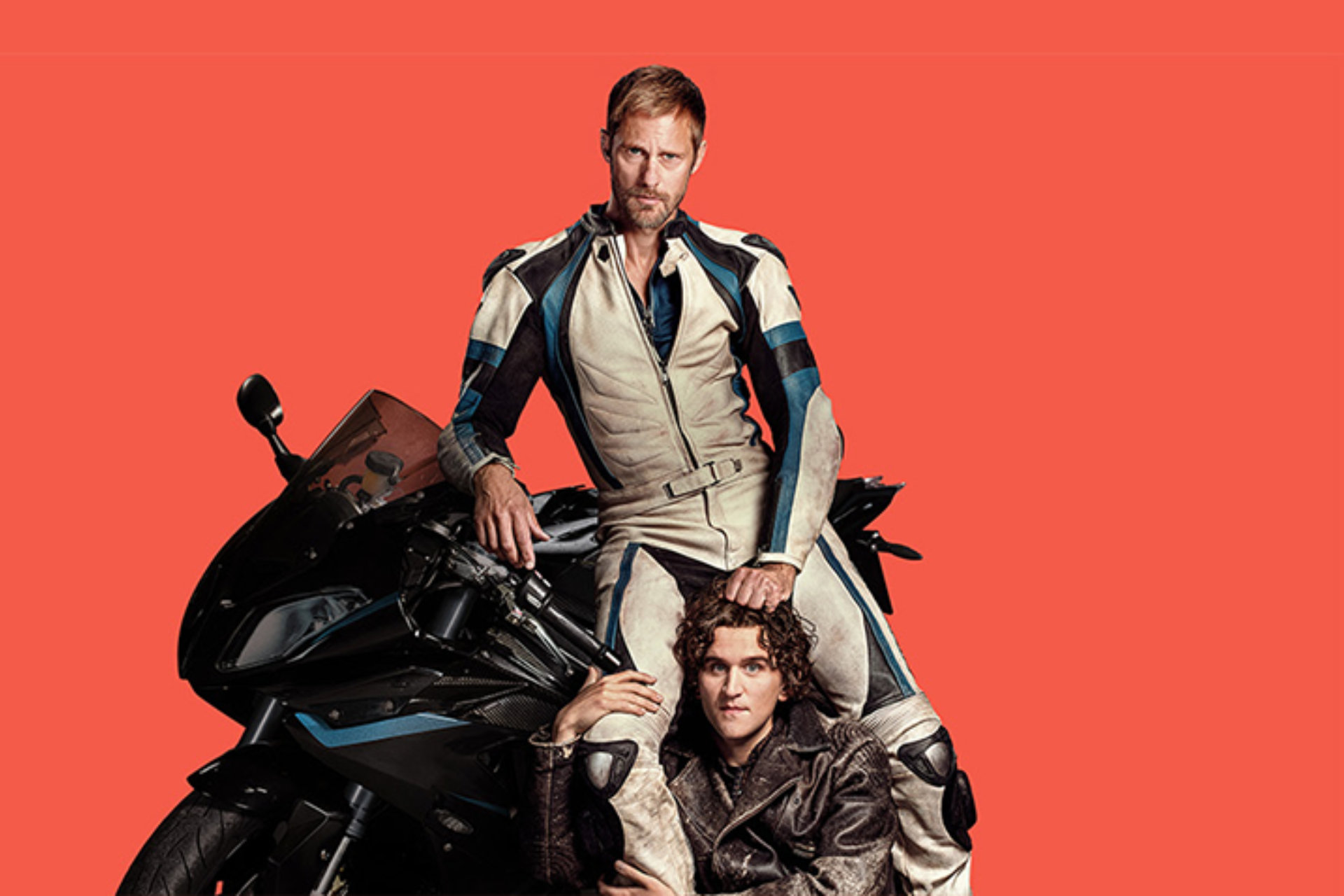
To say that this interview is NSFW would be an understatement. Then again, that’s inevitable when one sits down to talk with Harry Lighton about his brilliant new film Pillion, a gorgeous tale of first love that engages with kink in a properly explicit fashion well-suited to the subject matter. This isn’t 50 Shades, and would properly horrify the women of Book Club had they chosen Adam Mars-Jones’ Box Hill, upon which the film is based, as their selection that month.
Pillion – a term which refers to the backseat on a motorcycle – follows a shy lad named Colin (Harry Melling) who meets a stoic, stone-faced biker named Ray (Alexander Skarsgard) at a pub one night. They couldn’t be more different, but as Paula Abdul sang to the cartoon cat, opposites attract. Ray’s a dom, a member of a gay biker club, and absolutely alluring to the meeker, inexperienced Colin. The set-up works for them — Colin serves, Ray withholds affection (to an extent), they go on rides, and so on – until life gets in the way and challenges Colin to figure out what he really wants from his brand of romance.
Melling and Skarsgard are phenomenal in their roles, as each contributes a little something to keep the audience from jumping to a judgment about the ethics of their relationship – Colin’s excitement after their first encounter, Skarsgard’s strangely kind eyes – and helps Lighton create a coming-of-age tale unlike anything you’ve seen at the arthouse in recent years. It’s funny, beautifully shot, resonant, and, well, kinky.
We sat down with Lighton one sunny afternoon, a few hours before he accepted the Coolidge Corner Theatre’s Breakthrough Artist Award, to talk about how he translated a book like Box Hill to the screen, working and doing research alongside the real-life gay biker club shown in the film, his kink cinema recommendations, and, of course, prosthetic penises.
Vanyaland: I’d like to start with the changes you made to adapt Box Hill for the screen. I know you have an extra layer of complication there because [author] Adam Mars-Jones is also a film person, so that could be an extra layer of struggle.
Harry Lighton: I think it’s interesting. It actually turned out to be nice — I think it removed a lot of the struggle he was having as a film critic; that wouldn’t be the case for every film critic/novelist having to adapt. I spoke to him for an hour when I was trying to get the rights to the book off him. He was like, “Novels and films are two extremely different things. You can do a straight adaptation if you want, but I’d be more interested if you did something wildly different. Go forth and do whatever you want.”
He gave me complete carte blanche to take it however I wanted. One of the things I found reading the book, which is set in the ’70s, is that Ray’s mystery, the fact that he withholds his identity, my mind just quickly went to the homophobic context of Britain at that time. I’d be like, “Well, clearly Ray’s closeted, and he’s got a wife somewhere,” or that seemed to be quite an easy explanation, where I was more interested in Ray’s mystery being the possibility that it was just part of an erotic game.
I think there’s a lot of erotica and anonymity independent of fear of exposure, fear of being exposed as gay. I also meant that there were characters in the book, like the parents, who felt very typical of the time in terms of how they swept Colin’s sexuality under the carpet. He comes out to his mom, and then they never speak about it again. I was slightly bored with that trope of the homophobic parent, or even not loudly homophobic, but the unaccepting parent.
I thought it was more interesting when you’re making a film about kink to start in the present day with extremely accepting parents and then have them withdraw that acceptance when their son’s boyfriend, and they’re desperate for him to have a boyfriend, doesn’t meet their definition of what makes a good boyfriend. Through doing that, you can ask questions about what is acceptable gayness versus there are still versions of gayness which exist outside of societal acceptance.
Yes, absolutely. You do a really great job, I think, especially with the parents’ performances and the way that’s inverted and made somewhat ambiguous. Did you tease out that extra bit of ambiguity in the writing process?
Yes. I think I wanted the mom to be very close to the son as well, but fiercely close to him, and for her terminal illness to be adding pressure for her in her mind to try and make sure that her son, who’s in this version of arrested development, is going to be all right once she’s died. I also thought it was interesting — Colin and Ray’s relationship is so transparently unequal in terms of power dynamics and domination/submission, but every relationship has some form of power negotiation.
I wanted his parents to be the visual opposite of Colin and Ray, in that they’re exactly the same height and feel very much of the same world. Then, over the course of the film, you can see that Peggy, his mom, wears the trousers and is definitely the dominant one there. I just thought they could provide a mirror to Colin and Ray.
They would definitely win that side of bacon for sure. [laughs]
I was really fascinated by it because it’s such a genuinely empathetic film. You have characters who could be punchlines in other films, but they never become that. I think that comes out best in the relationship, which is quite different than what’s on the page. How did you go about crafting their pairing in a way that didn’t necessarily always come off as abusive?
The book sets up their first sexual encounter as a rape. It categorically describes, Colin says, “I was raped, but I was still proud of having sex.” That is typical of Colin’s attitude in the book, which is that he’s optimistic to a pathological extent, where you, as the viewer, are pretty certain that the experience he’s having is abusive. I wanted the question of whether Ray was a force for good or bad in Colin’s life to be gray at points.
I didn’t want it to be like Ray was just this redeeming figure in Colin’s life. I didn’t want it to be categorically abusive because I think that then the audience is unable to invest in their relationship. I wanted to make a film about kink, which explored it and its complexity. Part of that was working with the actors on set to make sure we were striking that balance. In the first alleyway scene, for instance, when we started shooting that day, I remember it was much more aggressive.
I think Ray slapped Colin at one point, and Colin seemed more scared, whereas after a couple of takes, we were like, “Okay, how can we warm this up?” Harry, in particular, is great at adding that sense of play and excitement. He’s giggling as they’re doing mercy-mercy. We make sure that when we finally panned down, it’s quite a confronting blowjob, partly because of Colin’s inexperience more than anything. When we pan down to him, once Ray’s ejaculated, we see him grinning as he wipes the cum off his face.
Through choices like that, I think, allow the audience to know that Colin is really keen for this ride. There’s definitely a question of whether there’s informed consent in the film. Colin isn’t informed about anything. While Ray says, “What do you mean? What can I do with you? What am I going to do with you?” Colin says, “Whatever you want.” Colin is kind of clueless as to what that means. I think making sure that there was enough lightness in Colin’s experience that it didn’t become shrouded in abuse. That was the thing in my head, anyway.
I feel like that’s typical of a lot of sexual experience, where the informed consent is a great thing when you literally know everything about kink and everything about that. There’s an ethos of experimentation that goes into it as well. You do a great job capturing that.
Yes. That’s exactly it, right? Is informed consent really only about being informed? Sure, there’s the model responsible Dom who makes informing their sub the crucial part of the setup of the relationship, but lots of people’s experiences, including my own, you can have early sexual experiences and early relationships, which are certainly not the blueprint of what a relationship should be like, but they teach you loads about how to better negotiate your desires in the future.
The parallel between touching a hot stove and that… I guess there’s an intentional metaphor there, somewhat.
Yes. Put like that, it sounds incredibly blatant.
[laughs]
That is such a fascinating, painful, and comforting moment in that film, how it leads into the tenderness represented by, of all things, Ray’s pizza joke. It’s so interesting because there’s just such a complexity to these two characters. Even if we know so little about Ray, there are just lots of true-to-life details – such as his glasses.
I thought part of the costuming and the makeup around Ray was that we would start with this, we meet him in the alley, and his body’s glistening and he’s ripped, and it’s like a kind of sexual fantasy. Then over the course of the film, he doesn’t get uglier. You can’t really say that Skarsgard gets uglier, [laughter] but you start to see the human weaknesses, like poor eyesight and pockmarks, and things like that, which is often the difference between the pornographic fantasy of someone and the reality of them.
It’s like seeing the leftover pencil marks on a Tom of Finland drawing. [laughs] That’s always the thing. When you see glasses like that, it’s usually before or after the latex.
Yes. Contacts when the latex is on.
Absolutely. You don’t want to spoil the moment. Anyway, how was the research process with the bikers? I read a little bit about that. I believe Harry and Jake Shears did that as well.
Jake independently went off and read the leather handbook and did some stuff. I started by meeting up with the GBMCC, Britain’s biggest gay bike club, riding and talking with them, and then casting some of them in the film. Then Harry went and spent a day. He biked up. He was the pillion on the back of the pup in the film’s bike. Paul the Pup, he’s called. They went to Cambridge Pride together.
Harry went to some party where he was taught how to lick a boot well and how to lick a boot badly. He found it really useful. The thing he said was, which I think is true of my experience of working with the bikers, the real bikers, was just like they were so generous in teaching him about stuff which can be quite exposing. I think that’s probably partly why I wanted to warm up the film from the book: to get the sense of generosity and camaraderie that can come within these spaces, so it’s not just a brutalizing experience.
Yes, you’ve got the aftercare baked in when you’ve got a community like that. What has surprised you most about the reaction to the film?
I think that, in touch wood, it’s sort of fairly early days, but as of now, it’s made good on — I always said, oh, I want this film to be able to appeal to both the core audience, the kinky queer audience, but also someone who has no experience in that world like my mom or whoever, who just wants to go and see a film which might make them laugh and think.
I always said that, but in my head, I was like, “Well, it’s probably still going to be pretty underground.” Even when Skarsgard came on, which obviously gave it more mainstream potential, I was still like, “It’ll be pretty niche.” At every screening I’ve gone to so far, there’s been a portion of the audience, often a big portion of the audience, who definitely aren’t involved in the kink scene, who really do seem to find the film invigorating.
There’s been much less of a like, “Ooh.” Obviously, if you ever go on Twitter or whatever, you’re going to get that section of the audience. In the room, people seem to have really found it quite an inviting film, which surprises me a little.
I completely see that. It’s a credit to you that you all were able to make the community and this relationship so true and real that it doesn’t feel like something we’re used to seeing bondage and kink and stuff and the power dynamics, especially in the multiplex. I’m not even going to say the name, but we had a great cultural phenomenon on these shores about 10 years ago.
Yes, I know the one.
I’m surprised you didn’t put a Chronicles of Riddick poster somewhere in there. I’m also somewhat fascinated by the international response. I think there’s just so much you guys have done in creating it that makes it accessible to a worldwide audience. I think it really crosses the pond very well. I hate that term as well.
That’s been a surprise to me. I thought that the humor wouldn’t cross the pond. So far, it has.
It’s very funny. It helps if you’ve got a little bit of English blood in you.
Yes. If you’ve watched Wallace & Gromit, then that’ll help you out.
Oh, exactly. [laughs] Say someone sees Pillion and they’re like, “Oh my God, I need to go out and watch more narrative films on this subject.” What sort of movies would you recommend to them?
On kink?
Yes.
I would say, well, two films which come to mind which I just really like are The Duke of Burgundy, the Peter Strickland film, very different, totally from this. It’s, I think, much more fantastical, and it’s kind of ironic, but really interesting, funny, and surprising, and a film that I think explores the way in which the submissive holds a lot of the power.
Then there’s another great film which came out five years ago, and I think it’s called Dogs Don’t Wear Pants. That’s what it’s called, right? I remember seeing that at a London Film Festival and just really liking it. I think it has a little bit of Ruben Ostlund in it, in terms of the tone. It doesn’t scrimp on the extremity of the kink. There are some quite hardcore scenes, say, the masochistic ones, from memory, but it manages to juggle that with a really human story and a father-daughter grief story.
Do you think you’d return to kink topics in the future in making movies, or are there other things you’d like to pursue?
It’s funny, there are definitely other things I’d like to pursue. I feel like right now, with my next film, I’m just sort of starting to write my next film. I don’t want to directly explore kink in the way I have with this. To this point, I’ve made what, three shorts and one feature film, and two of those shorts are about some version of transgressive sex, and it’s something which will definitely continue to fascinate me.
I read a great novel the other day called The New Life, by Tom Crewe. That has a strand about kink in it, which I thought was fascinating. I went, “Ooh, maybe there’s something in this.” At some point, I’ll be coming back. Also, Pillion II, I’ve convinced Harry and Alex to when they’re 50, not when they’re 50, in 50 years’ time, we’ll come back to that story.
You’re doing what, the [Pillion equivalent of] Find Me, the Andre Aciman sequel to Call Me By Your Name?
Exactly.
I would pay to see that ASAP, honestly. Well, maybe not ASAP — because I’ll be old as shit too then.
We’ll all be old, and that’ll be part of the majesty of it.
Totally. Let’s see. I’m sort of blanking on other questions. I didn’t want to come in and ask you about dick prosthetics. It seems like everyone just sort of gravitates towards that.
Weirdly, I haven’t spoken much about them because I like to keep the mystery to myself. Clearly, I don’t think anyone’s seeing that dick and being like, “That’s a real dick.” What I can say is that they’re incredibly expensive.
I believe it.
We probably spoke for a good 12 hours about the prosthetic penis and the practicality of putting a Prince Albert piercing through one. They’re much cheaper if you find one that has already been made. You have to get the actor’s permission to use it. I was dead set on the Prince Albert. I thought it was really essential that Ray’s penis gave you an insight into how embedded in this world he is.
Yes, it’s definitely an “Oh, shit” moment when you see that, for sure. The best part is, it’s awesome that this is an A24 pickup because between this and Red Rocket, they have the best prosthetic dicks in the business.
[laughs]
This interview has been edited and condensed for brevity and clarity.