
Nia DaCosta’s 28 Years Later: The Bone Temple is what Danny Boyle’s prior entry in the now-resurrected faux-zombie series should have been: A brutal, bizarre exploration into what culture remains in England following its highly localized apocalypse, willing to take the broad promise of the high-concept premise for all its worth without regard for narrative niceties. 28 Years Later suffered from the conceptual phase, where Boyle and writer Alex Garland ensured that their work conformed to the post-McCarthy tradition of sci-fi-collapse survivor narratives* and made their story a thoroughly uninteresting bildungsroman in the coziest of catastrophes. Toss in Boyle’s continued fondness for consumer-grade cameras and inability to shoot compelling action (the not-bullet time is only cool when you learn about how it was done, not when you see it), and they had, on paper, the recipe for a flat-out dud. Yet Garland remembered how fun his writing could be when he ditched rhyme or reason and went straight for the weird. Good taste be damned, he was going to have an orange Ralph Fiennes and a Jimmy Saville cult, and he was going to make it work. Sure enough, he pulled it off, and DaCosta only improves on his inventions… by realizing how funny it all is.
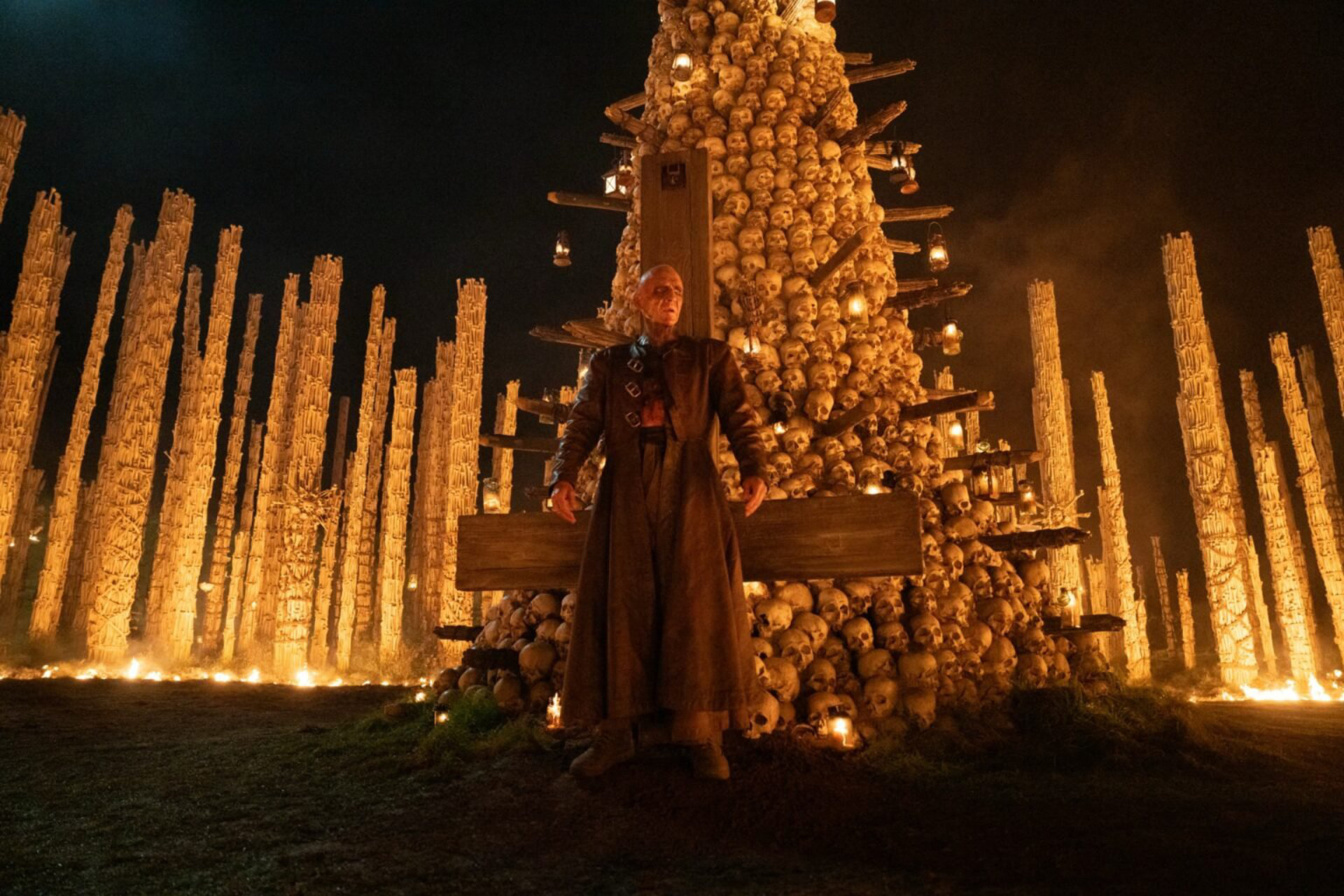
By the time Dr. Ian Kelson (Ralph Fiennes) stops bleaching bones for his “memento mori,” sheds his shirt, enjoys a taste of the cocktail of tranquilizers that he blow-darts into the chests of the infected, and serenades “Samson” (Chi Lewis-Perry), the infected muscle-bound alpha zombie, with Duran Duran’s “Rio,” one feels encouraged to let slip a chuckle or two. This time around, Fiennes isn’t just a closer brought in to redeem a struggle-filled outing from his younger teammates; he’s a starter. His presence transformed Boyle’s film on both an aesthetic level – in addition to his iodine-stained skin, he gave the film its most memorable location, and this film its title, in his Andy-Goldsworthy-meets-Ed-Gein temple – and in its pathos, with the film’s most effective moments coming directly as a result of his awkward, estranged sincerity. DaCosta proves this character could have anchored a previous film, and allows Fiennes to go as wild as possible without betraying Garland’s designs for him. We get to watch him “make a friend” this time around, coming as close as anyone might to discovering the root reasoning for the Rage Virus’s effects through his time spent in drug-induced stillness with the alpha, and see as he engages with some curious visitors who are convinced that he might be “Old Nick,” in the words of their leader.
Those visitors are, of course, the infamous Jimmys, who baffled audiences when they showed up in Years doing high-grade kung fu to a metal cover of the Teletubbies theme, if Boyle tacked on a TikTok remix of the “Pancakes” scene from Eli Roth’s Cabin Fever to end the film on a brilliant troll. There is, and was, more to it than that. Sir Lord Jimmy Crystal (Jack O’Connell), whose origin opens the first film, is a perfect antagonist for Spike (Alfie Williams), in that he too was betrayed by a father figure**, and chose to go on his own instead of following in their footsteps, to survive rather than submit. Where Spike saw a chance to grow up, put away childish things, and become his own man, Jimmy took on the worst attributes of his father and refused to mature. His garb – the tracksuits, wigs, rings – is a memento to a false god, a toppled idol who, in this world, was never exposed as the monster he became when the cameras were off. From the jet-liner people in Thunderdome to the bomb-worshipping mutants in Beneath the Planet of the Apes, cargo cults are often a feature of post-apocalyptic fiction, but there’s never been one designed to be as icky as the Jimmys are in practice, and the way that Garland and DaCosta weave this concept into a grander thematic tapestry prevents it from being offensive. Jimmy maintains control over his gang through violence (obviously) and mysticism, though his primary texts are episodes of Jim’ll Fix It and Teletubbies, with a heaping dosage of Hot Topic satanism thrown in the mix.
Spike is a bridge between these two weird worlds (and, should there be a sequel, he’ll ultimately grow to cover yet another gap), and his discomfort is understandable. He’s practically a vestigial element, like a prehensile tail evolution forgot to lop off, and he doesn’t play much of a role here beyond being sick while the Jimmys torture their way through what remains of the non-infected countryside. One could point to his elder-sister-younger-brother relationship with the most empathetic of the gang, Jimmy Ink (Erin Kellyman), a doubting Thomas who puts Kelson and Crystal on a collision course, but it’s easy to visualize a version of this that doesn’t totally trash the solid conclusion Spike had in Years. He’s mostly an audience stand-in, vomiting when we should, doe-eyed when the moment calls for it, and DaCosta doesn’t pay him too much mind. There’s just better material elsewhere, even if he’s to be our protagonist for each film in this new trilogy, and, besides, he’d just get in the way of all of the fantastic scenes she’s constructed.
I’ve never been the world’s biggest DaCosta acolyte – Little Woods was aggressively bland yet well-meaning, Candyman was the worst kind of legacy sequel, The Marvels was a disaster that was, admittedly, not her fault, and Hedda garbled Ibsen by sanding off its anti-heroine’s edges – but her experiences running productions big and small have given her the ability to capture moments of bombastic action and still reflection with the same grace. Her work on the finale is superlative, her connection with Fiennes and O’Connell sustains the emotional arcs, the pace is kept tight, and the tonal whiplash only makes Bone Temple stand out as a unique franchise feature in a landscape of dull, iterative sequels. Importantly, she ditches all of the bullshit Boyle crams his films with – there’s no iPhone bullet-time here or janky drone shots – and uses her well-crafted style to ground the construction so as not to take the focus away from the wacky shit she and Garland have dreamed up. I hope she sticks around for the teased third installment of this series, though, if she doesn’t, I’m quite excited to see what she does next.
It’s to Bone Temple’s credit that it could serve as a proper conclusion to the 28 ___ Later franchise, should horror fans not come out to see it while it’s in theaters. It does so by embracing its odd, distinctly English vision of blighted “Jerusalem” amid a sea of unsatisfying regional imitators. The perspective, rather than the style, has always been the feature here: Days wouldn’t have been nearly as evocative had Cillian Murphy emerged onto, say, a deserted Denver street, and the setup only grew to be more compelling as it seemed to echo current events. Its isolated Britain, full of rage and terror, beset by plague would be hoary had it not been written twenty years ago. Yet it also shows that there’s still gas in the postapocalyptic tank, provided that filmmakers and writers embrace the ridiculous and/or poetic. Such is the case with all forms of genre fiction – the faddish element of the zombie was dead and gone by the time Fear the Walking Dead hit AMC – but meaning emerges less from po-faced seriousness or “realism” than in the funhouse-mirror way that it twists and distorts the modern world. And, ultimately, regardless of whether it’s a bang or a whimper, the end of the world will be bizarre, and, in some bleak way, pretty funny.
* The Road may be one of the most influential novels of the century, given how many genre-fiction imitators it spawned.
** A literal “father,” in fact, given that his papa was a Padre who let his congregation infect him in a fit of end-times madness.