
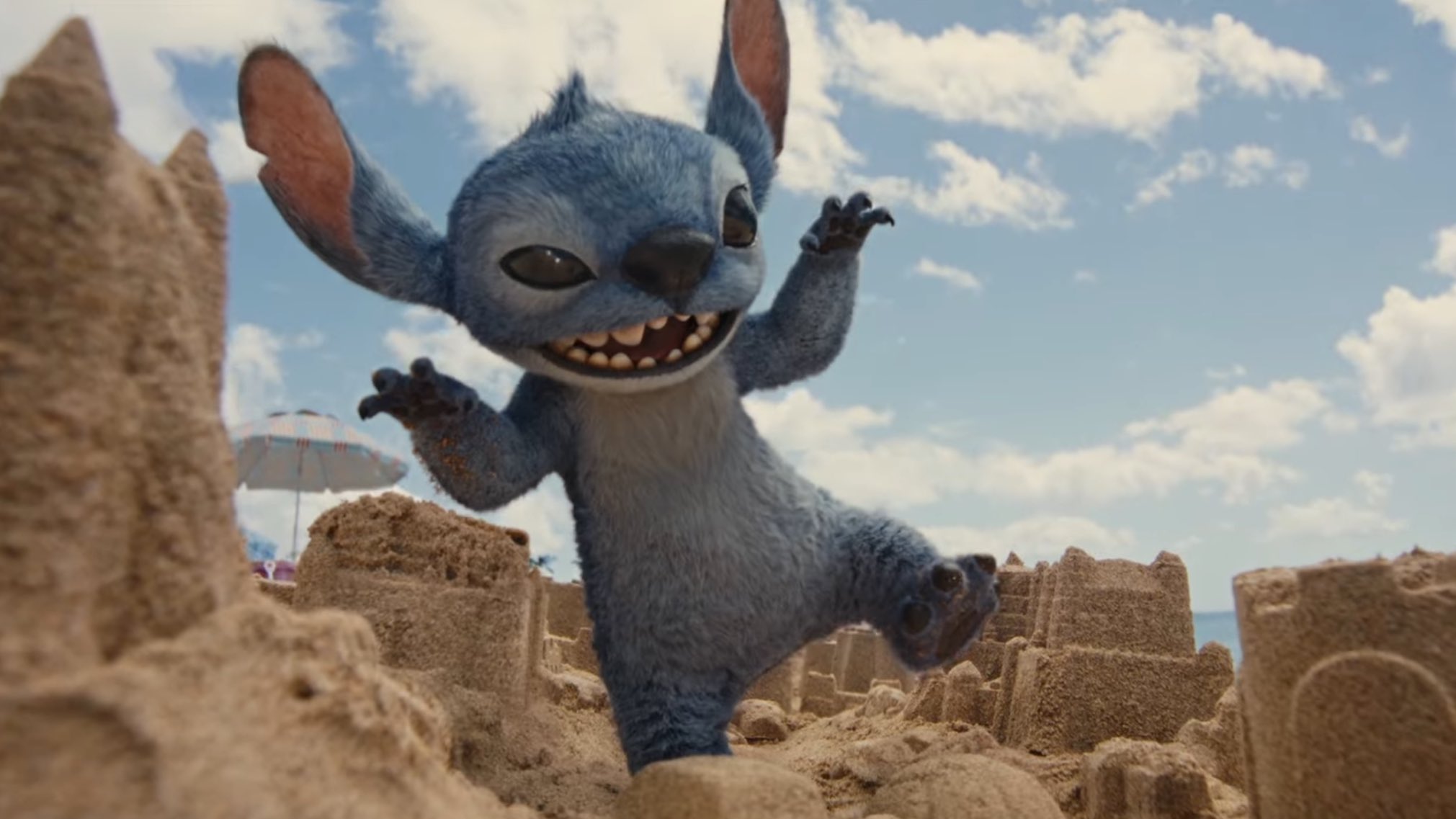
Hell has frozen over, and the devils finally can have their long-awaited snowball fight. Crimson blood flows from stones like lava. Pigs have taken to the skies in a V formation. Leopards can now change their spots in any way they see fit. In need of a silk purse? Try a cow’s ear – you can now make one into a fancy handbag. Jelly may now be firmly nailed to the wall, unlocking new possibilities for interior decorators. NASA has reanalyzed moon rocks, and it seems they’re made out of an undiscovered kind of “green” cheese. The impossible is possible: Disney has made a live-action remake that is Pretty Good, actually. To add one more idiom to the mix, Dean Fleischer-Camp’s Lilo & Stitch teaches the old not-dog some new tricks and offers a template for future guns-for-hire to make these adaptations without totally mauling the source material or remaining slavishly faithful to it. There are several important reasons for this, some specific to this particular adaptation (it’s a relatively recent-yet-timeless property that is by design intended to be a little more grounded than the usual Disney fairy story), and some that could apply to any one of these films (good casting, clever writing). But it also just comes down to vibes: Fleischer-Camp places it in a cultural context by making this Lilo & Stitch feel like an early-2000s DCOM.
Yes, a DCOM. Like some people (Southerners or those without cable), I didn’t grow up watching Disney Channel Original Movies, but a COVID-era project with a group of friends introduced me to them, and they were a cultural touchstone for people who didn’t come from my region of the country. Most weren’t particularly good; some were fantastic, and a few had some legitimately incredible talent working behind the scenes (directors Robert Townsend, Joyce Chopra, DuWayne Dunham, and Levar Burton, among others). Yet they all had a strangely anarchic and freewheeling sensibility that was not part-and-parcel with what the Michael Eisner-era Mouse put on multiplex screens. The low budgets, the gross-out humor, the still-inexpensive practical effects, the occasionally touching bit of sentiment, the comparative freedom – it all added up to a surprisingly unique brew of children’s programming unlike anything in long-format television, which endeared itself to a generation of kids and has been seldom seen since in Iger-Chapek-Iger eras. Such happens when you get a string of flops so painful that you decide to scrap any original-concept films or punt them to streaming services.
Despite coming from the other side of the tracks – a prestige blockbuster painstakingly hand-animated at the tail end of the Disney renaissance – Chris Sanders’ original Stitch shared a tonal ethos with those movies. It was slapstick-heavy and silly, yet had pathos to any member of the audience, child or parent, who had ever raised a stray into a Good Boy or who discovered that under their “bad” dog, there was a bad former owner and a whole lot of healing to do in their aftermath. It was also eminently relatable- perhaps the closest Disney had come to making a “real” setting in years in their picturesque Hawaii, full of mundane and serious concerns to go along with the wonder. Beyond the well-executed sentiment, Sanders had a delightfully cartoonish style (in keeping with other late Renaissance classics like The Emperor’s New Groove), a keen sense of humor, and a willingness to contrast the more serious elements of the premise with the absurdity of its intergalactic universe. In short, it had all the good bits of DCOM DNA, with the benefit of a fully unchained imagination and a big budget.
Thus, a live-action remake would always be set for some manner of success because the transition from pure unreality to partial “realism” could be done significantly easier than, say, Snow White. Fleischer-Camp changes specifics and alters some plot elements, but the core tone and style of the film remain the same, just with a few added delights. These mainly come from the cast, who make up the best ensemble that Disney has assembled for one of these features. Central to the film’s success are its leads – Lilo (Maia Kealoha), her sister Nani (Sydney Elizebeth Agudong), and Stitch himself (Chris Sanders, returning to the role he co-created). Kealoha and Agudong are incredible discoveries, gifted with excellent comic timing and a sterling wit. Sanders is again well-paired with his creation, a chaos demon that eventually spawns a full-fledged soul, and the CGI character has a little more heft to it when supported by Fleischer-Camp (whose Marcel The Shell work is reflected well in how the alien reacts to those around him). Supporting them are Zach Galifianakis and Billy Magnussen, cast as the alien goofballs sent to track Stitch down, Courtney B. Vance as the CIA agent spying on them, and Tia Carrere as the social worker looking out for young Lilo. Special mention should go to Galifianakis and Magnussen, who are expertly paired as a set of contrasting energies, and it’s just plain nice to see Magnussen doing more expert physical comedy in a major release these days.
Lilo & Stitch is just what you get when you pair the right person with the right project, and Fleischer-Camp brings an admirable low-fi quality to some of this without skimping on the beauty. Sure, some of the CGI looks rough when it’s not focused on Stitch, but the on-location shots of Hawaiian vistas and villages are lovingly captured in his frame – something, despite what Google may have you believe, can’t be equaled in a text prompt. Yet there’s a quality to Lilo and Stitch that so few Disney products have today, which is that it feels primarily intended for children. This is perhaps why the DCOM comparison feels so apt to me – much like those made-for-TV movies, often never seen by anyone other than their intended audience, Fleischer-Camp has made a movie that feels all-inclusive without resorting to the cloying patronization in the tone that emerges when prestige talent is poached from the boutique distributors.
What I’m saying to the parents reading this is that you might find some of the humor dumb or worse than you remembered from the original (and it may be! I don’t watch a ton of Disney movies in my spare time), but I know one thing: Your kids are going to howl at some of the antics here, and probably be moved to tears by how well the plot resolves itself. That is perfectly alright. Just wait; there’ll be another Lion King prequel or Little Mermaid sequel for you to feel nostalgic during in a few years. In the meantime, just thank whoever realized that this deserved a full-fledged theatrical release instead of being buried in the Disney+ Vault.