
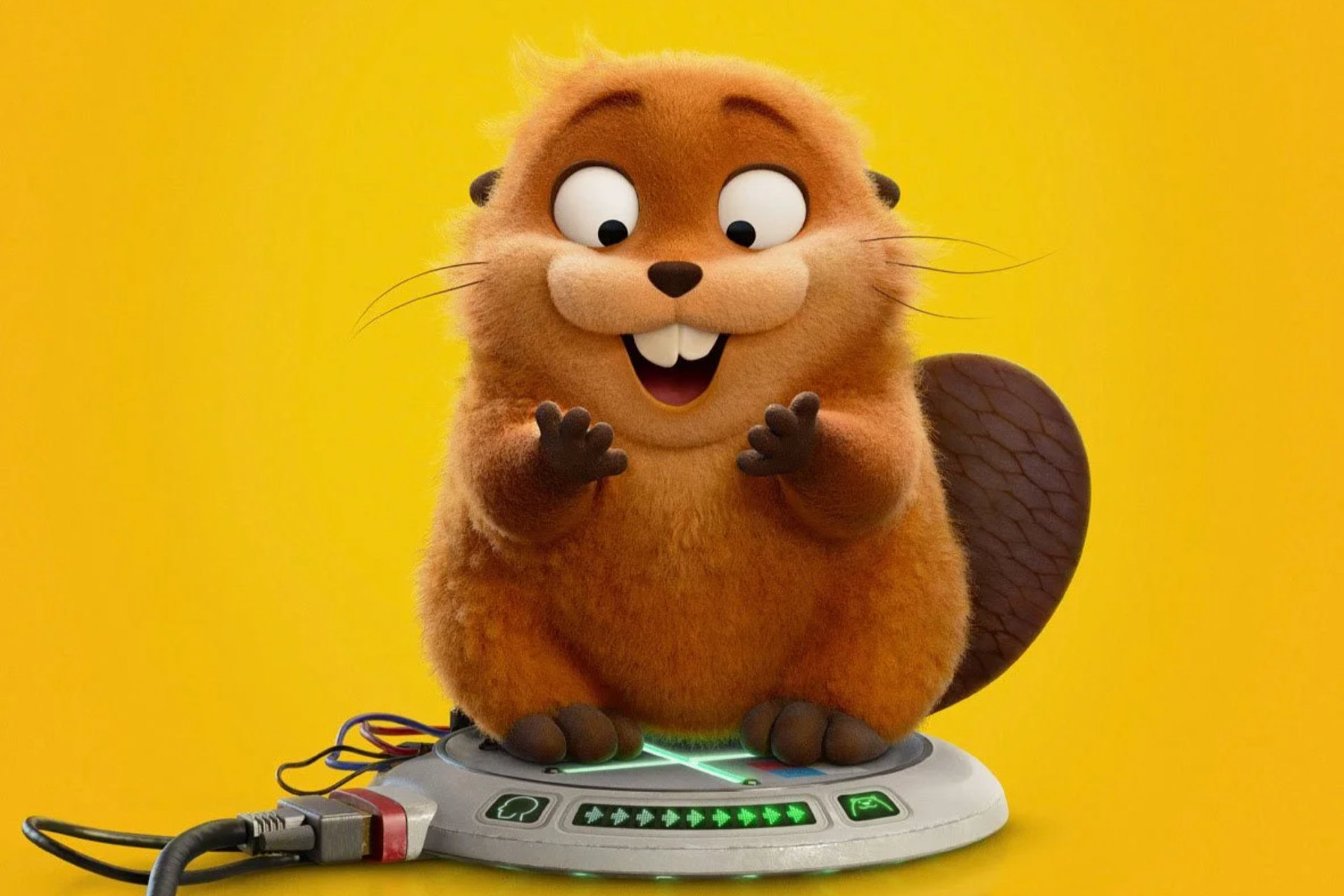
Daniel Chong’s Hoppers is the rarest of all cinematic treasures in this current decade: a Pixar movie that, without leaning heavily on past iconography or taking great pains to present itself as Art For Adults (and kids, we guess), manages to evoke the entertaining and moving qualities of the classics from the studio’s golden era. Chong does so by making a comedy first and foremost, and a silly one at that, before his film becomes an Aesop-like fable of surprising resonance. His re-hiring, following his departure from the studio and work on We Bare Bears for Cartoon Network, feels as if the studio heads in Emeryville suddenly remembered that, yes, somehow, both children and parents really like to laugh. In light of this unexpected rediscovery that they’re in the “entertainment” business, it seems that they’ve rediscovered a formula that, strangely, isn’t plastered on every entrance in the Disney lots and campuses for crew members to slap like a “Play Like a Champion Today” sign: a spoonful of sugar helps the medicine go down.
If the central conceit of Hoppers seems familiar – a misfit, through the advent of body-swapping technology, is transported into wonder-filled nature full of strange personalities, threatened by the advent of industrialized destruction — it’s more than happy to laugh along with you at the Avatar comparisons.* Yet its protagonist, Mabel (Piper Curda), won’t engender any comparisons to Jake Sully or whatever the hell Kevin Costner’s character was named in Dances with Wolves: she doesn’t have to learn to love the community she wants to protect. We open with her as a child, attempting to free the assortment of classroom pets from her elementary school, and she’s remained (mostly) unchained into her college years. Her love for nature was nurtured by her kindly grandmother (Karen Huie), who used a glade behind her home to teach the girl about controlling her frustrations. She’s heavily bothered by the indifferent state of the world, to the point that she’s been nearly ostracized by her community at large for caring about some dumb pond when there’s a brand new beltway going up in its place.
Seeing this symbol of tranquility — and a physical reminder of her now-departed grandmother — ruined by bulldozers and dynamite sets her off, drawing her into conflict with Jerry (Jon Hamm), the somehow-popular mayor who is cut from the same cloth as many a slick politician. After their latest conflict, he gives her a 48-hour deadline to do something, knowing full well that she probably won’t be able to muster up any support. But in a stroke of luck, Mabel sees a beaver get abducted by a black transit van, and, after hurrying off to stop the dammer-knappers, she discovers that it wasn’t really a beaver at all — it was a robot, created by her professor (Kathy Najimy) to infiltrate wild spaces, given that the beavers tend to notice when a big-ass person in a furry suit is coming to take their picture. Mabel sees her opportunity and commandeers the beaver-bot, transferring her consciousness into the critter, escaping the lab, and getting dropped (by a hungry owl, no less) right into the heart of the pond community.
Mabel’s not just observing, though: She can communicate with the wildlife as if she were one of them, and decides to use this gift to find an anchor animal so they can return and restore the glade’s ecosystem. She’s met with the same indifference she faced when she tried going door-to-door with a petition, and runs afoul of the “Pond Rules” They’re laws set by King George (Bobby Moynihan), a charming little fellow who is a born politician (at least in how he can remember every single one of his constituents’ names) and a die-hard fan of calisthenics and “partying” or, as we would call it, building a dam. He soon appreciates Mabel’s unusual skills, though, as she begins to undo some of the damage the humans have done to the glade, but she draws undue attention to his side of the animal kingdom. See, he’s only King of the Mammals, and the rest of the Animal Council, representing the various other types, have their own ideas about how to solve the human problem: namely, that they should kill Jerry. So, between craven humans, crazy animals, and a group of researchers looking to get their robo-beaver back, what’s she going to do to make sure everybody’s happy? And will she ever feel at home in either of these worlds, especially once her true identity is revealed?
To find out, you’ll have to watch it, but I can tell you that it’s a pleasure to watch the chaos unfold. Its sense of humor is very much akin to what Chong did with We Bare Bears, a mixture of goofyballery, understatement, deadpan, and slapstick, delivered with less of an ironic touch than you might assume. It had me in stitches for most of the runtime — be it Mabel’s effervescence at finding herself in the woods, or the animals’ attempts at recreating a strange noise that caused them to leave the glade, or, most uproariously, the surprising fate of the Butterfly Queen, voiced by Meryl Streep. There are too many good jokes to list, all of which emerge organically (instead of forced “randomness”) and are, shockingly, amusing to all ages. The action scenes have stakes, but also brilliantly silly flourishes, such as when a robot stork plunges into the side of a mountain and explodes like a TIE-Fighter hitting a canyon wall. It all feels appropriately pitched, as the cliché goes, for the whole family. The visuals are cartoony, not the kind of tech demo that Pixar’s often fallen back on in recent years as a justification for their abdication of the animated-storytelling throne. The critters are cute — I’ve been in love with the design of the beavers in this film for a bit — and the locales are gorgeous, and, all in all, it’s a very appealing package.
Wrapped within is a moral about finding one’s place in the world and nature, dispensed to us by the folksy wisdom of George’s Pond Rules, less golden rules than an echo of Vonnegut’s Bokononism that takes on additional meaning when rendered in the abstract. These credos aren’t patronizing in the same way that other Pixar lessons have been, perhaps because Hoppers is so willing to endear itself to the audience, and how hard it works to ensure that these messages are meaningfully deployed. Cue the normal jaded responses about the irony of Disney being the messenger, with the requisite “I Am Very Smart” ending the retort. This isn’t a sermon delivered to us by hypocrites — instead, it has a genuine feeling animating it, much like the spark that Mabel brings to the little robo-beaver. It’s very gentle in how it states its themes, refusing to push too far into territory that might bore the kids. This was the old Pixar formula, after all: Lead with a high concept, have plenty of fun along the way, and have the pivotal moments resonate. The great error Pete Docter made with Up, whose first ten minutes and the subsequent critical circlejerk that followed I blame more than Cars for its role ruining the studio’s Golden Age, was to forget this, and it took until now for them to rediscover it. Chong gets it, and that’s why Hoppers is such a dam good time at the movies.
* Undoubtedly helped by the fact that Disney also owns that property.