
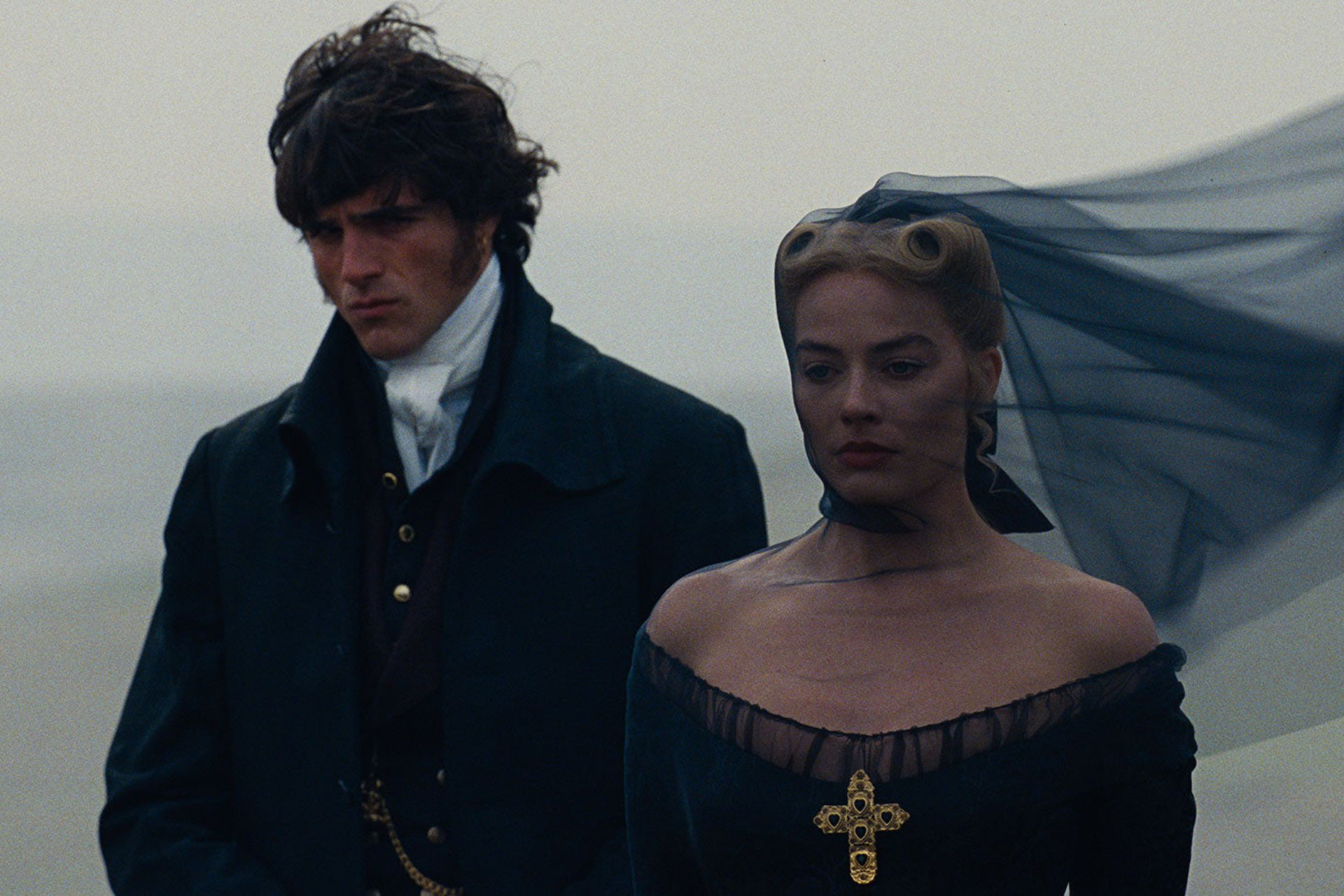
In one of those typographic power moves that’s becoming way too common in modern cinema, Warner Bros. is asking that writers always refer to Emerald Fennell’s “Wuthering Heights” with the quotation marks. This is less the enforced romanticization of Old Hollywood aesthetics and more a preemptive defense against the legions of BookTokers who will likely savage the adaptation, with some justification. I’m by no means an expert on that book, so I’ll leave that to others to explore, but it gives off similar vibes as to what Cecelia Giménez, to the internet’s horror, did in restoring the fresco Ecce Homo 14 years ago. It’s somewhat recognizable as the Emily Brontë text — there are characters named Catherine (Margot Robbie) and Heathcliff (Jacob Elordi), and they’re bitter dark-triad personalities locked in a faux-incestuous pattern of mutually-assured self-destruction — but, much like Ecce Homo, it’s had all of the detail smoothed over by heavy coats of paint. This is why Fennell insisted on the quotation marks, which read in practice as scare quotes: It is her take on Wuthering Heights, and, goddamn it, she can do whatever she wants with it.
She’s correct in that. Brontë’s lone published novel has been adapted countless times across various media, has inspired numerous derivative works, and is generally misunderstood as an epic romance because of those adaptations’ aesthetics. What we haven’t seen before, and what Fennell starts off her version as, is a bawdy farce. The opening titles play accompanied by the sounds of what we presume is a man mid-coitus, eventually revealed to us in a smash-cut as the jerking spasms of a condemned man choking to death while he’s being hanged. Kids in the crowd point out he’s got a boner, a nun licks her lips, folks frolic and cavort — as the hangman says, “It’s fuckin’ ‘angin’ day!” Say what you will about matters of propriety or whatnot, at least this is an ethos grounded in some amount of historical fact. It was an interesting time to be alive — one could just buy children at local taverns, as Catherine’s alcoholic dad (Martin Clunes) did with young Heathcliff. They live, alongside Catherine’s paid handmaiden Nelly Dean (Hong Chau), on the Yorkshire Moors in a dilapidated estate, rendered by Fennell as the Fortress of Solitude, with a manor house attached to it.
Young Heathcliff and Catherine have a master-servant relationship—her father refers to him as her “pet” — and they eventually fall in love, though neither would be willing to admit it as children. He takes beatings intended for her, she teaches him how to read, and so on. By the time they’re adults, Dad’s worsening alcoholism has put them into dire financial straits, and Catherine agrees to marry the rich Edgar Linton (Shazad Latif), who lives at the adjacent estate with his awkward sister, Isabella (Allison Oliver). Heathcliff overhears part of her discussions with Nelly, and abandons the only home he’s known for some chance at a better future. A few years later, he returns, wealthy, clean-shaven, ready to hate-fuck Catherine like the Byronic hero he is, but Catherine’s got other ideas. They fall, once again, in miserable, messy love, only this time they’ve got more capital to burn and lives to ruin. If you think I’m being flippant, I’m not: I’m accurately describing the story as Fennell portrays it, as if she read a Mad Magazine parody of the Ralph Fiennes/Juliette Binoche version and decided to play it straight with the creative license. You’ll witness the most passionless lovemaking in the history of cinema, excruciating humor, and a truly odd turn into treacle tragedy in the final few minutes.
The tonal clash is really what sinks the picture. Fennell cannot manage the transition between broad, filthy comedy and dark, passionate romance, and one can feel pieces of the hull getting scraped off by the rocks each time she fumbles a joke or a love scene. It’s astonishing how poor the editing often is — the first scene following the hanging is arrhythmic in a truly weird way — and the visuals are muddled with grey-blacks, and I’m assuming that they’re meant more for an OLED TV than on a theatre screen. Robbie and Elordi are caught in a trap: Their characters never show organic growth or consistency, yet they must spend scenes desperately searching for a way to accommodate their director as she flails. They’re not a bad pairing, though I’ll never understand why Robbie abandoned the dynamism of her earlier work to glower — there are glimpses of real energy here (she crashes out at the stoic Elordi a bunch, which is decently amusing) — and are probably the best-equipped to deal with the varying demands and oscillating tone, though by the time Elordi starts breaking out the dog collars for Oliver, we’re well-past the point of no return.
This, I guess, is what’s so interesting about why “Wuthering Heights” doesn’t work: Fennell can’t come up with anything more shocking than what Brontë wrote, but she also is strangely terrified of adapting the book or dealing with any of its meanings. She is, let us not forget, a Message filmmaker first and foremost, and her works are always derivative in some fashion. Promising Young Woman was a second-hand Ms. .45; Saltburn a Ripley novel if gently informed by modern class struggle and Eton bullshit. The other hallmarks of her work are here — gaudy production design, with the interiors of the Lintons’ manor lifted straight from Bergman’s Cries and Whispers; psychosexual games vaguely influenced by a kink that comes close to abuse; a light critique of excess steamrolled by her thirst for depicting it. Is it the “anxiety of influence” here? Given true-blue event film status — including a Charli record mostly left unspun in favor of HEAVY STRINGS meant to tell us when we should be feeling something genuine — it’s bizarre that she would cede the chance to make a work motivated by purpose, much like her prior output, to craft a limp retread that doesn’t even succeed as shock-value camp. Such is “Wuthering Heights,” a film likely to please no one, including Fennell herself, at least by the standards she’d previously held herself to. Call it Ecce Defectus. No, wait: “Ecce Defectus.”