
Ric Roman Waugh’s Greenland: Migration* is a late Christmas gift to pedantic “science-on-screen” YouTubers, given that they’ll likely tear this thing to shreds the minute they find a rip of it online. Disaster movies normally have it rough with that crowd, as most of the time, realism is anathema to fun, and instead of being told “Yes, we know the Mayan calendar doesn’t work like that” or “No shit the moon isn’t a giant hollow space station” by friends, they’ve formed a whole cottage industry around taking Alfonso Cuaron and company to task for their sins against science. If Waugh wanted to make a scientifically accurate version of this movie, well, it’d be a whole lot of people starving to death inside of a bunker located in the title territory, as the air outside would likely be impossible to breathe, and the notion of trekking across a surprisingly somewhat functional Europe to a paradise inside of a crater just five years on from impact would be something John Garrity (Gerard Butler) might imagine as the carbon dioxide crowded out the oxygen in his lungs. That’s not much of a movie there, regardless of whatever happened in Jacob’s Ladder.
That “fantasy,” in the broadest possible terms, is what happens as text here. It’s been five years since John, his wife (Morena Baccarin), and their son (Roman Griffin Davis) made their way to the bunker, following the comet Clarke colliding with the Earth. Its devastation is impossible to ignore, even in the “safe” spaces – the air is toxic, radioactive lightning storms frequently ravage the grey, dead landscape, and if you look up at night, you can see the new ring of micro-comets the Earth has surrounding its orbit, some of which enter the atmosphere each day – but the Garritys are keenly aware that they’re lucky. John, being a man’s man, volunteered for a dangerous job searching the surface for useful tools and items that may wash up on the beaches, and even though he’s got PPE, he’s got a nagging cough that suggests something much worse. That’s all well and good, and a problem for the future: right now, he’s got to focus on his day-to-day responsibilities, as it’s looking like the bunker might be the only place they’ll be able to stay in for the foreseeable future, as taxed as their resources are, as low as their food supplies may be. It’s still a home, full of what remains of human kindness, and it’s perhaps the most secure place on Earth.
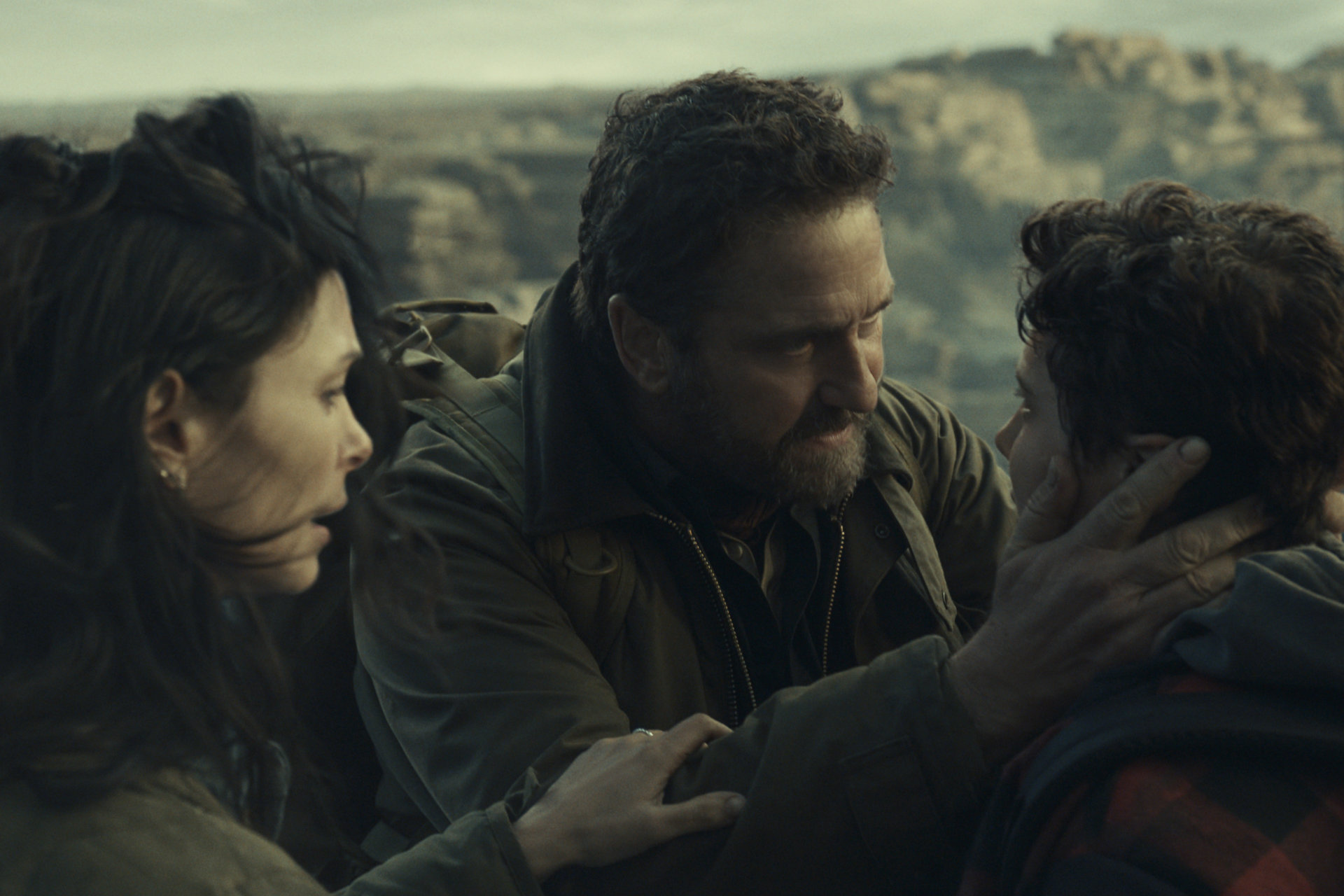
Well, it was the most secure place on Earth until plate tectonics decided to ruin that party. A massive earthquake and subsequent tsunami force the Garritys to leave well before it’s safe or they’re ready to do so. That’s when they begin their credulity-straining trek, traveling in a lifeboat from Greenland to Liverpool, where they encounter what remains of the British government, and from England to France, where they meet a kindly mail carrier (who turned his regional post facility into a fortress) and his family, and from France to the impact site, where, much like the Ngorongoro crater in Tanzania, a new, healthy biosphere has emerged from disaster. The only problems are the other people in the way and the fact that everything wants to kill them. Crossing the English Channel, for one, becomes an arduous mountain-climbing experience, where high winds and earthquakes threaten to send the family crashing down a chasm. If not that, it’ll be the lightning storms that kick up or the comets themselves, or some other manner of post-apocalyptic destruction. Like the first one, John’s main goal is to get his family to safety, even if it means his death in the service of that mission. It’s kind of a bummer, frankly.
Here’s the thing: disaster movie narratives, in and of themselves, are honestly very simple when taken out of the realm of the personal. A rogue wave strikes a ship, and a few people survive. A building catches on fire, and a few people survive. Global warming creates superstorms, and the United States moves to Mexico. The Mayan calendar ends, and we finally get to see what Noah’s Ark might have looked like if they had modern engineering in biblical times. An asteroid hits, and Morgan Freeman tells an assembled crowd in front of the Capitol building that they’ll rebuild. Unless you’ve got a small-scale disaster like in the first two examples, you rarely get a follow-up**, and that’s because the aftermaths are complex, sad, and incredibly messy, antithetical to the very values that a disaster movie tends to hold dear. It all becomes quite real, in a way, where the horrors of a world-changing tragedy stop being fun and start resembling something one can empathize with rather than a destruction-heavy satire. We had a whole discourse about this in 2013, when Man of Steel and Star Trek Into Darkness crammed the indiscriminate deaths of millions into narratives that didn’t really require them: the sequences’ intrusion, once again, ruined the fun.
Every choice Waugh makes here is meant to try and disguise how utterly horrific it would be to walk a craggy mile in his protagonists’ shoes, but it’s impossible to avoid acknowledging the hopelessness of their circumstances. In the moments between set-pieces, he accidentally evokes other, better movies like Cuaron’s Children of Men, which attempted to engage with the malaise its characters suffered, viscerally realizing the pain and intensity of the real-world analogues to incidents in its narratives***. A stop in London to see an old friend, now the guardian of a functional nursing home, echoes Clive Owen’s visits to Michael Caine’s elderly stoner, caring for his disabled wife, waiting for the clock to run out. A midnight raid on the Garritys’ car on their way to Dover reminds one of the equivalent, infamous sequence in Cuaron’s film, complete with out-of-nowhere death in the middle of idle chatter. Yet Children of Men retains a sociological interest in this depressed Britain, while Greenland: Migration is cognizant that it can’t indulge in the same curiosity – there’s only so much time to spend on, say, the last modern war, outside of the Promised Land, between the French and “Eastern” enemies, even though that’d be fascinating to explore a bit – as it would kill the momentum. Besides, there’s the budget to think of.
Yet, despite all of this, I commend Waugh for trying to do something that very few genre filmmakers attempt or are even allowed to pull off, and I think Greenland: Migration should come with a disclaimer stressing that you should not be watching this for accuracy but rather for the quality of Butler’s performance. In many ways, Butler shares a great deal in common with Hugh Jackman – talented stage performers who found their way into Hollywood through comic book movies, their arcs only diverging because Butler didn’t have additional sequels on his contract for 300, a bedrock to return to in between more adventurous gambles. There’s a certain amount of Logan in Butler here, playing a character thoroughly worn down by all of the shit he’s witnessed, only alive through sheer dumb luck, only sustained by the idea that his family might have a future, and he’s able to communicate this with a relative amount of naturalism. It’s through his tired eyes that Greenland: Migration finds an empathetic anchor, some light to guide us through the dark surrounding humanity at the end of this world.
* It’s called Greenland 2: Migration in the marketing materials, but the actual title card for the movie leaves out the numeral.
** Even then, Beyond the Poseidon Adventure would have likely been a legal thriller about whether or not the shipbuilders and cruise companies were liable for damages.
*** Cuaron’s prescience – the refugee experience, for one example, as highlighted in the astonishing finale — is one of the reasons I think the movie isn’t talked about as much as it should be. It’s too real.