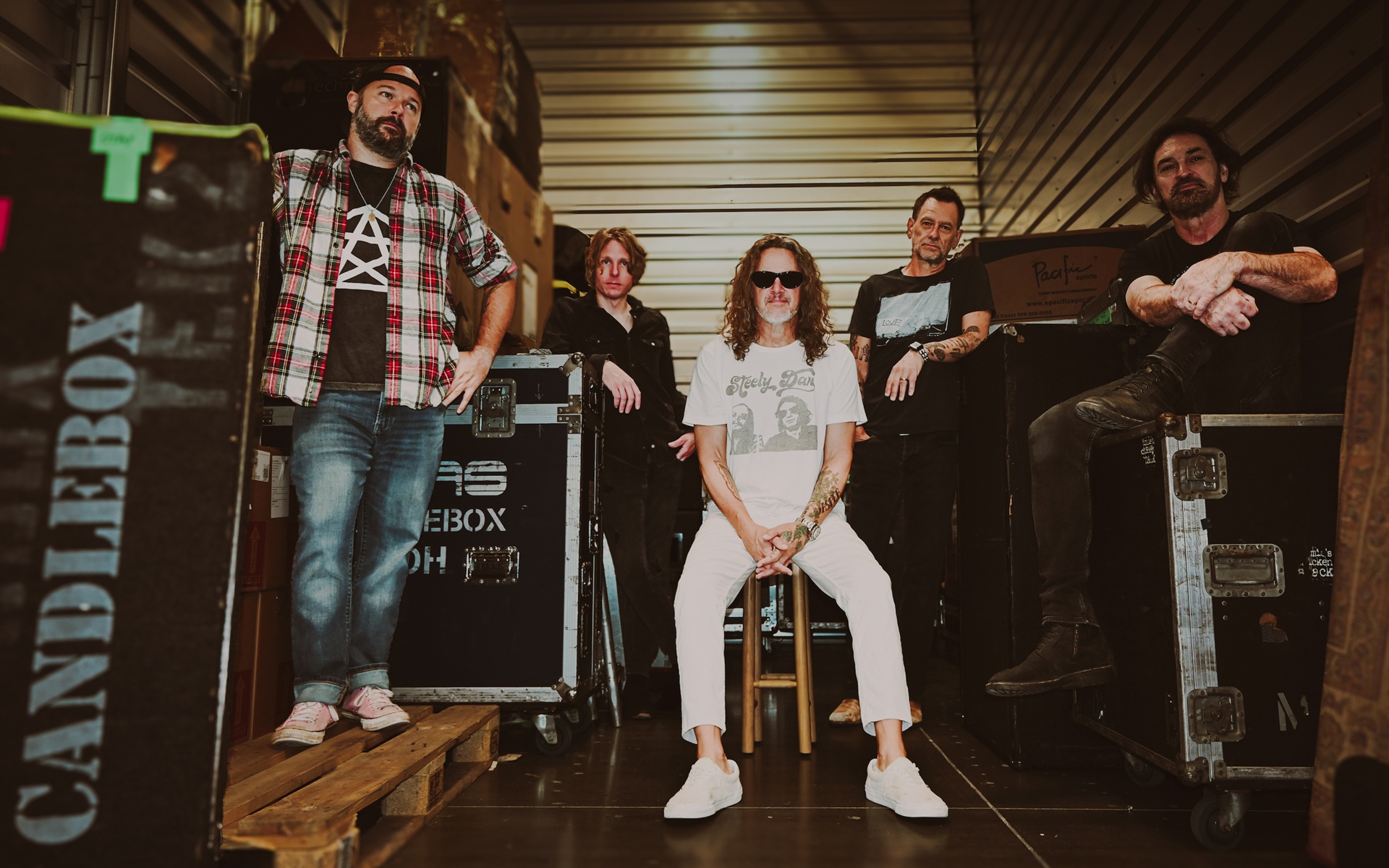
Not too long ago, Candlebox was ready to call it a day. Having burst onto the scene in the wake of the early ‘90s grunge explosion with hits like “You” and “Far Behind,” the Seattle outfit launched its Long Goodbye Tour in the summer of 2023, with frontman and sole original member Kevin Martin frustrated on a number of levels with touring and the industry at large. The trek kept getting extended, with a first-ever foray into Australia, before perennial road dogs Bush tapped the group as openers for yet another Stateside run in 2024.
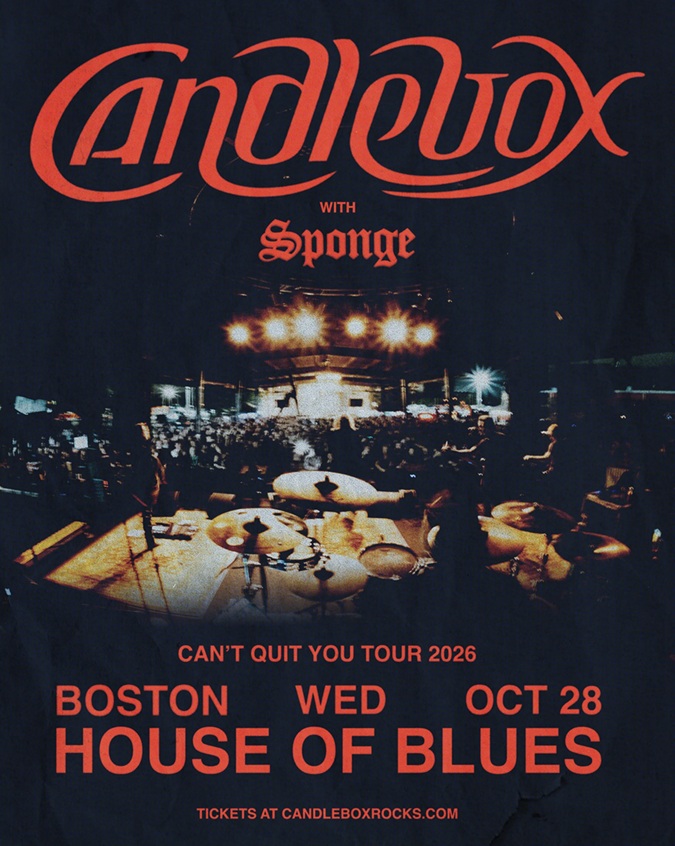
Just when it looked like things might finally be winding down, it was announced in January of last year that co-founding guitarist Peter Klett had returned to the fold full-time after departing a decade ago. The move reinvigorated Candlebox, and last month they began the Can’t Quit You Tour, which stops in Boston at House of Blues on Wednesday night (October 28). A new song, “I Remember Everything,” was released to celebrate Klett’s return and the start of the run, with more music on the horizon.
In some respects, Candlebox’s second act – or maybe third at this juncture – might stand as the greatest testament to their staying power. From the beginning, as the inaugural artist signed to Madonna’s vanity label Maverick Records, they were derided by many a critic and fans who didn’t consider them in the same league as Pacific Northwest heavyweights like Nirvana, Soundgarden, et al. The fact that they’re still going, despite the endless obstacles, is the ultimate rebuttal to those who thought they’d never last.
Ahead of tomorrow’s show, Martin sat down with Vanyaland for a 617 Q&A (Six Questions; One Recommendation; Seven Somethings). He discussed the future of Candlebox, the disappointment with the way the band was received by the press and music community in the early days, and what it is that makes the ‘90s such a special decade. Martin, a former drummer himself, also went deep on his favorites to ever sit behind the kit.
***
:: SIX QUESTIONS
Michael Christopher: Have you officially said goodbye to the idea of The Long Goodbye?
Kevin Martin: [laughs] Yeah, pretty much. It’s funny, I really, honestly thought that I was done [but] having Pete come back, we’ve been very inspired in the writing process. Listen, I’ve said it before, I think retirement is one of those things we all think we need in the music business. We all think we get there, and it’s not what we need. It’s really we just need a break, and we need to reconnect with the things that we love. What we got involved in the music business in the first place was for the music. So that’s kind of where I’m at.
Thinking back to the things that you love and the reasons you first got into it, obviously your partnership with Pete is one of them. How much of a role has that played in rekindling the fire behind Candlebox?
It’s probably about 100 percent of it, to be honest. I don’t think I really realized how much I actually missed writing music with him. I had gone and done three records with my buddies, and Candlebox continued to move forward, but it just felt like something was missing. And I’ve said it before, I don’t want to discount what I have with [current members] BJ [Kerwin] Island [Styles], and Adam [Kury] at all because I love those guys and they’re great players, but there’s just something about working with the person that you started the project with. And Pete and I have that connection. I don’t know, I really just did not realize how much I missed writing with him.
One of the things that I always found fascinating about Candlebox is you go out and do all these tours and records, but every now and again you would reconnect with the original lineup for hometown reunion shows. And when the rest of the guys originally left the band, it was like, “Oh, it was amicable.” Everyone says that, and nobody ever believes it. But with you, it’s really true. What are those shows like for you, and what’s the future hold for them?
Well, I mean, the reunion shows are always fun. They’re very stressful, I’ll tell you that much.
Really?
Yeah, because Bardi [Martin, bass] and Scott don’t keep playing Candlebox. They’re not on the road. They’re not playing the songs. They haven’t played them in five, 10 years. So, it’s very stressful because it’s difficult to get into a rehearsal space where we can actually work on this stuff as a group. And Seattle used to have all these great places [to rehearse] and that’s all gone because the city’s changed so much. So, finding a place to get together to rehearse is a pain in the ass.
Having a bass player and a drummer that haven’t played together in 15, 20 years, trying to reconnect on that level of things is stressful. But once it kicks into gear, it’s an absolute blast. The shows are amazing, and we all have a good time, and we split everything equally. There’s no “Pete and I are still doing it, so you guys only get five percent.” Everything’s 25 percent. We do it exactly how it should be. And the shows end up coming off great. It’s difficult to schedule the time. And normally we only do it on a 25th anniversary, a 30th anniversary, stuff like that sort of thing. So, it gives us time to prepare.
I don’t know going forward if we’re going to continue to do that. I think Bardi and Scott are so busy now with their world outside of Candlebox. Bardi’s going to be a judge. He’s running for that. Scott’s got so much business going on, it’s not funny. So, I really don’t know what that holds for Pete and I with Bardi and Scott in the future, to be honest with you. We haven’t really talked about it, so I don’t know. I mean, my goal is – I told Pete, I said, “Look, I don’t want to be doing this when I’m 61, 62, 63 years old.” I’m 57. So maybe when we all hit 65, we do a show. I don’t really know, but I mean, I’m tired, I’m old, and I’m cranky [laughs] – you know? And I’m letting the future kind of dictate itself.
Those early days of Candlebox, you were looked at as sort of the second wave of grunge. And when Maverick signed you, there were a lot of people who were like, “Oh, that’s just Madonna trying to get a grunge band on her label.” Was that frustrating for you, knowing that you had been on the scene since day one, and that people didn’t consider you a “real” Seattle band, or whatever else people would say?
No, absolutely, man. I mean, you work very hard to create music that people want to listen to, and we grew up in a city full of incredible talent and brilliant human beings and brilliant artists, and to not be recognized for it by that community is a very strange feeling. It was worse, though, in the media because we were kind of the redheaded stepchild from the Seattle music scene, and the media was kind of at the point when we hit… like, when we did Woodstock in ‘94, we got invited to do the press tent, and we were introduced by Larry White, who is one of the most famous Warner Brothers A&R reps to travel with bands on the road and do your media and stuff. He was handling the Chili Peppers and Van Halen – his list goes on and on and on.
So, when he walks in the tent, everybody’s like, “That’s Larry White. Who’s he got?” And Larry’s like, “Hey, ladies and gentlemen, this is the only band to be in the Billboard Top 10 right now. They’re currently moving 170,000 units a week. Their record is number seven on the Billboard charts; ‘Far Behind’ just hit number two on modern blah, blah, blah. Ladies and gentlemen, Candlebox, any questions?” And there was not a single question, nothing.
We did a Rolling Stone [feature], and they sent a writer out with us, and he kind of bashed us. We were just never really accepted into that world. So of course it was very, very frustrating, and I’m easily perturbed [laughs]. So being that band and not having the support of our community behind us, let alone the industry or the media, was incredibly frustrating. But that being said, the beauty of what that was was we are the favorites of our audience, and our fans had been there since day one. We don’t have the millions of fans anymore that we had back in the day, but we do have a pretty solid foundation, and 33 years later we’re still doing this. I think it speaks for itself in that sense.
***
One of my favorite memories of Candlebox, and the time might not be one of yours, but it was on the Happy Pills tour, ‘98 or so, and you were playing a small club in Philly. Times were kind of lean. Something happened with your throat, and some dates got canceled in the beginning of the tour. The lineup is shifting around, but you come out and do this killer set, a ton of covers. You do “Sweet Emotion” [Aerosmith], “Cinnamon Girl” [Neil Young] – I think you threw in “The Ocean” [Led Zeppelin] during “Arrow” or something, and you were just running this room. I was curious as to what you were thinking around that time. Were you just happy to still be doing music and just getting out there in front of whoever was going to show up?
I think so. I mean, it’s kind of hard for me to remember that perfectly, even though I just wrote a song called “I Remember Everything” [laughs]. But I think I do. What I loved about that tour was… I think we were very disjointed at the time as a band, but there was something that was happening magically on stage, and it was because of that new blood [in the lineup]. Pete was struggling with his emotional well-being, drug addiction, alcohol addiction. He just celebrated 25 years sober the other day, which is incredible, but he was going through some difficult times. So, Robbie [Allen], myself, Shannon [Larkin], and Rob [Reddick] picked up and took the show to a new level, and I really enjoyed that.
And I was also very inspired by Jonathan [Wilson] and Benji [Hughes] from [openers] Muscadine because those guys were so incredibly talented that I just really was inspired every single night by what they were doing. And so I think that, yes, I was very happy. I was concerned as to what was going to happen with Candlebox, but I was incredibly happy with where we were in that arena of things, the venues we were playing, the songs we were playing, the length of our shows. I had gone through the healing process of my throat because I had had a vocal hemorrhage early on in the summer, so everything was feeling really good for me, and I was enjoying myself a lot. But I do think that we were struggling as a band with trying to keep it together and how far we were able to take the band, or how far the band was going to continue to go.
Eventually, the band goes on an extended hiatus. Now you’re back and getting such a positive response from audiences, not just people that grew up on Candlebox, but from the newer audience. Is that just, “Well, it’s cyclical, the ’90s are popular again,” or do you think there’s something else going on there?
Well, I think that it’s all of the above. I’ve said it in several interviews: There’s something very special about the ‘90s, the music scene from the ’90s. There’s a sincerity to those songs and to that music that I don’t think we’ll see ever again. There was a movement that was happening, and this is all obviously pre-cell phones and all that sort of thing. So, if you found out about a band, you had to find out the hard way or the real way or the organic way. There were things that were happening that were incredibly magical.
What’s happening now, I think, is that there’s a young generation that’s obviously seeing it or hearing it on TikTok, but they’ve also heard it from their grandparents or their parents. We’re seeing kids in their 20s that are like, “My mom raised me on you guys,” or we’re seeing kids that are 12 and 13 and 14 going, “My grandfather used to listen to you all the time, and my mom listens to you, or my aunt or my uncle,” or something like that. So that’s kind of what we’re seeing.
And the weird thing is they know the songs; they know the new stuff, so they’re the ones that are digging through the catalog. They’re the ones that are going through Spotify and finding other tracks. They’re not just listening to “Far Behind,” “You,” and “Cover Me.” They want the deep cuts, and that’s kind of a cool thing. So, it’s rewarding, and at the same time, it’s confusing and shocking, but I love every second of it, man. It’s nice to see new faces. It’s nice to see young kids that are singing your song that maybe other audience members are going to get a beer [during].
Does it trip you out at all to think that when you were young, around the same age as a lot of your audience, you were getting into bands like Zeppelin, and at the time, that band was three decades removed from where you were in life? Now, the people that are getting into your music today are the same age as you were when you were getting into Zeppelin, but they’re getting into Candlebox. I’m sure they’re still getting into Zeppelin and everything, but that’s got to trip you out a little bit.
Yeah, it’s pretty cool. I’ve thought about that a lot. It’s interesting that you brought that up because that’s one of the things that’s crossed my mind. It’s kind of like the first time I found Led Zeppelin when I was 12 years old, and I had been playing drums, and I was inspired by Neil Peart because of my older brother, but then all of a sudden I got hold of Led Zeppelin I and immediately had to learn how to play “Communication Breakdown.” So, I’ve thought about that, and the interesting side of that is it’s probably completely parallel to my life, which is pretty rad.
:: ONE RECOMMENDATION
I’m going to go with music, man. I think that there’s so much great music out right now, and a lot of the young punk stuff that’s happening is brilliant. And I think that the female punk scene is insanely cool. Niis out of L.A. I love The Bad Nerves out of the UK. Those guys are incredible. There’s a band called October Drift, which is kind of a grunge punk band, which I really like. They’re out of Manchester. I think they just broke up, though, sadly. And what’s going on in music, I think, like, what the Fontaines D.C. are doing, this kind of ethereal dream pop, rock, Manchester, punk thing…Idles is insane. And I’m not giving [you] anything new that nobody’s heard about. It’s just I think that this punk rock scene that’s going on right now is so impressive to me, and it so hits home because it’s how I grew up. It’s what I grew up listening to, and I think that it’s important right now.
***
:: SEVEN OF SOMETHING
A lot of people don’t know that you were once a drummer. Who are seven of your all-time favorites? And give me a song from each that you feel like represents them best.
Number one’s going to be John Bonham. Anything from Led Zeppelin, but “Trampled Underfoot,” I think, is one of his most interesting…I mean, “Stairway to Heaven, forget about it. It’s insane. But “Trampled Underfoot” is incredible, just the way he pockets on that song and picks up – everything about that song.
Jeff Porcaro, “Rosanna” [Toto]. Again, very similar to “Fool in the Rain” by Led Zeppelin, but Jeff Porcaro had such an interesting approach towards the jazz side of rock and roll and the pop side.
Alex Van Halen. That’s certainly going to be “Hot for Teacher.” Alex is one of my favorites…I mean, I think probably my favorite Van Halen record’s going to be “Mean Street,” but I think “Hot for Teacher” is such an interesting way to approach drumming, and the way he starts that song, he’s moving in between insane time signatures.
Greg Upchurch, one of my favorite drummers. I met him when he was playing with Chris Cornell. He was a drummer for 3 Doors Down forever. He played in my band, The Hiwatts, for about six months, and it was one of the greatest experiences I’ve ever had with a drummer. Super, super, super talented kid. He could do four different time signatures when he plays. So, he can do a kick pattern that’s in a seven, he could do a hi-hat in a six, he can do a snare in a four, and he could do a ride or any other tom movements in 16s or 11s. He’s insanely brilliant and a super underrated drummer, and I love Greg, and he’s a great friend. He puts out his own music. He’s got a song called “Skin to Skin,” which came out during the pandemic, which he plays drums on, but it just shows his ability as a musician and as an artist, everything that he’s capable of. But his drumming on that is spectacular.
Dean Butterworth I’d seen play with Ben Harper and The Innocent Criminals, and that’s how I first got to know what his drumming was, and I loved his playing, but I think what he did on that song of mine, “Enemy,” is just incredible.
Neil Peart, and I’m going to go with “Red Barchetta.” I mean, 2112, there’s a million songs on there, but I always loved playing “Red Barchetta” on the drums, and it’s one of the songs that I would go to during my learning to play parts and figuring things out. It was not an easy track for me to learn, because I learned by ear. I never took drum lessons. I taught myself how to play, and I always loved that song.
Josh Freese. There’s a million songs, but let’s just go with “Judith” from A Perfect Circle. I mean, one of the greatest… the way he comes in on that is just amazing, but he swims so beautifully in everything he plays
I’m forgetting Scott Mercado, I’m forgetting so many drummers, but those are my seven that inspire me as a drummer, and those are drummers that I go to when I want to find what it is that I’m looking for in a song.
How often do you play the drums these days?
Once a month, maybe. [laughs] Not enough, not enough, but it’s not my job. Not my job.
CANDLEBOX + SPONGE :: Wednesday, October 28 at Citizens House of Blues, 15 Lansdowne St. in Boston, MA :: 7:30 p.m., all ages, $32 to $102 :: Event info :: Advance tickets