
Editor’s Note: Vanyaland film editor Nick Johnston has left the country, posting up this week in the Great White North to cover the 51st Toronto International Film Festival. As usual, and perhaps now more than ever, we wish we were up there with him! Check out our continuing 2026 coverage, get rolling with our official curtain-raiser, and revisit the complete Vanyaland coverage archives from past TIFF editions.
Thinking of a movie like Lauren Miller-Rogen’s Babies as a hot-button political statement is bizarre, but such is the weird world we live in currently. If one had a nickel for every time some minor pundit brought up falling birth rates, they’d have enough for a comfortable early retirement. Much of this concern comes from the fear that, in the pundit’s estimation, the “wrong” people are having the babies — we’re nowhere near having the anxiety a country like Japan should have about its aging population — and if that cord is tugged at too hard, you’re likely going to be buried in an avalanche of pseudoscience and/or outright racism. Any solution to this problem that also results in a would-be child and their parents thriving is dismissed out of hand as socialism, so any policy mainly focuses on causing hurt — restrictions, punishments, and so on — and the continued panic continues when these attempts fail at making well-off and educated WASPs reproduce at replacement rate levels.
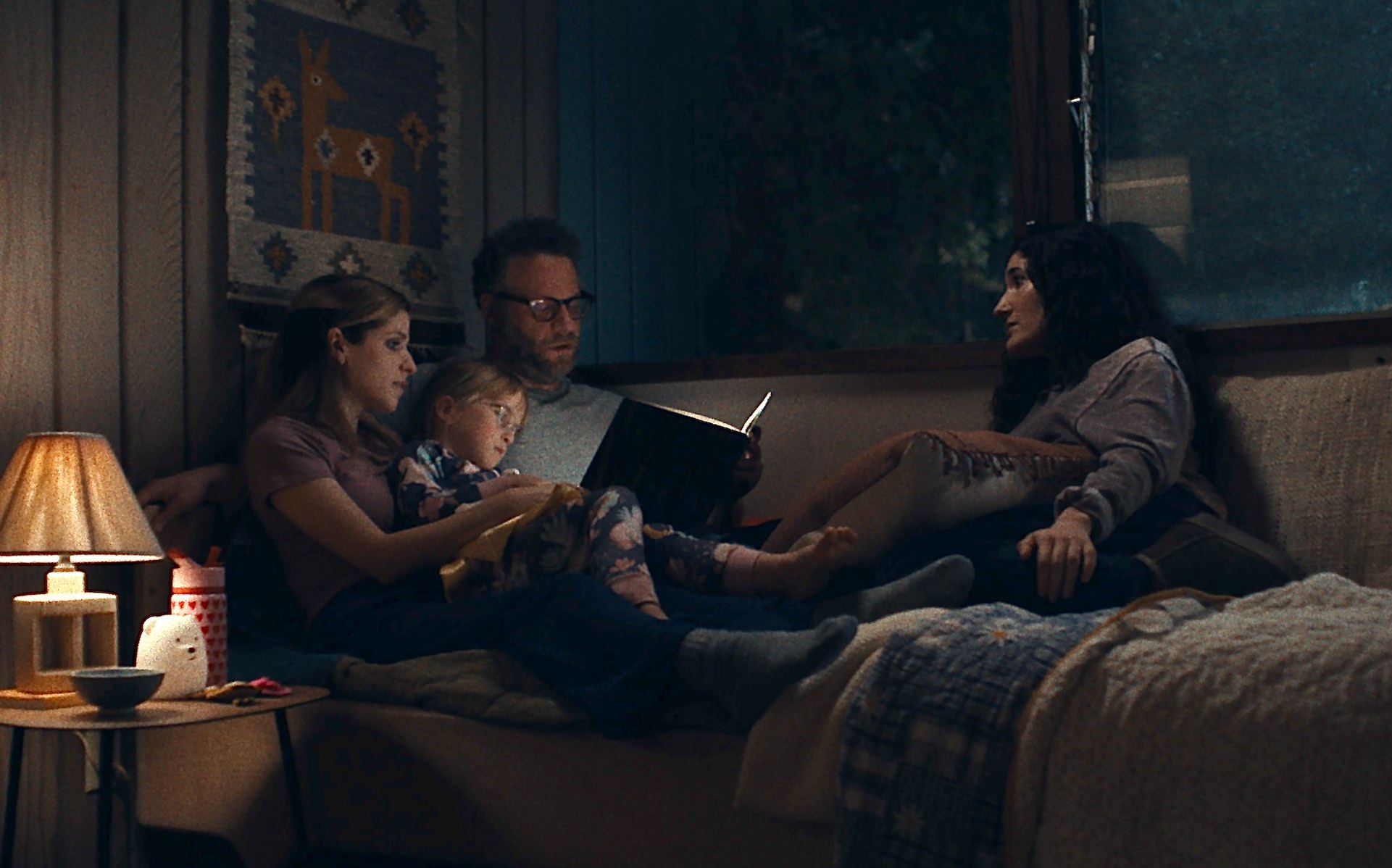
Truth is, the Industrial Revolution happened, the 20th century happened, and people like Annie (Anna Kendrick) and Aaron (Seth Rogen), an upper-middle-class LA couple in their mid-30s, have the right to choose whether they want to have kids. They’re not doing subsistence agriculture — Annie teaches pottery classes and hopes to open her own gallery, Aaron does an email job of some kind — and are comfortable, so why bring a child into an ideal DINK situation? Well, they love kids. They’d be fantastic parents, as proven when Annie’s friend Eliza (Kate Berlant) leaves her husband (Dan Stevens) and brings her daughter to crash with her in A&A’s guest room. They become pseudo-parents while Eliza’s out showing houses, and they’ve got a real aptitude for it — even when the kid is a kid and not a DJ prodigy who loves the Cocteau Twins. Childhood is pretty gross, and they’re pretty good at dealing with all of the disgusting things that come along with it. They’re also warm-hearted: Annie takes care of her aging father (David Strathairn) while he exhausts himself tending to her mother, near the end of her struggle with Alzheimer’s; Aaron openly weeps while reading bedtime stories to the little girl.
What bothers Annie and Aaron is the pressure to “choose.” Their early-millennial friends made theirs a while ago, and their acquaintances, not understanding how insanely rude it is to even mention this much less expect a response, continue to ask them why they don’t have any children. When the Anthropologie Gestapo question you, they expect an answer, and instead of doing what one should do if they know they’re never going to see someone again — launch into the wildest, most-uncomfortable sob story known to man so as to hopefully prevent them from feeling they have the right to interrogate childless adults — Babies takes the form of an answer. There’s plenty of narration, some of which works (Rogen’s segment is well-written and less burdened with pointed rhetoric), and some of which doesn’t (Kendrick’s, whose voice feels less interesting when detached from her screen presence). There are lots of little scenarios and observations, documenting the joys and struggles of specific stages of parenthood, and some exploration of legitimate anxieties about both sides of this argument. They could wind up like Annie’s mom, only without someone to take care of them. They could bring a child into a First Reformed nightmare of climate change hell. Ultimately, the decision is selfish — it’s about what Annie wants, as it should be, with Aaron offering opinions without coercion.
Look, it’s way funnier than I’m making it out to be. Miller Rogen is a strong writer, and she does a good job capturing this dilemma without turning it into maudlin drama (all the time). Kendrick and Rogen are a really wonderful on-screen couple, which surprised me at first but made a ton of sense upon reflection — she’s all fire, he’s all sativa — and they play off each other well. A few diversions don’t quite work: one involves an angel investor, played by Ed Helms, looking to invest in Annie’s gallery; another has Strathairn’s character go on an awful friend date with a crazy lady played by Sharon Stone. These elements don’t gel because they’re too wacky, and Miller Rogen does such a good job realizing her core group of characters — including Issa Rae as one of Annie’s oldest friends — that they’re just a little more distracting than hoped for. Back to that point about drama, though: that aspect of the film works very well, and it’s genuinely moving at times. It’s hard not to choke up a bit when Kendrick panics about her father’s stress or her mother’s slow decline, or when Rogen tries to comfort her after a health scare. These moments have a clear-eyed earnestness, presenting bits and pieces of life honestly rather than forcing them into cliché.
Babies is a bit messier than one would hope — the scene-to-scene transitions are jarring and frustrating — but I think, out of the whole Apatow-adjacent set, Miller-Rogen probably has the best chance of making a full-on, hard-hitting drama. This is no small compliment, given how Apatow himself has struggled with that over the years, and the fact that her third feature works better than, say, This Is 40, is kind of amazing. One could rage about the myopic class-oriented focus or a lack of characters who, you know, can’t have kids regardless of whether or not they want to, but the issue is explored with such sensitivity and warmth that it’s hard not to get swept up in it. Ultimately, she presents to us the faces behind the statistics that so badly worry the neo-natalist types and reminds us that these aren’t tossed-off careless choices (and not like it would matter if they were) — there are both good reasons to have kids, and good reasons not to. What matters is the choice, and that respect follows the decision. So please, for the love of God, stop asking people why they don’t have kids. You don’t really care anyway.