
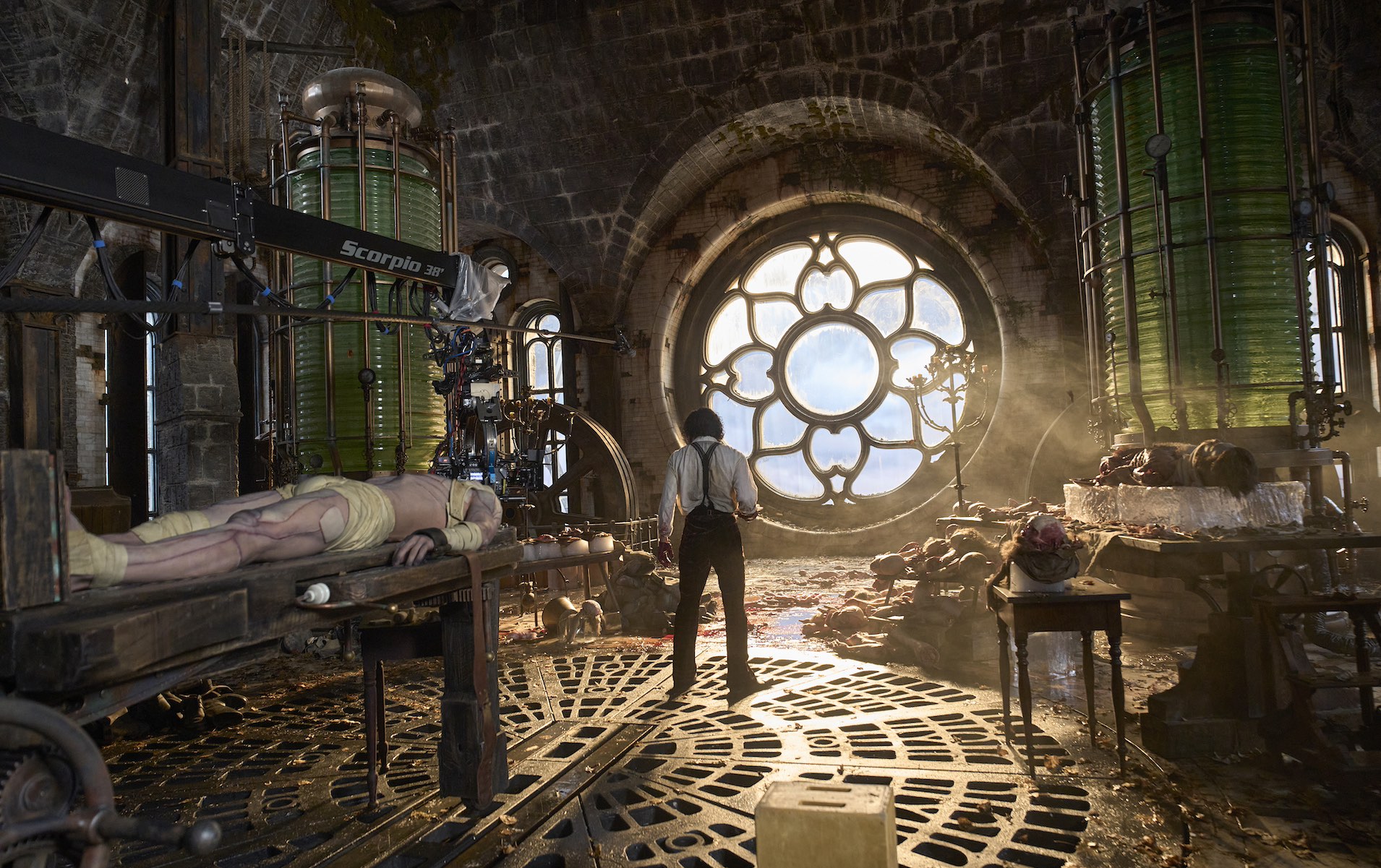
Editor’s Note: This review originally ran as part of our coverage of the 2025 Toronto International Film Festival, and today we’re re-publishing it with the film’s wider release. Check out our extensive review slate from TIFF50, revisit our official curtain-raiser, and check the complete Vanyaland coverage archives from prior editions.
In retrospect, it looks like the worst thing that ever happened to Guillermo del Toro’s filmmaking career was The Shape of Water, though I imagine he’d argue that it was At the Mountains of Madness falling apart in the early ‘10s. His projects have always spent a certain amount of time stewing in development hell. Shape of Water ran into issues over having the Gill-Man from Creature from the Black Lagoon fuck when he tried to pitch it to Universal before turning it into original IP; he sold the script for Crimson Peak nearly a decade before that movie hit screens; and his Pinocchio had an agonizingly slow path across studios before it eventually settled on Netflix. But, barring that aforementioned Lovecraft adaptation collapsing, it’s been his take on Mary Shelley’s Frankenstein that’s had the most prolonged and arduous path. He spent nearly two decades trying to get this to the screen, and when he won his second Oscar, he finally accumulated enough capital to make Netflix shell out the big bucks to realize his vision. This is his second solo-directed adaptation of a story with an already iconic film version (or in this case, versions) out there in the world, and, like how Nightmare Alley can’t hold a candle to one of the most fascinating film noirs to emerge from the classical period, this doesn’t even come close to equaling James Whale’s masterpiece. It barely beats Branagh, even.
I feel like a colossal red flag warning should have been issued around the time del Toro started mentioning how much he admired Frank Darabont’s original screenplay for Mary Shelley’s Frankenstein in interviews. Structurally, the movie owes as much to that unaltered script as it does to the original novel, and you can see its influence from the first frames. Like that film, it uses the ending of Shelley’s story as a framing device, with a group of sailors working to free their ship from the Arctic ice discover they’ve got a monster in their midst. And, for that matter, a Creation (Jacob Elordi) is howling in the distance. Unlike that film, though, this version is set some 60 years later in the 1850s, the sailors who discover the mortally ill Victor Frankenstein (Oscar Isaac) are Scandinavian, and, once they evacuate the dying man to the ship, the Creation goes about doing Hellboy fight moves on his creator’s rescuers. It’s only through quick thinking that they’re able to prevent the Creation from turning over the damn boat entirely, and, after he falls through cracked ice and is temporarily ferried away by the currents, Frankenstein starts to tell his sad story to Captain Anderson (Lars Mikkelson).
After this prologue, the story is then told through flashback, split into two parts to match the two perspectives of the storytellers. The first belongs to Victor, who gives the captain the complete history of his woes. He had a considerably rougher childhood than Branagh’s character: his father (Charles Dance), one of the greatest surgeons in Europe, was a stone-faced authoritarian, and his mother (Lauren Collins) was the light of his life. Alas, the young man’s time with her was far too brief – she died giving birth to Victor’s brother – and it was that child, William (Felix Kammerer), whom his father loved and cherished. The eldest became a kind of project for his dad to tinker with, training his son in the art of surgery and the sciences of biology and anatomy, punishing him viciously for missteps, inspiring Victor to conquer death (and become a better scientist) than his father through pure spite. His father would die long before his son would begin his first experiments with electricity, but his awkward childhood envy of his brother’s favored status would endure until the bitter end of their relationship years later. Yet, by the time Victor reached the pinnacle of his career, he would become more brilliant than his father could have ever anticipated. We see him again, years later, presenting his work to the Royal Academy, shocking all in attendance.
Frankenstein’s demonstration of his work to these learned men is by far the strongest sequence in the film, and it shows that del Toro is still really great at crafting a kind of charismatic horror cinema. There is madness to his method and method to his madness, and you see the result spectacularly: following a yelled monologue about the limits of science and death, he brings a partially dissected corpse back to life through the use of a battery-powered system. The assembled scientists all scoff at this initial flash of life – everybody knows that a light jolt makes a lifeless body move – but Victor plays catch with the mounted corpse, horrifying all of the men and nearly causing a riot in the process before he takes his leave, a shit-eating grin on his face. However, it turns out he did have an admirer in the crowd: Henrich Harlander (Christoph Waltz), an arms dealer with a vast amount of resources and a willingness to spend whatever it would take for Victor to achieve his goal. He has his own reasons, as well, but for that specific moment in time, he’s the perfect partner in conquering death. It doesn’t hurt that Harlander’s niece, Elizabeth (Mia Goth), is William’s fiancée, though it does hurt Victor that, once again, his brother has a kind of love that seems to (and will) elude him.
You know how much of the next bit goes, and I’ll leave it to you to discover whether or not del Toro’s additions and subtractions create a worthwhile sum. But once his work proves successful, after the Creation is given life through a well-placed lightning bolt at the top of Victor’s recently purchased and soon-to-explode gothic castle, things take an interesting turn. The bond between creator and creation explicitly resembles the bond between Victor and his father – he’s not horrified by the monster’s image or anything like that, as he created him, unlike De Niro’s potato-man creature, out of perfect parts. What he’s mad about is that his monster doesn’t seem to possess a soul or any signs of intelligence, as he hoped he could speed-run a childhood, or that God would endow him with something other than instinct. What gets him hopping mad is when Elizabeth and William come to visit, and the Creation forms a bond with the woman. That’s the final insult, though he tries to intellectualize it. As such, he blows up his digs in excessive fashion, losing a leg in the process, and the Creation escapes into the woods. It’s then, in the present, that the Creation arrives to tell his side of the story, of how he learned of the good in man, the indifference of nature, and how much he just fucking hated his dad, all from spying on one little family.
Elordi does a good job with the material he’s given (and for that matter, the rest of the cast as well), though he’s saddled with a compounding series of poor choices on del Toro’s part. One will never really be able to compete with Boris Karloff’s place in the popular imagination, but surely a master stylist like del Toro can do something better than asking one of the Space Jockeys from Prometheus to cut down on the trenbolone. He’s all ghostly-white, covered in scars, fit as a fiddle, and probably should have been Doug Jones in some of that immaculate make-up. Worse, he apparently can grow hair, and by the time we hit the Arctic, he’s got a long flowing mane that looks less raven-like than it does a bad dye job applied to the hairdo that Tyler Mane’s Sabretooth sported in the first X-Men movie. The comparison holds, too — he’s in a burnt trench coat, covered in furs, and moves like a wrestler when he’s killing wolves or sailors by snapping their spines or tossing them into the nearest wall. Imagine if Bill Skarsgard’s Crow had fewer shitty tattoos and much more hair – the neo-goth aesthetic running aground on the modern cinematic ice. The point is, it looks silly, never uncanny or alien as del Toro might have intended.
Though I have my issues with the visuals – this is perhaps the first time I’ve watched a Netflix movie on the screen at the Princess of Wales theatre and could distinctly visualize how it would look on my TV at home, having that stark sheen of streaming sterility – it’s the writing that really frustrated the hell out of me. Del Toro is the sole credited writer here, and it’s his first time without a co-writer or someone helping with the story in two decades. The obvious retort is that Pan’s Labyrinth was the result of his time out on his own, but the intimacy of that story and his closeness to the subject seemed to mean something greater, and he had no other vision or read to compete with. Here, the film suffers from the sprawl – for instance, it takes an hour for the monster to show up in the narrative that Victor tells the captain – and has a jarring rupture when the Creation takes over to grunt his way through his point-of-view section. The story also resolves so abruptly that it comes across as almost comedic, the creator and creation making nice, salving the emotional wounds they’ve inflicted on each other, when, just a few hours before, the good doctor was trying to blow up his monster with dynamite. This is why I’ve never really liked the framing device that Darabont used and that del Toro emulates here – it feels clever, but actually renders the entire narrative into ice-bound story time, which neuters the impactful aspects of their final conversation if one tries to put themselves in the room with the characters as opposed to watching the flashback from afar.
One last bad idea: The Creation, for whatever reason, has superpowers: a healing factor, super-strength, and de facto immortality. I know it wasn’t del Toro’s intention to make it come across this way, but everything about this movie seems to imply that there’ll be some sort of sequel, and that you should stay after the credits for your first tease of Frankenstein: The Fleshy Army. With those elements, it really feels like de Toro wanted this to be a sort of career thesis statement – all of his major works are represented in some capacity, be it narratively or visually – and one might think of this as a kind of career remix, much as his earlier studio pictures were often spins on the things that he’d never be able to adapt using the IP. Here’s the problem with that, though: It renders the film stylistically inert, and del Toro’s extensive knowledge of all things Frankenstein has muddled up the works. He’s picked and chosen from all of the various interpretations of Shelley’s story; the aspects he’s preserved are often incongruous with his aims, and the whole feature feels like it’s out of breath.
The reading of the Frankenstein/Creation relationship is flattening, as if the true horror of the “giving life to the creature through weird alchemy” plotline comes in second place to rushed family drama (I would kill to see this whole crew on Maury, though, talking it out, Victor getting punted through the office floors above). So, why is success so bad? Well, it makes you think you can take on a project like this by yourself. It feels like del Toro just wanted to keep this so close to his chest so that it couldn’t get ripped away again, and I think his process benefits dramatically from the presence of a strong co-writer. After all, Shelley had Byron and her husband to bounce her genius off of. Branagh had De Niro to co-sign his bad ideas. Who does del Toro have?