
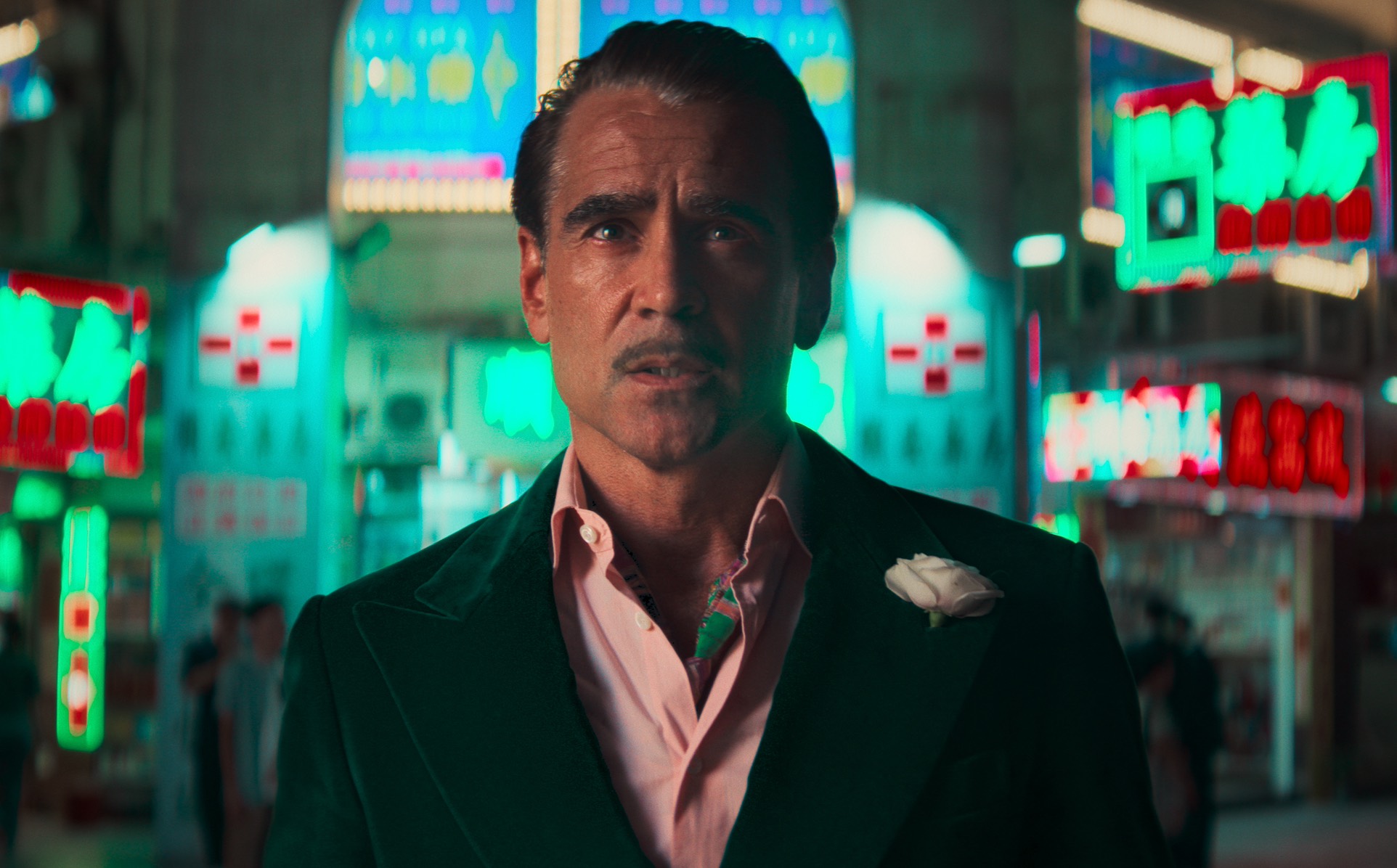
Editor’s Note: This review originally ran as part of our coverage of the 2025 Toronto International Film Festival, and today we’re re-publishing it with the film’s wider release. Check out our extensive review slate from TIFF50, revisit our official curtain-raiser, and check the complete Vanyaland coverage archives from prior editions.
Edward Berger’s Ballad of a Small Player can be best compared to the savory “elevated” cotton candy served as an amuse-bouche at high-end restaurants. This tale of a down-and-out gambler and con artist confronting his demons at Macau’s high-roller baccarat tables does pack a blast of ephemeral flavor, represented in this metaphor by Berger’s exaggerated and frequently stimulating imagery and Colin Farrell’s typical charm and sweaty charisma. The problem is that it quickly evaporates once it hits the tongue — its novelty due to its very presence on the menu and those first moments of curiosity — and the kitchen seems too busy dealing with other orders to bring out a more substantive course. One can’t help but be mad at the fact that they’re leaving hungry.
Adapted by Rowan Joffe (the screenwriter behind Corbijn’s The American and Pawel Pawlikowski’s Last Resort) from the novel by Lawrence Osborne, Small Player opens with “Lord” Doyle (Farrell) asleep in his high-rise hotel room, surrounded by the detritus of his messy, lavish existence. He’s certainly got the sensibility of a Lord, at least in the popular imagination: a foppish, flashy personal style, defined by loudly-colored suits and a pencil mustache; a taste for old scotch, beef wellington medallions, and gloves from Savile Row; and a carelessness with money that screams “generational wealth.” It’s all bullshit, of course. Doyle’s in Macau because it’s a dead end, living on credit from the casinos, dodging the hotel’s creditors, one hand of Macao-rule baccarat – according to Doyle, the fastest way to make life-changing money in the gambling world – away from settling all his scores.
His path to absolution begins when he meets Dao Ming (Fala Chen), a casino loan shark, at the start of the Feast of the Hungry Ghost, right after he loses his bankroll to an old woman with great luck behind her and even greater stacks of chips in front. Dao gives him a nightmarishly bad deal on a line of credit, he loses it all, and Grandma laughs. It’d just be another debt on a long list of them, if not for Doyle noticing a strange shape speeding past him from one of the windows – it was one of Dao’s debtors, pushed to the edge by the impossibility of his situation, and the man’s wife holds her wholly responsible for his suicide. At that moment, Dao and Doyle form a strange bond, the seeds of their liberation planted over the course of a long night in the streets and on the beaches. With his debts due the following Tuesday – thank God for long weekends – and a new private investigator (Tilda Swinton) with a grandmotherly sense of fashion, whom Doyle notices sticking out like a sore British thumb among the rich men, on his trail, something’s gotta give soon. Perhaps the arrival of Doyle’s own hungry ghost might improve his odds.
The biggest problem Berger has is Joffe’s script, which is once again undercooked and spartan in the same way The American was, with a wholly wrong protagonist for the style. Joffe keeps Doyle at a distance – a fair choice, at least early on, given that he’s hiding so much about himself from all around – but there’s never a moment in which we’re able to get close enough to him for his descent into temporarily stress-induced madness to have any punch. The stakes are never quite clear, as the worst that will happen to him is that he’ll hypothetically go back to the UK for a prison bid (mobsters breaking his kneecaps and/or threatening his life would least provide an immediate wince of recognition). Farrell mostly nervously flops-sweats his way through dialogue exchanges, never quite as charming as he should be as a confidence man, always annoying and beggarly in the same way that addicts often are to those who they hope can help them. He’s good at this, but he’s trying to fill in blanks where the writing should be, a variation on some of his most memorable characters, with all the specifics aside from the aesthetic filed off.
All of that comes before the absolutely moronic twist that comes near the end of the story, which I imagine works in a novel in which we’re much closer to the character and fails miserably when we’re at a distance, especially when the writer doesn’t want you getting close to the guy. There are goofy attempts at jump scares, miserable moments of bombastic grandeur, and the director’s attempts to strike at the surreal scenes of Macau’s gaming scene and nightlife. As a smart stylist who manages to get good work from his ensembles, Berger’s films live and die on the quality, depth, and detail of their scripts. If the writer’s pulling from classic literature (All Quiet on the Western Front) or has an accomplished background in adapting complex novels for feature-length projects (Conclave), Berger’s likely to do it and the original work justice in bringing it to the screen.
If he has something like Ballad of a Small Player, well, what you get is a lot of neon lights, stately set dressings, impeccable costume design, an overreliance on dutch angles, an aggressive score, and lots of intrigue. All that happens in the first five minutes, and you’ll wonder where all of that was over the next 90 as Farrell sweats his two-card hands at a far remove from any reason for us to care. You’ll be left hungry for anything else.