
Editor’s Note: Vanyaland film editor Nick Johnston is back in Canada this week covering the 50th Toronto International Film Festival. And as usual, we wish we were up there with him! Check out our continuing 2025 coverage, get rolling with our official curtain-raiser, and revisit the complete Vanyaland coverage archives from past TIFF editions.
Near the end of The Testament of Ann Lee’s opening titles, before we even get a glimpse of the Mother of the Shakers, filmmaker Mona Fastvold presents us with a bibliography of four works she cites as being particularly influential on how she shaped the next two and a half hours. This serves three purposes. First, it’s an earnest and somewhat goofy expression of gratitude (and you better bet the academics and writers will be crying for joy when those royalty checks hit the mailbox after this comes out). Second, it’s an appeal to authority – you will see an informed version of historical events, all shot on celluloid, so don’t doubt that every frame has been well-considered for its accuracy or, if a change has been made, it wasn’t frivolous. Third, it’s the historical filmmaker’s equivalent of shot-calling, with all of the self-assured ambition and brassy confidence that entails. We all remember when the Babe did it at Wrigley, and that’s the hope: You’ll hit it deep center, win the game, and go on to sweep the Cubs. It’s audacious and somewhat admirable to have that kind of faith in what you do, even if it doesn’t work out like you might hope.
Ann Lee is one of those outfield fly-outs, and begins similarly with an attention-grabbing crack that summons the audience up from their phones and popcorn and towards the action. Fastvold introduces us to Puritan New England with stark imagery of Shaker women in the woods, dancing in their plain dresses and bonnets, creeping through the oaks and pines in a sort of Quaker haka to the tune of Daniel Blumberg’s period-influenced score. It’s a striking opening, accompanied by Thomasin McKenzie’s near-whispered narration, presenting us with a glimpse of lush lands promised to Ann Lee (Amanda Seyfried) by her God.
Like many women in the Georgian era born outside of privilege, she suffered through a rough upbringing and an even harsher set of tribulations following her marriage. The one light – a sect of the Society of Friends, also known as the Quakers, who celebrate their faith with ecstatic song and dance – sustains her spirit, allows her to grow in her faith, and stimulates her desires to lead. It’s where she met her husband (Christopher Abbot), it’s where she turned to each time one of her children died (four in total would pass away, either in or shortly after childbirth), and it’s where she began to talk to God.
Encouraged by Jane Wardley (Stacy Martin), the leader of her sect, to start preaching, Ann quickly learns that, despite its advancements in culture and science, England isn’t exactly enlightened. The Anglican Church remains a powerful force in the lives of many, and disrupting random worship services on a Sunday morning to proclaim a specific interpretation of the Gospel isn’t perhaps the best way to recruit new followers. It is, however, a great way to go to jail, where Ann goes on hunger strike, consumed with thoughts of the World to Come and her role in helping sin-stained humanity realize it. Upon her release, she tells her followers of two revelations. First, they need to get the hell out of England. Second, fornication is the root of all evil. This includes procreation – a child is tainted by the very act of their emergence into the world – and, of course, all forms of sexual intercourse.
“Be fruitful and multiply” was a recruiter’s mantra, not an attempt to raise the Christian birth rate. Her followers accept this as a new Gospel remarkably fast, soon dubbing her “Mother,” who lives in purity with “Father” Christ Jesus, though her husband is… well, less than pleased. But he still comes with her as she, her brother (Lewis Pullman), and the rest of their flock cross the Atlantic and try to find their place in the wilds of upstate New York. As Lee’s brother spreads the word of her grace and talk of revolution brews in the colonies, she and the Shakers are about to discover that they may not have found the Land of Milk and Honey that they hoped, at least while still under the Royalist yoke.
Here’s the rub: Despite its beautiful attributes and accuracy, Ann Lee still leaves you at a far remove from its lead character, who remains a placid and perfect figure who only seeks to live in peace. There’s little insight into how her beliefs came to be (beyond the very obvious traumas that got her there), her struggles with faith, or even really her appeal to her congregants. There will be some who say, “Well, we don’t know things like that. Fastvold and co-writer Brady Corbet are simply sticking to what contemporary documents and analysis tell us about her.”
Well, I hate to tell you this, but this is historical fiction. Why limit yourself to what we know from historical research in a movie where characters sing their thoughts and, in a swell sequence, are guided by their pointer fingers to a holy site in the woods? Why portray Lee as the only “woman preacher” as if she were some historical aberration uncommon to New England shores? Keep in mind that the Puritans lost power in the region because Quaker women such as Anne Hutchinson challenged their beliefs, and others, like Mary Dyer, were executed for heresy over it. It’s why we have Rhode Island!
Her novelty as a historical figure, and that of the Shakers themselves, lies in the fact that they were celibate. Had Lee learned to read and write at any point, she could have been Joseph Smith’s antithesis: a spiritual leader and God’s prophet represented first-hand on the page, just with very different views about race and large households (though plenty about sexual segregation). Fastvold treats this as a quirk, less than the radical viewpoint it was at the time. Her followers’ quick acceptance is a joke, which my audience laughed at almost as much as when her husband’s complaints (and eventual abandonment) are presented to her with a New York sex worker in tow. Every other aspect – her sex, the modernity of her other beliefs – isn’t uncommon for a Quaker in her period, and had she landed just a little further down, she might have faded into the crowd, and confronting the truly novel aspect of her sect would take away from the true purpose of Ann Lee – aestheticization – but make it more fulfilling in the process. It wasn’t the preacher they hated on American shores. It was the preaching, which struck directly at the patriarchal notion of “wifely duties,” that courted such controversy and retaliation. I don’t think Fastvold communicates this notion effectively, if it’s present at all.
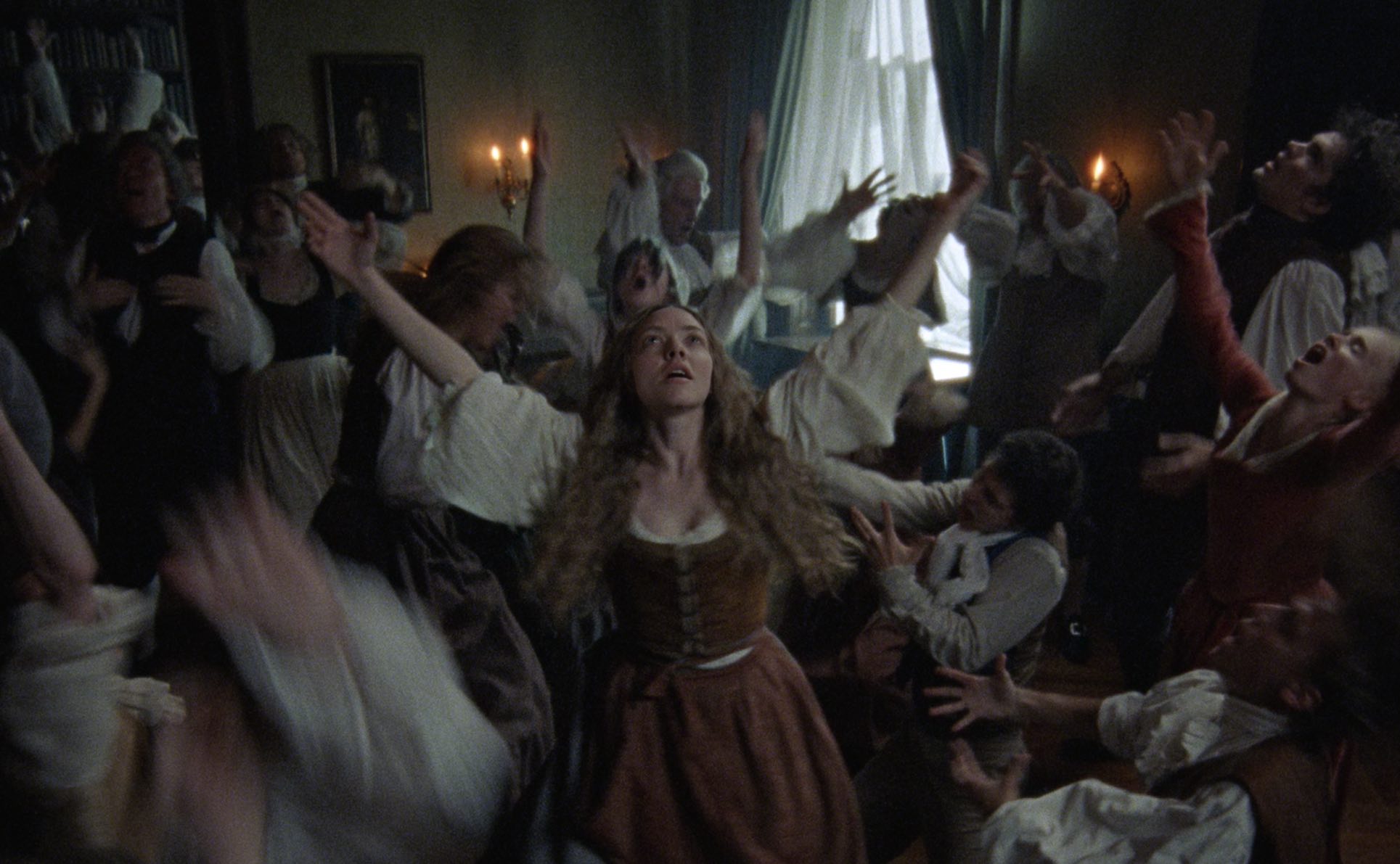
Ann Lee has an alternate title, which I can’t remember at the moment, but you could call it The Evolution of Shaker Dance. This is where Fastvold’s interest lies – the complication of period imagery with modern style – and it would be impossible to suggest that it isn’t visually interesting, if a little sonically overcomplicated (I still will never be able to get over the fact that the guy from Yuck can’t help but keep on making the same sort of “Business! Industry!” soundtrack that he did for The Brutalist nor weep for the Scott Walker score I imagine this might have received had he survived to see it). There are lovely, chaotic scenes of these Quakers shaking, rattling, and rolling through the ecstasies of the spirit, provided you can stomach that it feels choreographed in the earlier, chaotic scenes, before Lee’s iron fist shaped the group into an approximation of a modern-day cult by the time she left it. There’s a point in that evolution – the anarchic bliss of spiritual expression before she hits power, slowly giving way to Busby Berkeley bundt cake formations in the meeting hall after she keels over at 48.
This isn’t to suggest that she was a sort of Degrowth Marshall Applewhite or that she was, in fact, God’s messenger – it’s intended to say that the film supports these readings when it doesn’t necessarily mean to. After all, its lack of perspective is teased by the title – it’s not just Ann Lee, it’s her testament, a collection of her good works and tribulations. By its very nature, it’s not meant to be critical, yet that hasn’t stopped other filmmakers from trying to present their interpretations of faith on screen.
And I think that’s where my genuine disappointment with the film coalesces into a real criticism: Ann Lee is spiritually inert, its passions reserved for aestheticization and accuracy rather than insight. I’m glad someone is taking a story like this seriously, but I wish they focused on all of the serious aspects of the Shaker theology. Yet such is the way of the Corbet-Fastvold feature: Hit ‘em with a strong opening, distract and shock ‘em through a bladder-buster length, and pray it all comes together in the final shot. That’s what I’d call “just-in-time” storytelling.