
Filmmakers often make mediocre books into great films – it’s practically a tale as old as the medium itself and is responsible for alchemizing plenty of common elements into pure 24-carat gold. Take, for instance, Jaws, a Peter Benchley thriller that may have been consigned to the shelves at your local Savers before disappearing from print altogether were it not for Steven Spielberg’s Midas touch, who saw its potential, trimmed the fat and turned it into the crackling thriller it always wanted to be. Think of any adaptations of “Who Goes There?” by John W. Campbell Jr., better known to audiences as The Thing from Another World when directed by Howard Hawks or The Thing when remade by John Carpenter. Or, perhaps, you’re a Verhoeven fan and love a “Quaid! Get to the reactor!” joke but have never read “We Can Remember It for You Wholesale,” the Philip K. Dick short story that Total Recall expanded upon. The old Kurosawa maxim about how good directors and good scripts make good films, bad directors with good scripts and vice-versa make mediocre ones, and bad-bad pairings produce terrible results – that is only for scripts, not source materials. I’m trying to say that great art and entertainment can be adapted from almost anything, no matter the quality of the source material. Justin Baldoni’s adaptation of Colleen Hoover’s It Ends with Us is not one of those films.
I’ll say this upfront: I’ve never read any of Hoover’s works, and aside from the profile that was written about her in a recent issue of Texas Monthly, I know little about her background or her appeal aside from her resonance with women all over the nation and her absurd ability to churn out a bestseller-a-year. I don’t think I’d enjoy her work to the same degree that much of her audience does – our preferences don’t align. I’m not in the business of writing judgy think-pieces about literary success that also double as a way to shame female audiences for the specifics of their entertainment (the backlash to the Twilight mania from a decade ago feels particularly quaint and petty, given that a healthy number of that franchise’s fans relished in its oddity and acknowledged its flaws while suspending their disbelief), especially when that entertainment hasn’t had a massive effect on the artform and industry that I do write about. Neither do the fans care about “good” or “bad” or are forced to find ways to intellectualize the things they enjoy, which is an occasionally enviable position for someone who has to try and find aesthetic justifications for laughing at Daddy’s Home 2 for print. In a way, something like It Ends with Us is weirdly refreshing counterprogramming, much like Book Club was back when Avengers: Endgame was hogging multiplex screens like a fat sow at the trough. What I can’t imagine is that Baldoni’s take on this material, which is so goofy and tonally inconsistent that it eventually wore my audience down enough to where people were laughing at some of the film’s most “shocking” turns, correctly serves the book that it’s adapted from, regardless of whether or not the books are “good.”
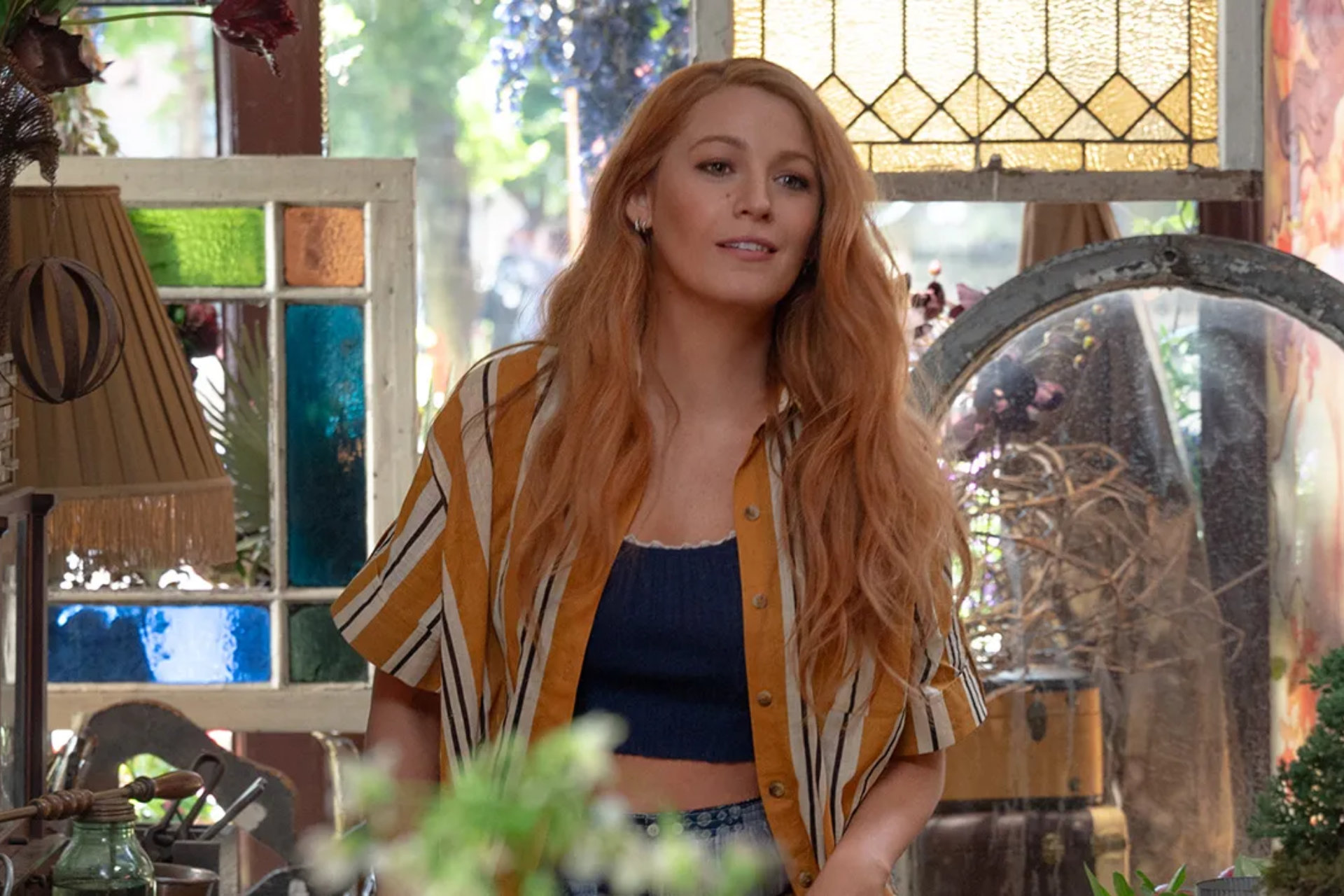
In Baldoni’s hands, It Ends with Us plays like a too-hot-for-TV episode of This is Us, in which the only thing missing from the dynamic is a Crock Pot fire and an additional three treacly speeches. It shares Dan Fogelman’s “sentiment above all else” sensibility, wanting so desperately to move you to tears that it comes across as manipulative without any of the ways Fogelman was able to elide that throughout a given season. Pithy summaries don’t help because the following will sound vaguely ridiculous. Lily Blossom Bloom (Blake Lively), an entrepreneur from Plethora, Maine, is looking to open a flower shop in Boston (and if you’ve ever wondered who lives in downtown Boston, here’s your answer) after her father’s death. She had a long and complex history with the man, who abused her mother and very nearly beat Lily’s first high-school boyfriend – a homeless kid named Atlas – to death when he discovered them in bed together decades ago. She sneaks onto a rooftop to collect her thoughts and have a good cry while looking at the city lights when she meets Ryle (Baldoni, in an inexplicable decision), a charming neurosurgeon who lives in the building with his sister (Jenny Slate) and her husband (Hasan Minhaj). They flirt for a while, sharing dark truths and secrets, but eventually, he’s called away for work. They think they’ll never see each other again. Yet, Ryle’s sister winds up being Lily’s first employee, who she hired without knowing who her brother was, and the pair begin a whirlwind romance. Ryle’s an ill-fitting bad boy – he’s a softboi masquerading as the kind of guy who says that he pays sex workers not to come but to leave – but he has a mean streak, and that kind of cruelty manifests itself in violent ways. Lily never wanted to end up like her mom. Still, she finds herself falling into the same patterns (the title is a mantra, more than anything else, about the cycle of abuse). Things only get worse when Atlas (Brandon Sklenar, AKA “I Can’t Believe It’s Not Glen Powell) reappears in her life, having achieved his culinary dreams after a stint in the Corps. It drives Ryle crazy, and Lily has to decide whether to leave this loser.
What isn’t bad is Lively, an actor consummately failed by modern Hollywood. She has a surprising amount of range buried beneath her affable persona and screen-ready image – she’s the reason that something like A Simple Favor works, relishing the chance to become a proper heel, and the same with the absurdly-underrated The Age of Adeline, where she plays up her ethereal soft-focus glamor to devastating ends. Here, she’s the classic vacant protagonist, who isn’t so much a person as a collection of past details assembled into a shoddy outline. At times, her charming nature can smooth over some of the ridiculousness of Hoover’s creation – laughing at the on-the-nose nature of a flower shop owner having a name whose three parts are all flower puns or managing to outwit both Minhaj and Slate at various points with a straight-man deadpan – but Baldoni’s spin on the narrative is less concerned with her self-awareness and more with her willingness to avoid red flag after red flag that Ryle throws up at Lily. Let me be clear: this is a movie in which there is no good option for Lily to end up with, with her former partner Atlas sharing some ugly traits with Ryle (a quickness to anger, a strange and dogged persistence, and very subtle forms of emotional manipulation). But Ryle is particularly bad, and it’s almost wholly Baldoni’s fault. I can see why he’d try to seize on this role once he stepped in the director’s chair – it is the most emotionally meaty part – but the tonal inconsistencies here never allow us to fall prey to his charms or to find genuine empathy for the devil.
From the very moment he’s introduced, when he storms onto his roof and kicks a chair, we’re mainly just waiting for the guy to snap, provided you knew anything about the film going into it (some people have cited Sony’s faith in this picture being a box office bonanza as the reason they moved the film’s release date out of the Valentine’s Day corridor, but I think it’s more because plenty of unsuspecting couples would have gone to see this over that weekend and realized, with no small amount of horror, what they’d gotten themselves into). Baldoni’s on-screen aloofness keeps him from being charming, as he always seems calculating and shifty, with most of the “falling in love” portions of the film relegated to montages, while the bad times are rendered in painful-yet-PG-13 detail. He’s given the same sort of tragic backstory that we’d give a monster (or a superhero, if he were to do any good with his history) to endow their awful actions with a sense of pathos, revealed in the same third-act climactic infodump that their tale would be if not previously explained in the first half-hour by a group of camp councilors telling stories around a campfire.
But it’s the little things, too – Ryle proposes to Lily in his sister’s hospital room after she’s just given birth to his niece, stealing the attention away from her in a classic narcissistic personality disorder move. However, the movie doesn’t seem to understand this as anything other than a showy declaration of love made in the heat of the moment. Reading through synopses of the novel, it does seem like Hoover tries to dig into his personality and temperament beyond the surface level, complicating Lily’s choices (at least until he crosses a line that makes him fully irredeemable) and making it genuinely hard for her to do what we, the audience, knows is the right thing in her circumstances. This complexity isn’t bad- it makes the work deeper, emotionally- but it’s not present here.
This isn’t an uncommon problem for adaptations, pointing the viewer to their local bookstore to grok the depth. I think of this as the “Editor’s Note” fallacy, which pops up in adapted works that can’t account for the different psychic distances a reader and a viewer have in their closeness to a point-of-view character’s perspective. Rather than trying to accommodate the differences in their mediums through cinematic means, the director and screenwriter just put the actions that are on the page directly on the screen – the “Editor’s Note” distinction coming from the time-honored tradition in the pages of comic books that would point readers to a prior issue for them to gain the proper context needed to appreciate a particular moment in the one they’re currently reading. “To understand what Lily is thinking of here, turn to page __ of It Ends With Us,” it’d read for the uninformed, but like a lot of adaptations – chiefly, I’m thinking of the inscrutable nature of the later Harry Potter movies — they know that audience members like me are the exceptions to the rule and that many have chapter-and-verse familiarity with the source like they’re members of the clergy. The best adaptations see this as an obstacle that can be easily overcome rather than an insurmountable roadblock, and they typically don’t lose anything in translation and, better yet, inspire curiosity (like, say, Peter Jackson’s Lord of the Rings films) as to the additional detail. You can excuse this error if you’re sufficiently awed on screen, but it just renders emotionally sensitive moments inert in something as mundane and intimate as this.
When paired with Baldoni’s thudding and clumsy direction, that inability to properly connect with the characters turns a tearjerker into something genuinely strange that walks the line between tedious strangeness and laughable. The film’s biggest moment, in which Lily finally decides that she’s had enough, comes out of nowhere at what might be the worst possible time, in which one can make a theoretical understanding of how it is supposed to function only after they’ve stopped giggling at its abrupt boldness. It’s positively stuffed with moments like that, albeit ones with much less narrative impact, and Baldoni can’t seem to stem the tide long enough for anything to connect with the audience. This is bad news for a movie tackling a legitimately sensitive subject matter that, unlike the adventures of wizards and elves, a member of the audience might have lived through and would react painfully to, much like how one might find themselves crestfallen at Mommie Dearest had they suffered through relevant childhood trauma.
And even though I, once again, have never read one of Hoover’s books, I left It Ends with Us feeling bad for the people with whom the book resonated, who were hoping to see an adaptation that preserved what made the story meaningful to them and to perhaps see it in a way that translated to their unaware friends why it mattered. Maybe it might have given them better ways to state uncomfortable things or to help their friends understand certain truths, but the way Baldoni presented it here, it just becomes easy to write off as camp – the worst possible ending for something like this, I guess. What a shame.