
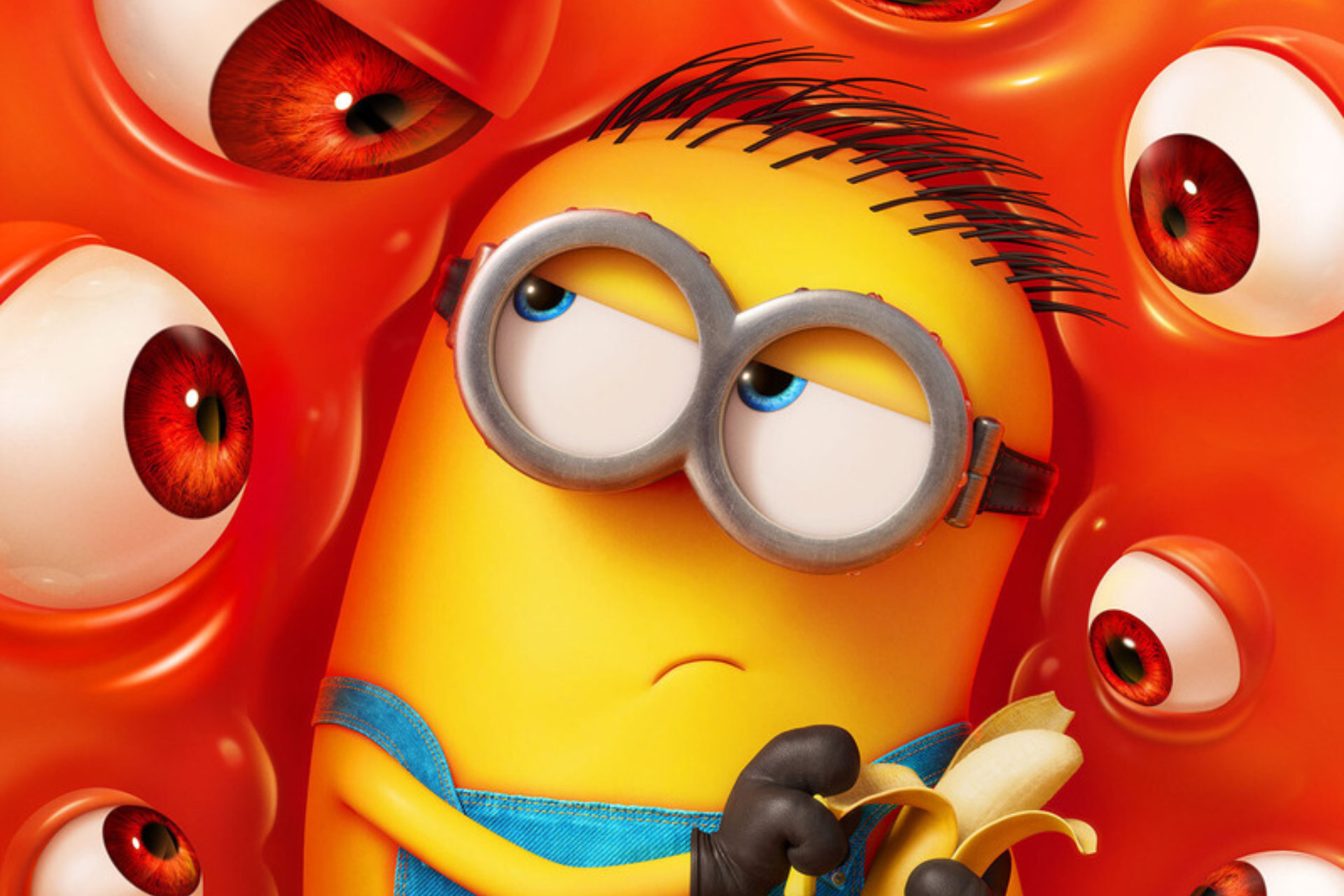
As I’ve said countless times in various reviews, I can not and will not hate the Minions. Sure, the wacky Tic-Tacs from Despicable Me can be annoying when they show up in a Facebook post shared by a fossilized relative bemoaning youth culture or hyping how sassy they are, and it’s possible that hearing Minion-speak for longer than 90 minutes violates the Geneva Conventions. Yet their franchise features some of the only big-screen children’s entertainment that isn’t aimed at parents — they’re unabashedly goofy and dumb, a celebration of cartoony slapstick and laughter, designed for amusement rather than moral edification. As adolescence starts to stretch into one’s 50s, it’s nice to have a cartoon series that wants to repel adults, whether or not the adults in question think of themselves as such.* Yet, compared to the two previous entries in the series, Pierre Coffin’s Minions and Monsters is an attempt to put the little guys in a larger context, as it pays homage to the figures children really care about: the icons of the Silent Era.
I’m only half-kidding when I say that kids don’t care about Buster Keaton or Charlie Chaplin or Harold Lloyd, all of whom make Looney Tunes-style cameos as caricatures. That’s because I was a kid who actually did, to some extent (when I was in first grade, I had a much-treasured DK guide to filmmaking that went all into the feats those masters accomplished). But it is an interesting and unexpected choice to have a roving gang of Minions take over the Silent and Golden ages of Hollywood – they could have just done a “Gru and the gang hit the ‘80s” riff and called it an easy half-billion – in both in how careful and loving a tribute it is to the films of and inspired by that age, and that it suggests that Illumination Entertainment is unhappy that they haven’t received their flowers. This is both because they’ve made some dogs in their day (and I don’t mean The Secret Life of Pets movies), and because they’re up against a smarm juggernaut in Disney/Pixar and, formerly, DreamWorks. These movies don’t win Oscars, and so it’s only fitting that they have to invent a banana one for a Minion to get in the one sphere where the Minions are beloved by the critics – in the world Illumination controls.
That Minion’s name is James, a little dreamer who doesn’t really see the whole point in finding the “Big Boss” that all of his brothers want to find so badly. He just wants to create, and he’s got a real knack for screwing everything up for the whole crew with his attempts to charm the bosses, as they usually end up dead afterward. Yet, through all of these trials and travails, he and his best friend Henry wind up steering the Minions to L.A., where they promptly ruin a big stunt-heavy film shoot by trying to chase down a cowboy (and subsequently crash a plane and a train in the process). The director, an émigré named Max (Christoph Waltz), is pissed at these weird little guys until he sees the dailies – these guys are built for silent-film slapstick. The two studio heads, a pair of corpulent brothers (both voiced by Jeff Bridges), agree. Pop the champagne corks and roll camera – these Minions are throwing Babylon parties (and, no joke, the movie is referenced at several different points).
Alas, as it always goes in these films, the Minions don’t take too well to sync-sound, and before you know it, they’re tossed out on their asses by the studio heads – hard to be convincing leading men when you’re speaking in a mix of English, French and Spanish pitched up six octaves. The rest of the gang goes off on a quest for the next Big Boss, but James and Henry come up with a scheme: if they can make the biggest monster movie of all time, Hollywood will have to take them back. They’ve got just the thing to realize that dream, no VFX budget required – it’s a spellbook full of summoning rituals for the scariest monsters imaginable. Imagine their surprise when a diminutive little fellow named Goombi (Trey Parker) emerges when they try to summon a Cthulhu-type from its pages. But it turns out he knows a few other monsters, and they know a real monster. All they need is a little sucker willing to do whatever it takes to get his little dream back. Meanwhile, the other 40-odd little guys find their next master – a weird guy-in-a-robot suit named Dort (Jesse Eisenberg) who may (or may not) be an actual robot. Your guess is as good as theirs.
You won’t be surprised to learn that there are some good gags and some that don’t land, that the movie feels about twenty minutes too long (even when it’s only 90 or so minutes), and that if you absolutely can’t stand the Minions, you probably won’t enjoy yourself very much. What you might be surprised by is the depth and richness with which Coffin and the Illumination crew capture early ‘20s Los Angeles, as well as the “Movie Museum” that our story’s framing device takes place in. There are the on-the-nose acknowledgments of truly popular cinema (and George Lucas has a cameo that feels straight out of Animaniacs or Tiny Toon Adventures). Still, there are even more amusing allusions to cinema of all sorts put in there, as well as layered sight gags that wouldn’t be out of place in a Chuck Jones short. Just look at the signs in the backgrounds or the way in which that train sequence organically strings together a highlight reel of silent classics – the Minions even follow The Tramp into the machine from Modern Times! Dort’s little romance feels straight out of City Lights! – and how they reward the informed viewer but don’t mess with the momentum. It won’t harm the incurious viewer, but it will surely pique the curiosity of other little nerds like myself out there.
That said, what elevates Minions and Monsters above many of its peers is its celebration of the art of filmmaking as a collaborative effort and the joy of creative endeavors. If Toy Story 5 tells its audiences that complete technological integration is an unfortunate but necessary part of growing up in this modern world, that even a wannabe Big Brother has its heart in the right place, Coffin and company wish to remind you how much fun it is to tell stories and make movies – that one can still make great art, even with lesser tools, as well as great entertainment. Nowhere is this clearer than in the finale, when Goombi and company reveal their big friend – a blob, looking to consume everything in sight, to render the whole world a puddle of orange Jell-O, starting with Hollywood itself. That’s right – Coffin could have called it Minions vs. Slop and pissed off OpenAI and Anthropic, but he went with the much more subtle approach, given plausible deniability and all. They can’t help how the Minions are used on social media, but they can – and will – kick this slop’s ass in big fantastic fashion, complete with a psychotic clown Minion at the forefront, trying his damnest to kill ‘em all, even if his guns don’t really work.
* Even then, they have only themselves to blame for giving up the easy pleasure of a well-executed gag. Lest we forget, Looney Tunes shorts played before all kinds of features, before the rise of television created a kind of codified age divide for animation.