
Editor’s Note: The Independent Film Festival Boston, or IFFBoston for those with things to do, has just wrapped up its 2026 program, with a flurry of films shown at the Brattle, Somerville and Coolidge Corner theatres. Vanyaland film editor Nick Johnston caught the best of the best as they hit the screen, and we’ll be relaying his reviews all week long. Check out all our coverage, including past editions, and revisit his two-part 2026 preview here and here.
Like most folk who strike it rich, John Carney’s spent the last 20 years trying to recapture the magic that endeared his work to audiences back in ’07. While other people might have just let the money sit in a mutual fund and cashed in the chips for other, different projects, Carney’s doubled down on music with each of his subsequent features. It’s not like he hasn’t come close to equaling Once – Sing Street is a lovely little film, after all — but a hook like “a pair of real-life folk bandmates and lovers play fictionalized versions of themselves” is hard to equal, especially when it coincides with Peak Indie, both at the multiplex and at the record store. Indeed, he’s been pretty smart about anticipating musical trends (Sing Street, again, being the big point in his favor), and his movies are always incredibly pleasant. They’re light, funny, occasionally moving, and leave audiences feeling satisfied – if the music works. This is the problem with Power Ballad, a Carney movie much like all the other Carney films, only that it has a real stinker of a faux-pop song at its core that makes it hard to take seriously and makes it hard for Carney to strike an appropriate tonal balance.
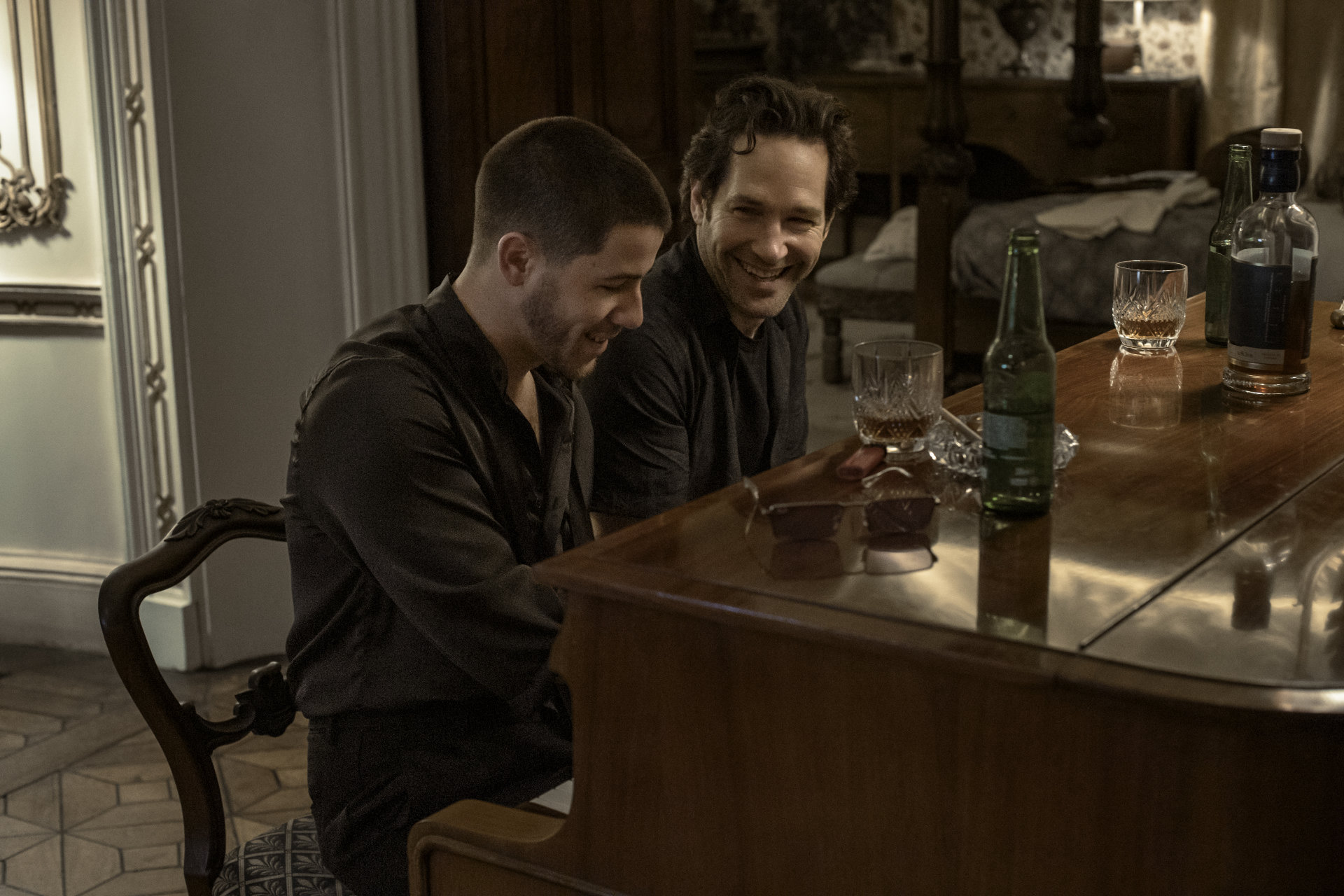
Power Ballad is functionally a comedy about settling, failed dreams, and intellectual property theft. Rick Power (Paul Rudd) used to be a contender, ready for interviews with VJs and to pose for magazine covers with his band back in the day, now he’s an ex-pat wedding singer crooning “Celebration” and “S.O.S” for Irish lads and lasses at their receptions after they jump the broom. He nurses some regrets over abandoning his dreams of superstardom, but they normally fade away once he hits the stage – or when he gets home to his loving wife and daughter, who were the whole reason he gave up the hustle. All in all, he’s happy, which is why it’s such a disaster when he spends an evening drinking, jamming, and getting high with Danny Wilson (Nick Jonas) following a “Bride and Groove” performance. Danny’s the kind of person you hope shows up to take the mic at your wedding reception – a friend of the groom’s who happens to be a former member of a One Direction-like boy band and is gifted with some serious pipes. They duet on a Stevie track – soon to be a viral hit captured by the attendees – and then meet up later on to share a joint, each complimenting the other on their talents.
That, of course, leads to some private jam time where Danny, in desperate need of a new sound, starts to pick Rick’s brain about what he could do differently. Rick’s more than happy to help: he’s been out of the game for decades, and he’s mainly just too excited and energized by a young person speaking to him on his level to think that anything bad might come out of it. Lubed up by booze and weed, he shares some long-gestating tunes with Danny over the course of the evening, and it’s a cross-generational bro-out. These scenes are the most delightful in the entire film – a reminder of what Carney is just so good at, seizing upon his leads’ talents and charisma while giving them the space to have what feels like a very natural hang. This is a vibe that Rudd’s always shone in (I Love You, Man being a perfect example), and one broad and genial enough to get Jonas comfortable, freeing him of some of the stiffness that has come across in some of his other roles. We feel, much like the characters, saddened that the night’s over as quickly as it is – but not before Rick plays Danny a deeply personal song, entitled “How to Write a Song (Without You)” and Danny gives Rick his management company’s card, telling him to call him whenever he needs him. Oh, and he gives Rick a very expensive Gibson.
Problem is that Rick didn’t give him that track, and months later, when buying his daughter some cleats at the local mall, he hears a very familiar tune coming over the loudspeakers. Sure enough, Danny’s recorded his own version of “How to Write a Song” as a vehicle for his comeback, the lead single for a big EP that’s meant to establish him as His Own Man. Rick’s not even that mad, at first: he’s honestly just sort of gratified that he was worth stealing from, and he thinks it’ll be easy to get credit. Of course, no one believes him. Not his bandmates, not Danny’s manager (Jack Reynor), not his wife and daughter, and it doesn’t help his case in the slightest that he can’t find any proof that he wrote the song before meeting the pop star at the wedding. He becomes a kind of local laughing stock, as he refuses to stop making his claim on the track, and ultimately nearly blows up his life in the process. So, with the assistance of his best bud, Sandy (Peter McDonald, also a co-writer), he decides to make Danny own up to the theft through some drastic action. Hijinks ensue.
Rudd’s solid as always, a dependable leading man with aw-shucks charm, and he’s paired well with Jonas, who is still in the “stunt casting” stage of his career. Carney trades on his co-lead’s experiences within the industry – lots and lots of archival footage is repurposed for glimpses of what Danny’s life was like before the wedding – and unwittingly ensures that the movie’s never as biting as it could be, nor as redemptive as Carney might have hoped. This is best illustrated by the contrasting versions of “How to Write a Song,” first sung by Rick on guitar and then transformed into a generic pop anthem by Danny and his production team. Carney knows his film would be too bitter if Rick came out and (rightfully) claimed that the boy-bander mauled his song, so he has every character in the film excessively praise it, Rick included. Yet it sounds like the version one would have recorded for the more jaundiced version, where Danny could be an out-and-out snake and Rick a more compelling, idealistic, naïve hero. Or, theoretically, it could be the version for the fully feel-good counterpart that sees the two mend their fences and go on to improve their situations: Danny, more in touch with the person beneath the public persona, making real art; Rick rewarded for his perseverance beyond a settlement.
Taking either of these paths would undermine the moral makeup of Power Ballad, though. The class-stratification sorted Rick and Danny into two different impermeable groups, and for either to be advanced or relegated would fundamentally upend Carney’s thesis about how one should appreciate their lot in life (provided, ultimately, that they eventually get what’s theirs – even if it isn’t credit). Try as he and Carney might, I just can’t feel much sympathy for Jonas’s character, no matter how many guilty looks he gives to those around him or pained monologues he lets out about how hard it is to maintain appearances after being in not-One Direction.*
Sometimes the easier routes are the better ones, and it’s bizarre that Carney decided on an unsatisfying merger of the two as his resolution. It could be that he’s got to sell some singles – this feels more like a soundtrack ad than most of his other works – but I think it’s because he’s cognizant of the moment enough to know that making a movie suggesting that dad-rock is more authentic is a form of social self-immolation with the audiences he’s trying to court. In that light, Jonas’s characterization serves as a blast shield from “ok boomer” buckshot, keeping enough of that message in there while ensuring his cast doesn’t catch strays. Personally, I don’t think anybody would have really minded either way: What works about Power Ballad, namely the energy between Rudd and Jonas when they’re on screen together, would succeed in any of those possible variations. It’s just a bummer we wound up with this one.
* God forbid you just go out and hire a co-writer, dude. Plenty of great artists have done it.